
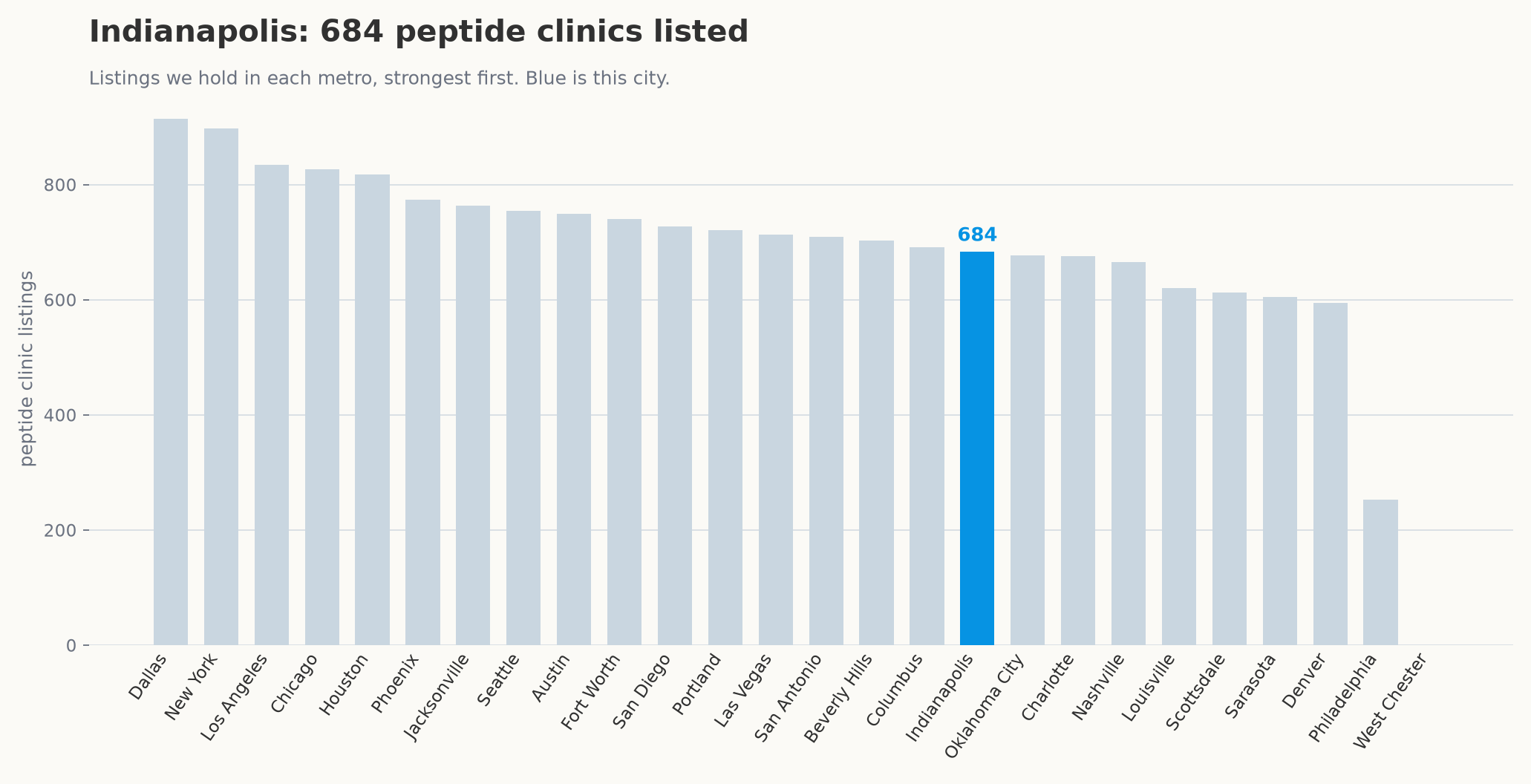
Indianapolis, Indiana holds a crowded field of peptide sellers: med spas, telehealth operators, and walk-in clinics. Some employ licensed prescribers and work with a compounding pharmacy. Others resell vials and keep a clinician out of the process. The marketing looks similar on each site.
One step matters before money changes hands: verification. Look up the prescriber in Indiana's medical or nursing board public lookup and confirm the license stands active. Ask which pharmacy compounds the peptide, what the evaluation includes, and the total monthly cost.
Federal law requires a prescription before any pharmacy dispenses a compounded peptide. The FDA places several peptides on its Category 2 list, which restricts compounding. A clinic that answers license, pharmacy, and pricing questions in plain terms gives you something to check. A clinic that deflects them gives you a reason to pause.
Who can prescribe peptides in Indiana
A pharmacy may compound a peptide only after a licensed prescriber writes a prescription for a named patient. That order comes first. The pharmacist dispenses after the prescription arrives. Federal law sets that sequence, and it applies in Indianapolis the same as anywhere else in Indiana.
Patients meet three license types.
Physician. A medical doctor (MD) or a doctor of osteopathic medicine (DO) holds a state license to practice medicine. This prescriber carries responsibility for the evaluation and the order.
Physician assistant (PA). A PA practices under a supervising physician and a written protocol. The protocol names the conditions the PA may treat and the drugs the PA may order.
Advanced practice registered nurse (APRN). An APRN, such as a nurse practitioner, also works under a supervising physician and a written protocol. State rules govern that collaboration.
The license type matters for one reason. Ask the clinic which license type you will see at the visit. Ask whether the supervising physician reviews the plan. Some clinics staff a physician. Others staff a PA or an APRN.
Verify any prescriber through public records. The Indiana Board of Medicine license lookup lists physicians and physician assistants. The Indiana Board of Nursing license lookup lists APRNs. Search the name and confirm the license status reads active. Check the record for discipline or restrictions. A lapsed license or an open disciplinary action changes the picture.
Then ask the clinic which pharmacy compounds the peptide. A 503A pharmacy compounds for a specific patient against a prescription. A 503B outsourcing facility compounds larger batches. Both operate under FDA oversight, and the FDA has placed several peptides on its Category 2 list, which restricts compounding. Ask the clinic how it handles a peptide on that list.
The compounding pharmacy question
Most peptides that clinics in Indianapolis offer do not carry FDA approval as drugs. A compounding pharmacy makes them under federal law, and that law splits compounders into two groups.
A 503A pharmacy compounds for a patient with a prescription in hand. Federal law requires the prescription before the pharmacy prepares the drug. The pharmacist works from a specific order for a specific person. State boards of pharmacy license these operations and inspect them.
A 503B facility registers with the FDA as an outsourcing facility. It can make larger batches and ship across state lines. The FDA inspects 503B facilities under federal authority, and these facilities report adverse events to the agency. The trade-off: tighter federal oversight and a narrower list of substances a facility may compound.
The FDA keeps a Category 2 list. That list names substances the agency considers unsuitable for compounding, in many cases because of safety concerns or because a commercial version exists. A pharmacy that compounds a Category 2 substance faces federal risk, and so does the patient. Ask whether the peptide in your protocol appears on that list.
Ask the clinic one direct question: which pharmacy fills the prescription? Get the name and the state. Then look it up. A 503A license appears in the state board of pharmacy lookup. A 503B registration appears in the FDA's database of outsourcing facilities. Check the license status and any disciplinary record. A clinic that names its pharmacy and shows you how to verify the license answers the question well.
Questions that separate clinics
Can you provide the prescriber's full name and license number? Ask for the license type, such as MD, DO, or NP. Verify the license through the Indiana Board of Medicine or Board of Nursing public lookup. A prescription must precede any dispensing of a compounded peptide, per federal law.
Does the clinic name the pharmacy that compounds the peptide, and does that pharmacy operate as a 503A or 503B facility? Ask for the pharmacy's license and location. A 503A pharmacy compounds for a specific patient with a prescription, while a 503B facility registers with the FDA as an outsourcing facility. Both models exist; the distinction shapes oversight and supply.
Will the initial evaluation include a clinical visit, labs, and a review of current medications? Ask what the clinician measures and documents. A prescription-only service needs a real evaluation, and a form does not meet that standard. Ask whether the prescriber speaks with the patient and reviews prior records.
If a reaction occurs, what is the after-hours plan and who answers? Ask for a phone number, a clinician contact, and a written adverse-event policy that names who covers weekends and holidays. Ask whether the clinic reports reactions to the FDA MedWatch program. A clear plan includes stopping the peptide and seeking urgent care when needed.
Can you quote the total monthly cost, including consultation, medication, and follow-up? Request an itemized figure in writing before payment. Ask about refill fees, lab fees, and cancellation terms. Prices vary, so a written total protects the patient.
What Indianapolis clinics get right and wrong
Two shapes shape the Indianapolis market.
The first is the franchise men's-health model. One brand, several cities, and a corporate parent that sets the script: intake form, lab panel, membership tier. The second is the physician-owned practice, with one location in many cases, an intake that runs longer, and a prescriber who sees the same patients across years.
Accountability differs between the two. A franchise location answers to a corporate office, which writes the protocol the prescriber follows. A complaint travels to a regional manager. A physician-owned practice answers to a state board, and the prescriber's license sits on the line with each prescription.
Indianapolis patients can test either shape with three questions.
Ask which pharmacy compounds the peptide. A 503A pharmacy fills for a named patient against a prescription. A 503B outsourcing facility registers with the FDA and may ship without patient-specific prescriptions in limited cases. Federal rules bar both from dispensing without a prescription.
Ask which lab panel the intake includes and who reads it.
Ask the prescriber's name, then check that name in the Indiana Board of Medicine or Board of Nursing public lookup.
Franchises get right: speed and a clear intake path. They get wrong: a patient who needs a slower workup gets a template. Physician-owned practices get right: continuity and a prescriber who carries liability. They get wrong: intake waits and a smaller menu.
Red flags
A clinic that collects payment before a licensed prescriber evaluates you raises a concern. Federal law requires a prescription before dispensing. Payment before evaluation suggests the clinic sells a product. Ask what the evaluation includes. Ask who performs it.
A guarantee of outcomes conflicts with federal status. The FDA withholds approval for compounded peptides as drugs. The FDA Category 2 list names many peptides for safety review. A clinic that promises a result ignores that framework. Leave.
Check the practice address. A physical office in Indianapolis lets you verify a location. A P.O. box or a virtual suite fails that check. Use the Indiana professional licensing lookup to confirm the prescriber's license type. Ask for the license number.
Urgency pressure appears as a demand to pay before the evaluation. Limited slots or a closing window force a decision. Legitimate care allows time to review the evaluation and the pharmacy. A prescription requires a patient evaluation, which takes time.
Ask which pharmacy compounds the peptide. A 503A or 503B pharmacy holds a license and follows federal rules. A clinic that refuses to name the pharmacy hides the source. You lack a way to check the pharmacy's record or its license.
What a legitimate Indianapolis clinic looks like
A clinic that follows federal rules hands a patient four items at the first appointment, before any payment for a compounded peptide.
The prescriber's name and license number. A patient can take that number to the Indiana Board of Medicine or Board of Nursing public lookup and confirm the license is active. Ask for the license type too: MD, DO, NP.
A compounding pharmacy they can look up. The FDA places most compounded peptides on the Category 2 list, and 503A and 503B pharmacies operate under different federal rules. Ask which pharmacy fills the order, then call that pharmacy and confirm it compounds the peptide.
A written plan with costs. Ask for the total monthly figure, the evaluation fee, the follow-up fee, and the refill price. Write it down. A verbal estimate gives a patient no record to check.
A way to reach someone if something goes wrong. Ask for a phone number that a person answers during business hours, and ask who handles an adverse event.
Federal law requires a prescription before dispensing. A clinic that ships product ahead of a licensed prescriber's evaluation skips that step.