
A search for peptides in Seattle, Washington returns a crowded page. Tobacco shops and supplement sellers sit beside telehealth clinics. Few of these pages tell you who writes the prescription or which pharmacy fills it.
One step matters before you send money: verification. Ask the clinic for the prescriber's name, then check that license in the state Board of Medicine or Board of Nursing public lookup. Ask which pharmacy compounds the peptide, and confirm the pharmacy holds a 503A or 503B registration with the FDA. A prescription must come first. Federal rules require it before a pharmacy dispenses a compounded drug.
A quoted price tells you nothing until you know who compounds the drug. Cost belongs at the end of that list. Ask what the evaluation includes and what the total covers. A clinic that answers in writing earns the payment. A clinic that dodges the questions does not.
Who can prescribe peptides in Washington
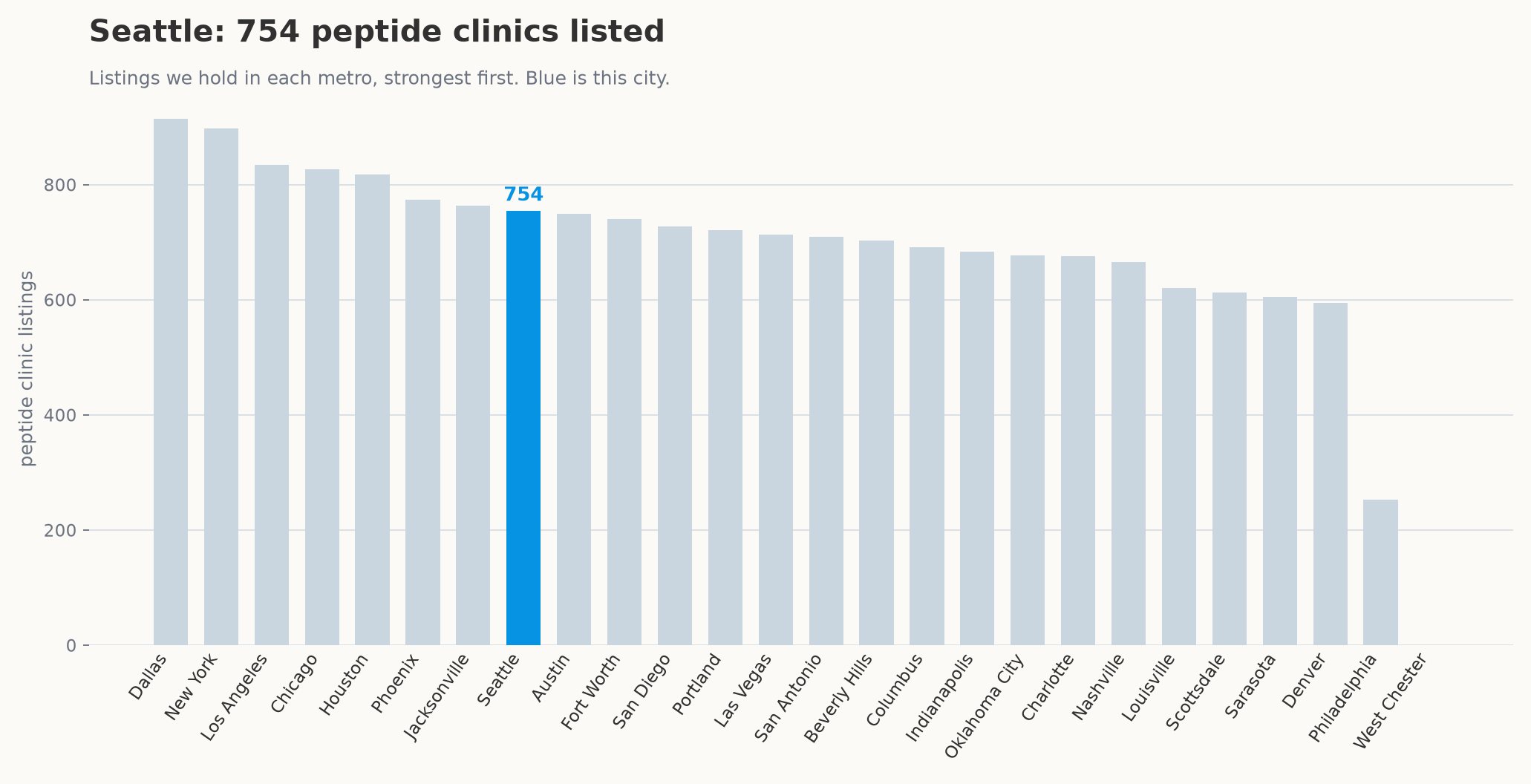
A peptide prescription starts with a licensed prescriber, no matter the city. Federal law requires a valid prescription before a pharmacy dispenses a compounded peptide. The FDA Category 2 list restricts bulk compounding of several peptides, and a 503A or 503B pharmacy checks for the prescription before it fills an order. Seattle patients meet three prescriber license types.
Physician (MD or DO). A medical doctor or a doctor of osteopathic medicine holds a broad scope. This prescriber can evaluate a patient, order labs, and write the prescription.
Physician assistant (PA). A PA works under a supervising physician and a written protocol. The protocol names the conditions and the drugs the PA can address.
Advanced practice registered nurse (APRN). An APRN works under a supervising physician and a written protocol. The state sets the terms of that practice.
Ask the clinic which license type you will see at your visit. A telehealth intake form may list the prescriber's credentials, and the name matters more than the marketing page. Confirm that license in public records. The Washington State Board of Medicine lookup covers MD, DO, and PA licenses. The Board of Nursing lookup covers APRN licenses. Both searches show license status, expiration date, and disciplinary history.
Ask the clinic where the peptide gets compounded and whether that pharmacy registers as 503A or 503B. Ask what the evaluation includes and which clinician reads the lab results. Ask for the total monthly cost, peptide and shipping included.
Supervision terms differ across states, so read the Washington lookup rather than a national directory. A clinic that answers these questions gives a patient something to verify.
The compounding pharmacy question
Most peptides sold as wellness products do not carry FDA approval. A pharmacy can still make one when a licensed prescriber writes a prescription for a named patient. Federal law sets the terms.
Two pathways exist.
A 503A pharmacy compounds for an individual patient. The prescriber sends a prescription, the pharmacist prepares the dose, and the patient receives a product made for that person. State boards of pharmacy license these operations and inspect them. Federal law bars a 503A pharmacist from making a copy of a drug that is already on the market.
A 503B facility registers with the FDA as an outsourcing facility. It makes larger batches, sometimes without patient-specific prescriptions, and ships to clinics and pharmacies. 503B status requires compliance with current good manufacturing practice and reporting to the FDA.
Both pathways have limits. The FDA maintains a Category 2 list of substances it considers unsuitable for compounding. A substance on that list cannot go into a compounded product, regardless of the pharmacy's license type. Check the list before you assume a peptide is available.
Federal law also requires a prescription before a pharmacy dispenses. A clinic that ships a peptide after a questionnaire and a payment skips that step.
Ask the clinic one question: which pharmacy fills the prescription? Then verify.
Look up the pharmacy name in your state Board of Pharmacy license lookup. Confirm the license is active and matches the address. For an out-of-state 503B facility, check the FDA's registered outsourcing facility list. A storefront that sells tobacco or vape products and lists peptides for sale gives you a name to check, and little more.
If the clinic will not name the pharmacy, treat that as your answer.
Questions that separate clinics
Prescriber's name and license number: does the clinic give you both? A prescription must come from a licensed clinician, and the clinic should name that person and the credential behind the signature. Ask for the license number, then check it in the state Board of Medicine or Board of Nursing public lookup. States license physicians, nurse practitioners, and physician assistants, and each credential has its own registry.
Compounding pharmacy: which one fills the order, and does it hold a 503A or 503B registration? A 503A pharmacy compounds for a named patient under a state license. A 503B facility registers with the FDA as an outsourcing operation. Ask which entity prepares your medication and confirm that name against FDA and state records.
The initial evaluation: what does the visit cover? Ask whether the clinician reviews your health history, current medications, blood pressure, and labs. Ask how the prescriber selects a starting dose. A short intake form with no clinical review carries less weight than an appointment with a licensed provider.
Adverse reaction: who takes the call? Get the phone number for urgent questions and the hours it operates. Ask whether the prescriber or the compounding pharmacy handles a report of a side effect. Request the clinic's written protocol before you pay.
Total monthly cost: what does the figure cover? Ask for one number that includes the consultation, the medication, shipping, and follow-up. Ask whether the price changes when the dose changes. Fees that surface after the sale signal a quote you cannot trust.
What Seattle clinics get right and wrong
Seattle's peptide market splits into two shapes. A franchise men's-health style clinic runs storefronts across several cities and markets to a broad metro audience. A physician-owned practice works from one office and books longer intake. The prescriber stays close to the chart.
The right part for both: a prescription precedes dispensing. Federal law requires that order. Neither shape may ship a compounded peptide without one.
The wrong part shows in accountability. A franchise answers to a corporate parent, and its clinicians follow a template built for volume. A physician-owned practice puts the prescriber's license on the line. That license sits in the Washington State Board of Medicine or Board of Nursing public lookup, where a patient can search the name and see standing.
Two federal points matter here. The FDA holds no approval for most compounded peptides, and the Category 2 list names ingredients the agency flagged for safety. A 503A pharmacy compounds for a named patient. A 503B outsourcer works at scale. Ask which pharmacy compounds the dose and whether that pharmacy holds a 503A or 503B registration.
Intake length says little on its own. A long form can lead to a rushed review. A short form can sit behind a careful prescriber.
Ask three questions before paying. Ask which pharmacy compounds the dose. Ask what the evaluation includes. Ask the full cost per month. The answers separate a clinic that checks its own work from one that does not.
Red flags
Payment before evaluation. Some clinics take your card before a licensed clinician reads your history. Federal law requires a prescription before a pharmacy dispenses a compounded drug. A payment screen that arrives first inverts that sequence, and it leaves you with no assessment to judge.
Guaranteed outcomes. No clinician can promise a result. The FDA has not approved compounded semaglutide or tirzepatide, and the agency keeps a Category 2 list of ingredients it considers unsafe or under review. A clinic that offers a guaranteed number of pounds or a guaranteed recovery sells certainty it cannot hold.
No verifiable practice address. Ask for a street address and a license type. Check the prescriber in the state Board of Medicine or Board of Nursing public lookup. A site that shows a mailbox and a phone number gives you nothing to check against a public record.
Urgency pressure. Countdown timers, "three spots left," and same-hour discount codes push a decision before you finish the intake form. Care does not expire at midnight. Slow down and read the consent document.
Refusal to name the pharmacy. Ask which pharmacy compounds the drug and whether it registers under 503A or 503B. A clinic that will not answer leaves you unable to trace the source. Ask the pharmacy whether it compounds that peptide.
What a legitimate Seattle clinic looks like
A Seattle clinic that follows federal and state rules will show its work. Leave the first appointment with four items in hand.
The prescriber's name and license number. Write both down, then check the number in the state Board of Medicine or Board of Nursing public lookup. A license in good standing takes a minute to confirm.
A compounding pharmacy you can look up. Ask which pharmacy fills the prescription and whether it registers under 503A or 503B. Federal law requires a prescription before a pharmacy dispenses a compounded peptide. The FDA Category 2 list names ingredients the agency considers unfit for compounding, and the FDA has approved few peptides for human use.
A written plan with costs. Ask for the total monthly cost, the evaluation fee, shipping, and lab charges. Paper beats a verbal estimate.
A way to reach someone when something goes wrong. Get a phone number or portal that reaches a person, plus who answers after hours.
A clinic that declines any of the four teaches you something about how it operates.
Frequently asked questions
Does Washington require a prescription for peptide therapy?
Yes. Federal law classifies most peptides as prescription drugs, and a pharmacy cannot dispense them without a valid prescription from a licensed prescriber. Washington applies that same rule through its pharmacy regulations. A Seattle clinic that sells peptides without a prescription warrants caution.
How do I verify a Seattle clinic's license?
Ask for the prescriber's full name and license number, then search the Washington Department of Health provider credential lookup. That record shows license status, license type, and any disciplinary action. You can ask which pharmacy compounds the peptide and check that pharmacy's license as well.
Are compounded peptides FDA-approved?
No. The FDA approves finished drug products, and compounded preparations do not hold that approval. Several peptides appear on the FDA Category 2 list, which names bulk substances with safety concerns, and 503A pharmacies cannot use those ingredients. Ask the clinic to name the peptide and the pharmacy, then check the FDA list yourself.
Can a Seattle clinic prescribe peptides over a video call?
Washington recognizes telemedicine, and a prescriber with a Washington license can evaluate a patient and issue a prescription when the visit meets state standards. Rules differ by drug and by license type. Ask whether the clinician holds a Washington license and what the video evaluation covers.
What should peptide therapy cost in Seattle?
No standard price exists, since cost depends on the peptide, the dose, the pharmacy, and the length of the evaluation. Ask for an itemized total that covers the consultation, the medication, shipping, and lab work. Compare two clinics on that total before you commit.