Philadelphia, PA · FDA Reclassification Pending Q3 2026

Peptide clinics in Philadelphia, PA.
The directory for when your state opens.

A vetted list of licensed physicians and 503A compounding pharmacies preparing to serve Philadelphia and the wider Pennsylvania medical corridor the moment the FDA finalizes Category 2 reclassification. We do not sell peptides. We connect you with practitioners who do this work the right way.

Why peptides · why now

Pennsylvania has the bench. The question is who shows up ready to work.

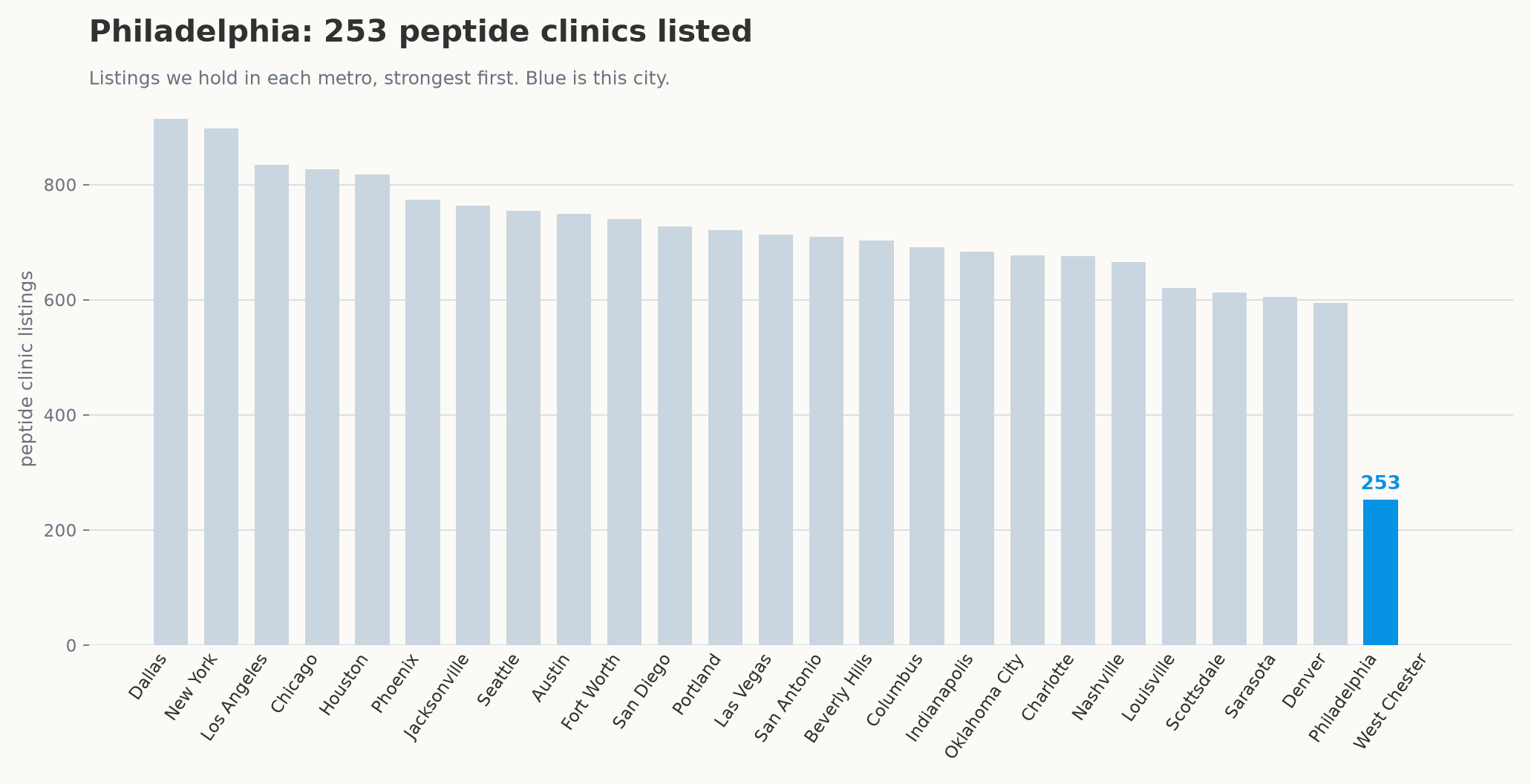
Philadelphia and the surrounding Pennsylvania medical corridor sit on one of the deeper integrative-medicine networks in the Northeast. Our internal database currently tracks more than a hundred Pennsylvania clinics already operating in the anti-aging, hormone optimization, and metabolic-medicine space — practices that have spent the last three years prescribing under FDA Category 2 restrictions while their peers in less-prepared states sat the period out. That scale matters. When supply normalizes, the patients who win are the ones who can tell the practice that did thier homework from the practice that just hung a shingle.

The pending FDA reclassification — expected in Q3 2026, never promised on a specific date — is the inflection point. Sermorelin, CJC-1295, ipamorelin, and the second-generation pineal and mitochondrial peptides are about to move from a slow drip through 503A compounding to something that resembles a normal supply chain. The clinics in Philadelphia and across PA that have kept their pharmacy relationships current, their lab protocols documented, and their patient managment standards defensible under state board review are the ones that will be ready inside ninety days. The rest will catch up. Or not.

This page is a directory entry, not a sales tool. We maintain the national directory of physicians and 503A compounding pharmacies who can legally prescribe and prepare these compounds. We do not sell peptides. The job is to make sure that when a patient in Philadelphia, the Main Line, the South Jersey suburbs, or anywhere across the Commonwealth is ready to ask the right questions, the names in front of them are the ones who earned the visit.

Top peptides · Anti-aging and longevity

The compounds Philadelphia clinics are preparing to offer.

Philadelphia's peptide search demand tracks the anti-aging and longevity bucket with measurable secondary interest in metabolic and immune-modulating compounds. Below are the named molecules that practitioners across the PA medical corridor are most likely to walk you through. Each is restricted under FDA Category 2 today. None is a finished pharmaceutical product. Each is a candidate molecule that, under federal compounding law, a licensed pharmacist may prepare on a patient-specific prescription when a physician determines it is clinically appropriate. The compound supply, oversight standards, and pharmacy verification practices used by clinicians in similar Northeast metropolitan markets are the operating standard Philadelphia practices are working against.

Sermorelin
GHRH analog

A 29-amino-acid fragment of growth-hormone-releasing hormone. Stimulates the patient's own pituitary to release GH in physiologic pulses rather than introducing exogenous growth hormone directly. The mechanism is well-described and the adult safety profile has been the subject of long-running pharmacologic review.

Walker RF. Sermorelin: a better approach to management of adult-onset growth hormone insufficiency? Clin Interv Aging. 2006;1(4):307–308. PMC2699646

CJC-1295 + Ipamorelin
Dual GHRH / GHRP pathway

CJC-1295 prolongs GHRH signaling half-life. Ipamorelin, a selective growth hormone secretagogue, complements the signal through the ghrelin-receptor pathway. The pairing is documented for sustained physiologic GH and IGF-1 elevation without the appetite or cortisol effects associated with older secretagogues.

Teichman SL, et al. Prolonged stimulation of GH and IGF-I secretion by CJC-1295. J Clin Endocrinol Metab. 2006;91(3):799–805. PMID 16352683 · Raun K, et al. Ipamorelin, the first selective GH secretagogue. Eur J Endocrinol. 1998;139(5):552–561. PMID 9849822

Tesamorelin
GHRH analog (FDA-approved indication)

A modified GHRH analog with an FDA-approved indication for HIV-associated lipodystrophy and a robust phase-3 trial record. Discussed in anti-aging contexts because it is one of the few peptides in this class with finished-drug regulatory data behind it, though its use outside the approved indication remains an off-label decision by the prescribing physician.

Falutz J, et al. Effects of tesamorelin in HIV-infected patients with excess abdominal fat: pooled analysis of two phase-3 trials. J Clin Endocrinol Metab. 2010;95(9):4291–4304. PMID 20554713

Thymosin Alpha-1
Immunomodulatory peptide

A 28-amino-acid peptide originally isolated from thymic tissue. Decades of clinical literature on immune-cell function in immunocompromised and post-viral populations. Discussed in longevity contexts where age-related immune decline — not acute pathology — is the target.

Garaci E, et al. Thymosin alpha 1: from bench to bedside. Ann N Y Acad Sci. 2007;1112:225–234. PMID 17435111

Epitalon
Pineal tetrapeptide

A four-amino-acid sequence with in-vitro evidence on telomerase activity and telomere elongation in human somatic cell lines. Earlier-stage clinical evidence than the GH-axis peptides; a credible Philadelphia practitioner should be able to walk you through what the mechanistic literature does and does not show.

Khavinson VK, Bondarev IE, Butyugov AA. Epithalon peptide induces telomerase activity and telomere elongation in human somatic cells. Bull Exp Biol Med. 2003;135(6):590–592. PMID 12937682

Further reading on the GH-axis safety conversation: Bartke A. Growth hormone and aging: a challenging controversy. Clin Interv Aging. 2008;3(4):659–665. PMID 19281058 · Sigalos JT, Pastuszak AW. The Safety and Efficacy of Growth Hormone Secretagogues. Sex Med Rev. 2018;6(1):45–53. PMID 28526632

How to find a clinic in Philadelphia

The questions that actually separate a real clinic from a storefront.

Four questions, asked in this order, will tell you within ten minutes whether a Philadelphia provider is operating under federal compounding law or operating something that should be walked away from. The same diagnostic line of questioning used by patients evaluating practitioners across other large metropolitan medical markets applies here without modification — though in a state with the depth of clinical infrastructure Pennsylvania has, the standard of evidence patients should expect is on the higher end.

1. Can the practitioner explain, in plain terms, why a peptide is being compounded under section 503A — and which pharmacy they work with?

A credible clinician will articulate the regulatory rationale without reaching for marketing copy: section 503A of the FDCA permits a licensed pharmacist to prepare a patient-specific compound when no commercially available equivalent meets the need. They should name the 503A pharmacy and be willing to discuss its Pennsylvania licensure and inspection history. Deflection on this question is itself the answer.

2. Will baseline labs — IGF-1, hormone panels, metabolic markers — be drawn before any peptide protocol begins?

A practitioner operating to a defensible standard will not write a sermorelin or CJC-1295 prescription without an IGF-1 baseline. If a Philadelphia clinic is willing to ship product without a workup, the question is not whether the price is fair — it is whether the clinic intends to survive a Pennsylvania State Board chart audit once reclassification draws regulator attention. Documentation that holds up to scrutiny is not optional in a state with this much board activity.

3. What is the follow-up cadence — three months, six months — and who reviews the labs?

Anti-aging protocols are not one-and-done prescriptions. The physician, or a credentialed nurse practitioner under direct physician oversight, should review repeat labs at fixed checkpoints and adjust dose, frequency, or cessation based on what the numbers show. Ask who reviews the labs and how that review is documented in the chart.

4. What conditions would cause the physician to stop the protocol — and how is that decision made?

A practitioner who cannot describe their stop-criteria has not thought about them. Reasonable answers include out-of-range IGF-1, adverse event, lack of measurable improvement at a defined checkpoint, or any new contraindication identified during follow-up. If the answer reduces to "we just keep going," that is a position the patient — not the clinic — will eventually be asked to defend.

Verified Philadelphia clinics

Practitioners we've confirmed.

We are finalizing verification on Philadelphia and broader Pennsylvania providers. Every listing on this site is confirmed against state licensure records and 503A compounding pharmacy relationships before it appears — we will not publish a clinic we cannot stand behind. Join the waitlist below and you will be the first told when verified Philadelphia and PA-statewide providers are added.
Priority Access · Philadelphia, PA

Get notified the moment Philadelphia clinics open.

Join the Philadelphia list

Be first in line for verified Philadelphia peptide clinics.

We send one email when Pennsylvania is cleared. No spam. Unsubscribe anytime.

Straight Answers · Philadelphia

What you should know before joining the Philadelphia list.

Are peptides legal in Philadelphia right now?
Peptide therapy is currently restricted under FDA Category 2 status, which limits which compounds a 503A pharmacy may prepare while the agency completes its review. A licensed physician in Pennsylvania may still prescribe certain compounds under section 503A of the Federal Food, Drug, and Cosmetic Act on a patient-specific basis. The full national reclassification — which is expected to broaden the available list — is pending agency action and is not guaranteed on any specific timeline.
Will Find Peptide Clinics sell me peptides?
No. We do not sell peptides. We maintain a directory of licensed physicians and 503A compounding pharmacies in Philadelphia who may prescribe and prepare them under federal law.
What does a peptide clinic in Philadelphia actually do?
A peptide clinic in Philadelphia is a physician's office — anti-aging, integrative, endocrinology, or longevity-focused — that orders baseline labs, evaluates whether the patient is a candidate, writes the prescription, and works with a licensed 503A compounding pharmacy that prepares the compound to specification. The clinic monitors the patient through follow-up labs and clinical assessment. It does not stock product, and it does not sell peptides.
How do I know a Philadelphia clinic is legitimate?
The fastest filter is the workup. A clinic that orders an IGF-1 baseline, hormone panel, and basic metabolic markers before any prescription is a clinic that intends to defend the medical record under Pennsylvania State Board of Medicine review. The second filter is pharmacy provenance — a credible clinic will name the 503A compounding pharmacy that prepares its compounds, and that pharmacy should be state-licensed and inspected. Pennsylvania has more than a hundred clinics already operating across its medical corridors; that scale rewards the patient who can tell the prepared from the unprepared.
Are the peptides themselves FDA-approved?
Most peptides discussed in anti-aging contexts — sermorelin, CJC-1295, ipamorelin, epitalon, thymosin alpha-1 — are not finished, FDA-approved pharmaceutical products for the indications patients most often ask about. They are compounded preparations dispensed by 503A pharmacies on patient-specific prescriptions. Tesamorelin is one exception, with an approved indication. The agency's pending Category 2 review will determine which compounds remain available, and no specific timeline has been promised.
How much does peptide therapy cost in Philadelphia?
Costs vary by compound, dosing protocol, and the cadence of physician evaluation. Philadelphia integrative practices generally price the workup and follow-up separately from the compound itself, with the compound paid through the 503A pharmacy. Insurance does not cover compounded peptide prescriptions written for anti-aging indications. Patients comparing other regional medical markets may find what comparable Southeastern doctor-authority markets are seeing useful as a benchmark, and our answers to the questions patients ask most cover the regulatory mechanics in more depth.