
Searching for a peptide doctor near me can produce a mix of physicians, telehealth companies, med spas, hormone clinics, and pharmacies. Those are not interchangeable. The useful question is not whether a website uses the word “peptide.” It is whether a licensed clinician can explain the diagnosis, the exact product, the evidence, the pharmacy, and the follow-up plan before asking you to pay.
This guide gives you a repeatable way to check those facts. It does not recommend a peptide, clinic, pharmacy, or treatment.
Quick answer: what should a peptide doctor disclose?
| Check | What a clear answer includes | Warning sign |
|---|---|---|
| Prescriber | Clinician name, professional role, state license number, and the state where care is provided | No clinician identified until after payment |
| Medical reason | The condition being evaluated, the diagnostic process, and alternatives considered | A menu of products offered before a medical assessment |
| Product status | Exact drug or compound, route, and whether it is FDA-approved, used off-label, compounded, or investigational | “FDA registered,” “medical grade,” or “research backed” used as a substitute for the actual status |
| Pharmacy | Pharmacy name, whether it operates under section 503A or 503B, and where its license or registration can be checked | The clinic will not name the dispensing or compounding pharmacy |
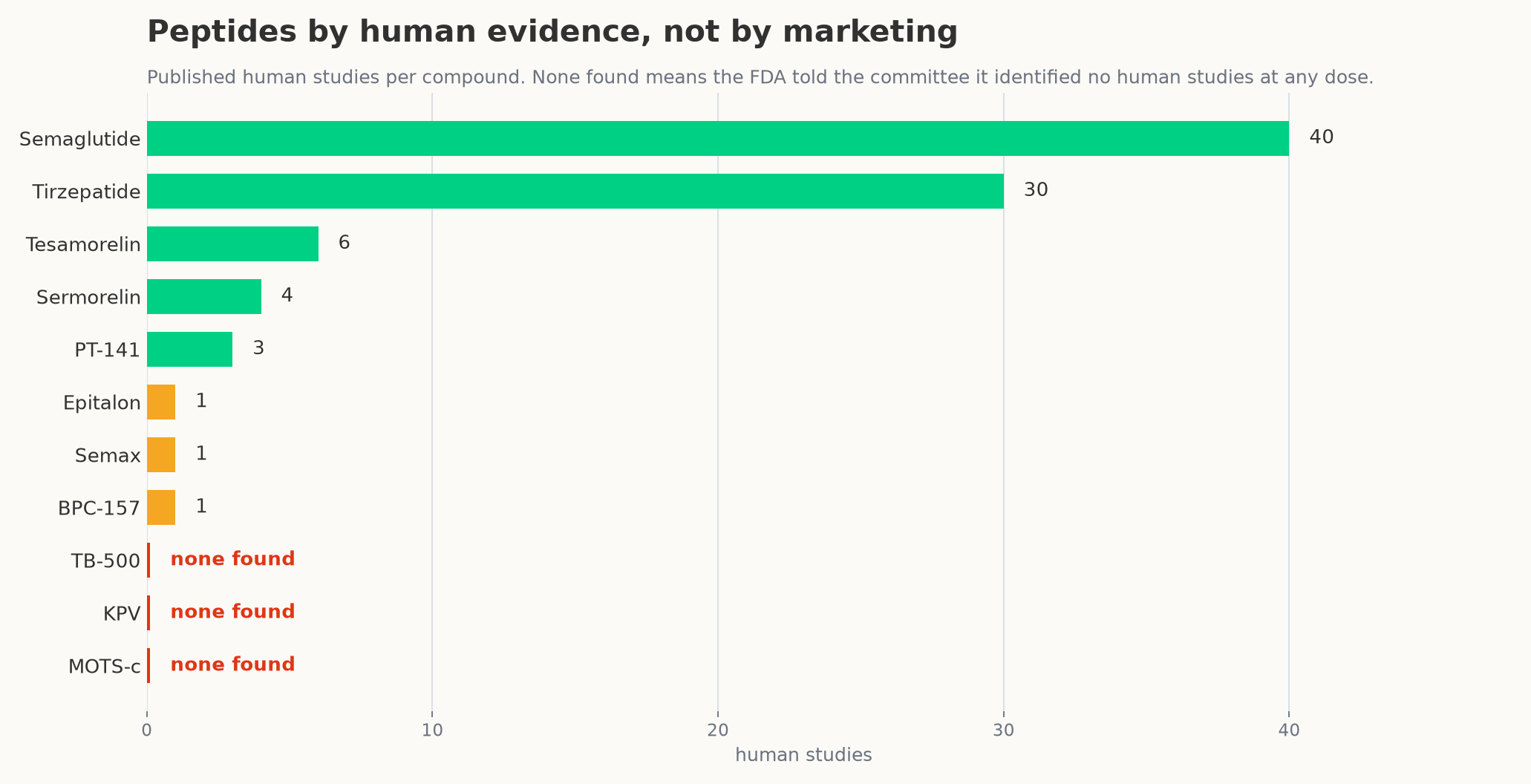
| Evidence | Human evidence involving the same compound, route, condition, and patient group | Cell or animal studies presented as proof of patient results |
| Follow-up | Monitoring plan, who answers questions, adverse-event process, and stopping criteria | Medication shipped with no named follow-up clinician |
| Price | Consultation, laboratory, medication, refill, cancellation, and follow-up costs in writing | A low introductory price with recurring charges left unexplained |
What “peptide doctor” can mean
“Peptide doctor” is a search phrase, not a medical specialty. A physician may practice endocrinology, urology, dermatology, obesity medicine, family medicine, sports medicine, or another field while discussing a medication that happens to be a peptide. Nurse practitioners and physician assistants may also prescribe within state law and their scope of practice.
A clinic name does not tell you who is responsible for care. Before booking, identify the actual clinician who will review your history and make prescribing decisions. Verify that person with the relevant state licensing board. The Federation of State Medical Boards also provides DocInfo for physician-license information. An NPI can help identify a health care provider, but an NPI is not proof that a professional license is active or that a treatment claim is supported.
Four product categories that should not be blurred together
| Category | What it means | Question to ask |
|---|---|---|
| FDA-approved drug used within its label | FDA reviewed evidence for the labeled indication, population, route, and manufacturing controls | What is the approved indication, and does it match the proposed use? |
| FDA-approved drug used off-label | A licensed clinician uses an approved drug for a use not included in the approved labeling | What evidence supports this off-label use for someone like me? |
| Compounded drug | A pharmacy or outsourcing facility prepares a drug under federal and state compounding rules when the legal conditions are met | Why is compounding medically appropriate, and who prepared it? |
| Investigational substance | A substance still being studied and not approved as a drug for routine patient use | Is this offered through a registered clinical trial, and what oversight applies? |
FDA states that compounded drugs are not FDA-approved. The agency does not verify their safety, effectiveness, or quality before marketing. Compounding can meet a legitimate patient need when an approved medication is not medically appropriate, but it should not be presented as equivalent to FDA approval.
503A and 503B: what the labels actually tell you
A 503A pharmacy is generally a state-licensed pharmacy that compounds for identified individual patients based on prescriptions, subject to the conditions in section 503A of federal law. Use our 503A pharmacy verification checklist to check the pharmacy, prescription, and product claims. State boards of pharmacy have primary day-to-day oversight, while FDA can conduct surveillance and for-cause inspections.
A 503B outsourcing facility registers with FDA, is inspected on a risk-based schedule, and must follow current good manufacturing practice requirements. It may compound certain drugs in larger quantities without first receiving patient-specific prescriptions when the legal conditions are met.
Neither label proves that every product is safe, effective, or appropriate. “503B registered” describes a facility and its regulatory pathway; it is not FDA approval of each compounded drug. Check FDA’s current registered outsourcing facility list, including inspection, recall, and enforcement information. Check a 503A pharmacy with the appropriate state board of pharmacy.
How to verify a peptide doctor near you
- Get the prescriber’s full name before paying. Ask who will make the medical decision, not just who owns the brand.
- Check the professional license. Use the state medical, nursing, or professional board that applies where you receive care. Confirm status, location, and any public disciplinary information.
- Confirm the diagnosis comes before the product. A medical assessment should determine whether treatment is appropriate. A product menu should not determine the diagnosis.
- Ask for the exact product and route. Similar names do not make two compounds equivalent. Topical, oral, and injected routes require different evidence and carry different risks.
- Separate approval from compounding. Ask whether the finished product is FDA-approved, whether an approved drug is being used off-label, or whether the medication is compounded.
- Name and verify the pharmacy. Check the relevant state license or FDA outsourcing-facility record. Do not accept “U.S. pharmacy” as the full answer.
- Match the evidence to the claim. Ask for human studies involving the same molecule, route, condition, and patient population. A paper about cells, animals, another compound, or another route cannot establish the proposed result.
- Read the monitoring plan. Find out who reviews laboratory results, how side effects are handled, when treatment is stopped, and who is available between visits.
- Get the total cost in writing. Include recurring membership charges, medication, laboratory work, shipping, refills, follow-up, and cancellation terms.
Local clinic comparison pages
Use the same checks when comparing clinics in high-demand markets:
- Peptide clinics in Los Angeles
- Peptide clinics in Chicago
- Peptide clinics in Houston
- Peptide clinics in Phoenix
- Peptide clinics in New York
For more context, read How to Check a Peptide Clinic Before You Book and Peptide Clinic vs Med Spa.
Not seeing your city? Request the clinic list for your area. Listings are informational; confirm the clinician’s license, services, and product status directly before booking.
Questions patients ask
Is “peptide doctor” a recognized specialty?
No. It is a consumer search term. Verify the clinician’s actual profession, specialty, license, and scope of practice.
Does an NPI prove that a clinician is licensed?
No. An NPI identifies a health care provider in federal administrative systems. Use the relevant state licensing board to confirm an active professional license.
Does FDA registration mean a compounded peptide is FDA-approved?
No. A 503B facility may register with FDA, but compounded drugs are not FDA-approved. Facility registration does not establish that every product is safe, effective, or appropriate for a patient.
Should a clinic name its pharmacy?
Yes. A patient should know who dispenses or compounds a prescribed medication and where that pharmacy’s license or registration can be checked.
What if a clinic says the treatment is “research grade”?
Ask whether the substance is an FDA-approved drug, a legally compounded prescription, or an investigational product offered through a clinical trial. “Research grade” is not a substitute for a lawful patient-care pathway.
How Find Peptide Clinics handles listings
Find Peptide Clinics publishes free verified listings and may offer clearly labeled enhanced placement. Payment never replaces credential checks or changes editorial conclusions. Patients can use the city pages above to compare disclosures. Licensed clinic owners can apply for a free or enhanced listing.
If a clinic offers injectable products, use our seven checks for peptide injections near you to compare the prescriber, product status, pharmacy, price, and follow-up plan.
Limitations
This guide is educational, not medical advice. Licensing rules, prescribing authority, and compounding requirements can vary by jurisdiction and circumstance. Verify current information with the relevant regulator and discuss personal medical decisions with a licensed clinician who has evaluated you.
Sources
- U.S. Food and Drug Administration. Compounding and the FDA: Questions and Answers. Content current September 16, 2025.
- U.S. Food and Drug Administration. Registered Outsourcing Facilities.
- Federation of State Medical Boards. DocInfo physician-license search.
- Centers for Medicare & Medicaid Services. NPI Registry.