
She Was Told to Quit Her GLP-1 Three Weeks Before Surgery. US Guidance Says Most Patients Should Keep Taking It.
The number of days you are told to stop your GLP-1 before surgery depends on which country’s doctors your anesthesiologist happens to follow. It does not depend on how good the evidence is, because the evidence is thin and three national bodies of physicians read it three different ways. The United States guidance says most patients should keep taking the drug. The Brazilian Society of Diabetes says stop semaglutide 21 days out, tirzepatide 15 days out. Australia and New Zealand say that stopping for one to two weeks will not change how fast your stomach empties.
These are published positions from physician societies, and they disagree about the same small pile of data. And the one document with the authority to settle it, the warning section of the GLP-1 labels themselves, does something rare on a drug label: it states that there is no published answer yet.
Judith Ann Harris: the Three-Week Question, and the Answer That Did Not Come From Any Guideline
It surfaced in the comment field of a September 27, 2026 episode of DOWNSIZED GLP-1 NEWS. A viewer named Judith Ann Harris had a question about having surgery while on a GLP-1, and she narrowed it: “Is it true I have to quit medication up to 3 weeks before surgery?”
The host, Christopher Durham, answered as a patient rather than a prescriber. He has lost 100 pounds on these drugs, says plainly that he is not a doctor, and has interviewed more than 200 patients on them. He told her a medical recommendation to stop does exist, told her to settle it with her surgeon or anesthesiologist, and then offered his own sense of the numbers: “Most doctors will do at least 10 days, usually 7 to 10 days. 3 weeks I haven’t heard of.”
Both of those numbers deserve daylight. In the United States, the guidance endorsed by the American Society of Anesthesiologists no longer sets a default hold at all, and the interval it falls back to when a hold is chosen is one week, not ten days. I could not find a ten-day recommendation in any US guidance document. The three-week figure he dismissed as unheard of is real, it lives in Brazil.
He was right about the part that matters: the decision belongs to the surgical and anesthesia team, and the advice has moved twice in three years.
The FDA Label: One Sentence That Admits the Question Is Open
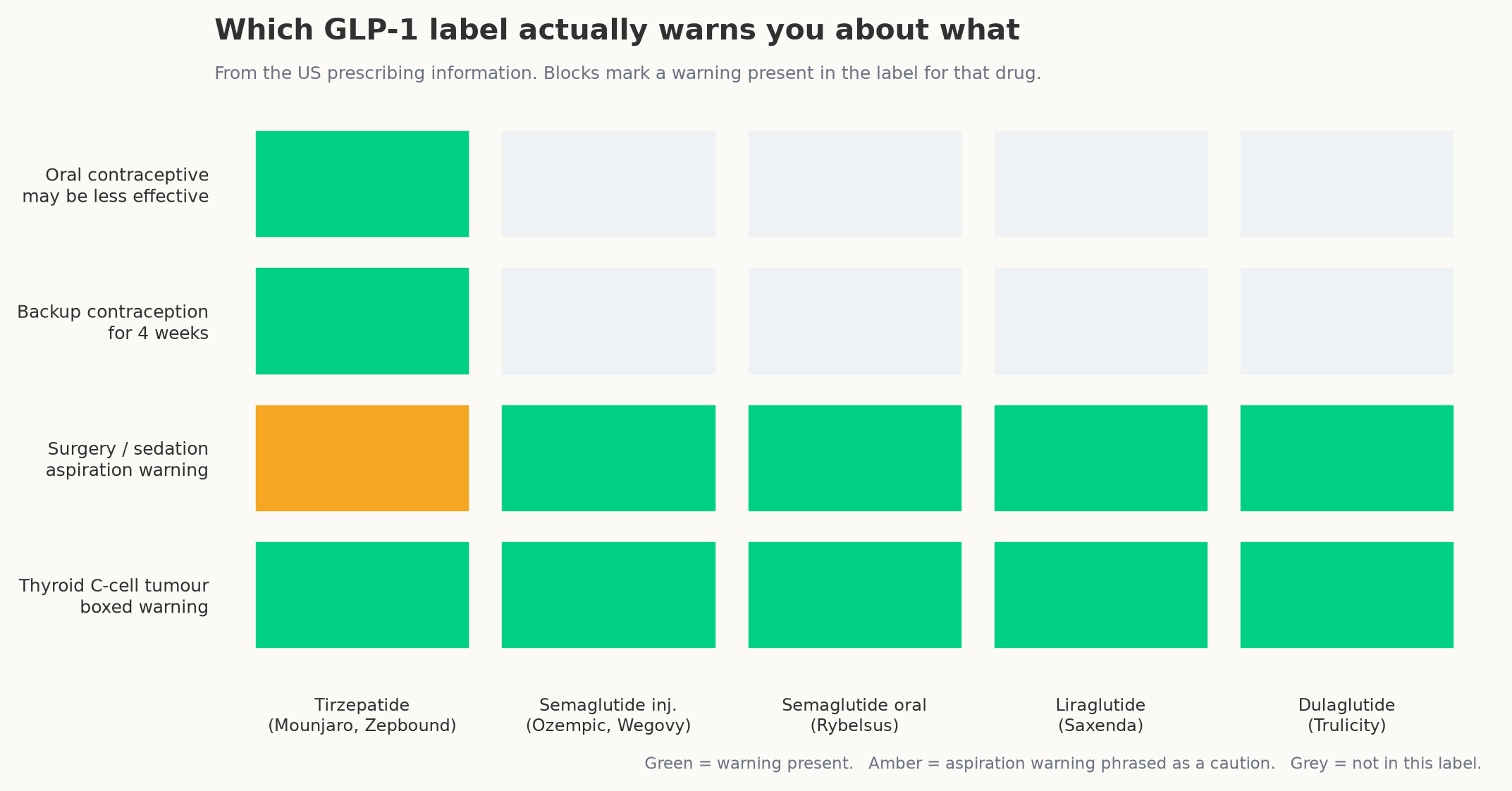
In November 2024 the FDA’s labeling database shows the GLP-1 labels gained a new warning subsection on pulmonary aspiration during general anesthesia or deep sedation. The text, as the FDA publishes it for liraglutide, reads: “There have been rare postmarketing reports of pulmonary aspiration in patients receiving GLP-1 receptor agonists undergoing elective surgeries or procedures requiring general anesthesia or deep sedation who had residual gastric contents despite reported adherence to preoperative fasting recommendations.”
Then the sentence worth reading twice: “Available data are insufficient to inform recommendations to mitigate the risk of pulmonary aspiration during general anesthesia or deep sedation in patients taking VICTOZA, including whether modifying preoperative fasting recommendations or temporarily discontinuing VICTOZA could reduce the incidence of retained gastric contents.”
That is the regulator saying it cannot tell you whether skipping your shot lowers your risk. The same section instructs patients to tell their care team before any planned surgery, which hands the decision to your doctors because the label cannot make it.
A compounded GLP-1 carries no FDA-approved labeling, so this paragraph is not on that vial. Whatever the pharmacy tells you about surgery timing is a pharmacy policy, not a federal warning.
The ASA: a Seven-Day Rule in 2023 That Got Replaced in 2024
In June 2023 the ASA published consensus-based guidance. Weekly dosing: hold a week before the procedure. Daily dosing: hold on the day. It also wrote down what it was working with, noting the evidence was “sparse limited only to several case reports,” and adding: “There is no evidence to suggest the optimal duration of fasting for patients on GLP-1 agonists.”
In October 2024 the ASA, the American Gastroenterological Association, the American Society for Metabolic and Bariatric Surgery, the International Society for Perioperative Care of Patients with Obesity, and the Society of American Gastrointestinal and Endoscopic Surgeons published joint guidance that reversed the default. Most patients should continue the drug before elective surgery. The risk groups get a liquid-only diet for 24 hours, an anesthesia plan adjusted for aspiration, and, where available, a point-of-care stomach ultrasound on the day.
The same release puts a population number on the problem: about one in eight US adults use a GLP-1 drug. It also names the escalation phase, the four-to-eight weeks when the dose is climbing, as the window when the stomach slows most, and says elective surgery should wait until that window closes and GI symptoms settle. One more line deserves attention: withholding the drug only in patients being treated for overweight or obesity, and not in patients taking it for diabetes, “could constitute overweight and obesity bias.”
The Multisociety Guidance: “the Duration to Hold Therapy Is Unknown”
The published guidance behind that release is candid about its own footing. On holding the drug, it states that “the duration to hold therapy is unknown,” and directs teams back to the older ASA interval of a week for weekly formulations when a hold is chosen. Its conclusion says the document “should be considered guidance, and not an evidence-based guideline.”
Treat it as a working document, not a rule.
SPAQI 2025: Keep the Drug, Move the Fasting Clock
The strongest attempt to replace guesswork with a systematic review came from the Society for Perioperative Assessment and Quality Improvement, whose multidisciplinary consensus statement ran a registered systematic review and a modified Delphi process, reaching full agreement across 16 voting members. Its first recommendation: continue GLP-1 receptor agonists around the procedure in patients without significant gastrointestinal symptoms, where significant means severe nausea, vomiting, or an inability to keep food down. Then it changes the fasting instructions instead, recommending a 24-hour fast from solids with clear liquids allowed.
The statement is blunt about the guidance it followed, noting that the June 2023 ASA statement “has been criticised based on lack of supportive data.” Its evidence tables carry the two cohort numbers worth holding in your head. A retrospective cohort of 31,816 patients found aspiration pneumonia in 0.83 percent of GLP-1 users against 0.63 percent of controls, a hazard ratio of 1.33. A separate review of 1,512 endoscopy patients found retained stomach contents in 142 of them, 9.4 percent, with solid residue making up 78.9 percent of that material, along with four episodes of low oxygen and two aspiration events.
A small risk with a real body count, and the intervention with the most support behind it is a longer fast, not a gap in your prescription.
Brazil, Britain, Australia: Three Answers to One Question
The three-week hold Judith Ann Harris heard about traces to the Brazilian Society of Diabetes, which per a 2025 letter in the Brazilian Journal of Anesthesiology advises withholding oral or subcutaneous semaglutide for 21 days and tirzepatide for 15 days, working from three elimination half-lives. The same letter notes semaglutide’s elimination half-life of roughly 165 hours, about seven days, and describes a 2025 British multidisciplinary consensus that recommends continuing GLP-1 and dual GIP/GLP-1 drugs straight through the perioperative period.
ANZCA’s April 2025 recommendations, endorsed by four Australian and New Zealand bodies, go further than the Americans on one point: elective pre-procedural cessation is not recommended for anyone, and the document states that omitting a long-acting drug for one to two weeks is unlikely to alter gastric emptying at all. It recommends a 24-hour clear fluid diet for all patients on these drugs, and says teams without time for that diet should treat the patient as having a full stomach.
One study argues the other way. A paper presented at the 2025 annual meeting of the American Academy of Orthopaedic Surgeons, and summarised in the meeting’s press materials, examined patients having hip or knee replacement and reported that stopping semaglutide 14 days out removed the elevated risk of aspiration complications, while stopping only three to seven days out was itself a risk factor. Patients who kept taking the drug through surgery had the highest complication rates in the study. That is a conference abstract, not a guideline, and it is not a randomized trial.
So the honest state of play in October 2026: the US physicians’ guidance says continue with a longer fast, Brazil says stop three weeks, Britain says continue, Australia says continue and fast, and one orthopaedic meeting abstract says stop fourteen days. Your anesthesiologist picks a lane.
What to Do With This If You Have a Procedure Booked
Name the drug and dose to your surgeon and your anesthesiologist at the pre-operative visit, not on the morning of the procedure. Compounded tirzepatide and semaglutide belong in that sentence too, because the anesthesia team may not realize those count.
Ask which hold interval your team uses and what it is based on. Ask whether a 24-hour clear liquid diet is part of your prep, since that is the measure with the widest agreement behind it. Ask whether gastric ultrasound is available where you are.
Report GI symptoms on the day. Severe nausea, vomiting, or a sense of food sitting in your stomach change the picture, and both the US and Australian documents treat symptoms as a reason to pause or delay an elective case.
The unknowns sit on the record: whether stopping these drugs reduces aspiration risk at all, and how long a pause would need to last if it did. The FDA says the data cannot answer the first question. The multisociety guidance says the duration is unknown. Almost all of the human evidence behind either answer is retrospective.
Frequently asked questions
Is it safe to continue my GLP-1 right up to surgery? For most patients without significant GI symptoms, the US multisociety guidance and the 2025 SPAQI consensus say yes, with an extended fast from solids. Symptoms and dose escalation move you into the higher-risk group.
Do I have to stop three weeks before surgery? Not under US guidance. The 21-day figure comes from the Brazilian Society of Diabetes and applies to semaglutide. If a clinician in the United States tells you three weeks, ask which document that interval comes from, because the guidance the ASA endorses calls the hold duration unknown.
Does stopping the shot protect me? The FDA label states the available data are insufficient to determine whether temporarily discontinuing the drug reduces retained stomach contents. Stopping is not proven to help, and it carries its own costs for blood sugar control and appetite.
What reduces the risk? The measure with the broadest support is a longer pre-procedure fast, typically a 24-hour clear liquid diet, combined with anesthesia planning and, at some centers, a stomach ultrasound on the day.
None of this is dosing advice. Bring your team the documents.
Sources: U.S. Food and Drug Administration, American Society of Anesthesiologists, British Journal of Anaesthesia, Society for Perioperative Assessment and Quality Improvement, Australian and New Zealand College of Anaesthetists, Brazilian Journal of Anesthesiology, American Academy of Orthopaedic Surgeons.
Which of these compounds may a compounding pharmacy lawfully prepare, and in which state? The peptide regulatory status tracker sets out FDA status compound by compound, with dates and sources.