
By Find Peptide Clinics. Each figure below is traced to the FDA briefing document, a published systematic review, or a trial registry, and named at the end.
Tendons and cartilage do not heal well. That is not a marketing claim, it is the reason the sports medicine clinic exists. Tendons are poorly supplied with blood, which is much of why they take so long to recover, and why so many people will try almost anything that might speed it up.
Peptides have become that thing. Specifically two of them: BPC-157 and TB-500, sold separately and together, usually as a stack with a nickname. A surgeon with 200,000 views this week explained the FDA’s reclassification and what it might mean for joints. It is a fair question and worth answering properly, because the honest answer is more interesting than either side of the argument.
So here is what peptides are, what the FDA changed, and what has been tested in a human being.
What Peptides Are, in Plain Terms
A peptide is a short chain of amino acids. Proteins are long chains of the same building blocks. The difference is length, and length decides what a molecule can do.
Your body runs on peptides already. Insulin is one. So is oxytocin. So are the satiety signals your gut sends after a meal. The term “peptide therapy” means giving a synthetic peptide that copies or mimics one of those natural signals, usually by injection, so it reaches the bloodstream intact instead of being digested.
That is the whole premise. It is not a fringe idea. Several peptides are approved medicines, and the approach is legitimate science with real successes behind it.
The problem is not the category. The problem is what happens when a category becomes a market, and the specific peptide most people want for their knee has a very different evidence file from the approved ones.
What the FDA Changed, and What It Did Not
This is where most coverage goes wrong, so it is worth being precise.
On 23 and 24 July 2026, the FDA’s Pharmacy Compounding Advisory Committee recommended six peptides for addition to the Section 503A bulk drug substances list. BPC-157 passed 8 to 6 with one abstention. So did KPV and TB-500. MOTS-c passed 7 to 5. Semax and Epitalon passed on the second day. Emideltide was rejected.
The committee voted against the FDA’s own scientists on all seven. Agency reviewers had recommended against all seven, and their written concerns were not trivial. For BPC-157 they raised reports of anaphylaxis and cardiac events, potential for anti-drug antibodies, and the total absence of double-blind human trials. For TB-500, KPV and MOTS-c, the agency stated it had not identified human studies of any kind, at any dose, for any indication.
None of that made anything legal, and this part matters more than the vote.
A committee recommendation is advice. Adding a substance to the 503A list requires notice-and-comment rulemaking: a proposed rule, a public comment period, a final rule. That process historically runs twelve to twenty-four months. Until it completes, BPC-157 and TB-500 remain unapproved new drugs. Removing them from the old restricted category in April 2026 did not change that either. Coming off a do-not-compound list does not put you on a may-compound list.
In short: the headlines said peptides are back. A committee voted, and that is the whole of it. Nothing a clinic can lawfully dispense changed on the day of the vote, and nothing has changed since.
What Has Been Tested
Here is the part the marketing does not survive.
The FDA published a 68-page review of BPC-157. It found one clinical trial across the entire orthopedic literature: a series of 17 patients who received BPC-157 mixed with a second peptide, which means any result cannot be attributed to either compound.
A 2025 systematic review in the HSS Journal screened 544 papers going back to 1993 and included 36. Thirty-five were preclinical, meaning animals or cell cultures. One was in humans. The review’s conclusion on human safety runs to five words: no clinical safety data were found.
Read that carefully, because it does not mean unsafe. It means unstudied. Those are different findings and the distinction is the entire point.
The single human paper was a retrospective chart review at one clinic, looking back at patients given intra-articular BPC-157 for knee pain. There was no control group, no blinding, no imaging to show tissue repair, and no standardized measure of function. Its first author founded the clinic whose charts he reviewed.
Add it up and the total human experience with this peptide in published form is roughly 80 people across five studies. The longest anyone was treated in any of them is two weeks.
The Table That Should Decide This For You
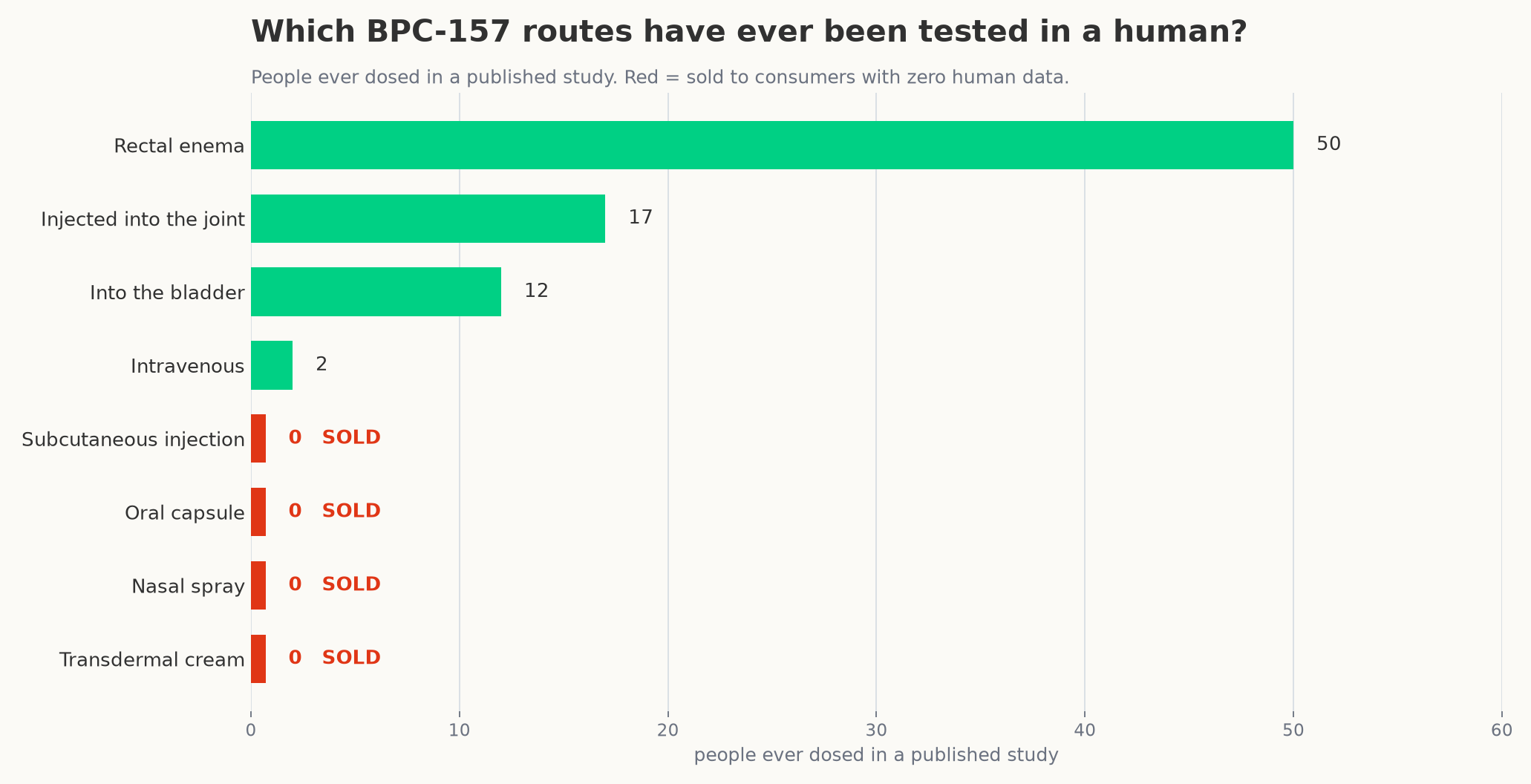
This is the part I would put on the wall of any clinic selling peptides. It compares the routes that have been studied in humans with the routes that are sold.
| Route | People ever dosed | Sold to consumers |
|---|
|—|—|—|
| Rectal enema | ~50 | No |
|---|---|---|
| Intra-articular (into the joint) | 17 | No |
| Intravesical (into the bladder) | 12 | No |
| Intravenous | 2 | No |
| Subcutaneous injection | 0 | Yes |
| Oral capsule | 0 | Yes |
| Nasal spray | 0 | Yes |
| Transdermal cream | 0 | Yes |
Each route studied in a human being is a route you cannot buy. Each route you can buy has zero human data behind it.
The subcutaneous injection, the one most people use, has not been studied in a human. Not at a low dose, not briefly. Zero.
There is also no human pharmacokinetic data to work from. The only published numbers are a half-life of 15.2 minutes in rats and 5.27 minutes in dogs. There is no known human dose, because no one has measured what the drug does in a person. The US Anti-Doping Agency’s phrasing is unusually blunt: there appears to be no legal basis for selling BPC-157 as a drug, a food, or a dietary supplement.
TB-500 Is Not a Better Bet
TB-500 is a fragment of thymosin beta-4, a protein involved in cell migration and blood vessel formation. It is usually sold alongside BPC-157 and the pair has a nickname.
Thymosin beta-4 does have one Phase III randomized trial. It is in an eye condition, using the full-length protein. There is no equivalent trial for the fragment, in muscle, tendon or joint. The FDA told the committee it had not identified human studies of TB-500 at any dose.
A 2026 review in Sports Medicine concluded that these compounds show favourable tissue-repair results in animal models while rigorous human safety data remain scarce, and noted the potential for serious harm. A separate 2026 review in JBJS Reviews classified both BPC-157 and thymosin derivatives as investigational, with uncertain safety profiles and concerns about grey-market product quality. Its graded recommendation for injectable peptides in sports medicine was predominantly C, the weakest tier.
Are Peptides Safe
The honest answer depends entirely on which peptide, because “peptides” is not one thing.
Approved peptides with human trials behind them are as safe as any medicine, with known risks and monitoring. The unapproved ones sold for recovery are a different question, and the answer is that no one knows, because the studies that would tell us have not been run.
There is one more layer that has nothing to do with the molecule.
The FDA’s warning letter to Empower Pharmacy in September 2026 found airflow testing failures, media-fill failures, and cleanup documentation that could not be traced. That is a large, established compounding pharmacy. If sterility assurance can fail at that scale, it can fail in a facility with no oversight at all, and the product people inject is not sterile by default. It is sterile because somebody verified it.
Add the absence of pharmacokinetic data and you have a situation where neither the dose nor the purity is established. A 2026 review put it better than I can: the primary barrier to clinical translation is not the absence of biological activity, but the absence of fundamental pharmaceutical science.
What Is Coming Next
There is a real trial now, and it is worth knowing about because it will settle some of this.
NCT07437547 is a Phase 2, randomized, quadruple-masked, placebo-controlled study of 120 people with MRI-confirmed grade II hamstring strain. Participants receive subcutaneous BPC-157 daily for 14 days against matched placebo. The primary outcomes are days to unrestricted return to sport and MRI-measured injury volume at day 14.
That is the study design the field has been missing. Primary completion is expected in February 2027.
Until it reports, anyone telling you this peptide is proven for tendons is describing results that have not been produced. And the FDA’s own evaluation of BPC-157, the one documented use it assessed, covered ulcerative colitis rather than tendons and found a lack of evidence to support effectiveness.
What To Do Instead
If you have a tendon or joint problem, the unglamorous answers have better evidence behind them than the injections do: load management, progressive loading, and time. If you are considering a peptide anyway, the questions that matter are not about the peptide. They are about the vial, the pharmacy that filled it, and whether anyone is monitoring you.
Ask which pharmacy prepared it and whether it holds a current licence in your state. Ask for the certificate of analysis and read the date on it. Ask what the prescriber will do if you have a reaction. A clinic that answers all three is a clinic worth talking to, whatever you decide about the peptide.
And if a provider tells you the FDA made these legal, you now know that is not true. It is the single fastest way to find out how well they know their own business.
Which of these compounds may a compounding pharmacy lawfully prepare, and in which state? The peptide regulatory status tracker sets out FDA status compound by compound, with dates and sources.
Frequently Asked Questions
Do peptides work for joint pain?
For the two peptides most sold for this purpose, the human evidence does not establish that. BPC-157 has roughly 80 people studied across five papers, one of which was a controlled comparison, and TB-500 has no human musculoskeletal trial. The animal literature is consistent and the human literature is close to absent.
Did the FDA approve BPC-157?
No. On 23 July 2026 an FDA advisory committee voted 8 to 6 to recommend it for the Section 503A bulk substances list. A recommendation is not approval, and it does not permit compounding. That requires notice-and-comment rulemaking, which has not begun.
Is BPC-157 legal to buy?
It is sold openly and it is not lawful to sell as a drug, food or supplement. The US Anti-Doping Agency states there appears to be no legal basis for selling it in any of those categories, and it is prohibited in sport.
What is the Wolverine stack?
A combination of BPC-157 and TB-500 sold in one vial. The name comes from a comic book character’s healing ability. Neither compound has a completed human trial for tendon or joint injury, alone or in combination.
Can I trust a certificate of analysis?
It tells you what was tested and when. Check the date, check that it names the specific batch, and check whether the laboratory is independent of the seller. A certificate you cannot trace to a testing lab is a document, not a result.
When will there be a real answer?
A 120-person randomized placebo-controlled trial of injectable BPC-157 in hamstring injuries is running, with primary results expected in February 2027. That is the first study designed to answer the question the market has been selling against.
Sources: FDA Pharmacy Compounding Advisory Committee briefing document for BPC-157 (fda.gov); FDA, 503A interim bulk drug substances category lists; Vasireddi et al., systematic review of BPC-157 in orthopaedic sports medicine, HSS Journal, 2025; Mayfield et al., American Journal of Sports Medicine, 2026; Mendias and Awan, peptide therapies for musculoskeletal injuries, Sports Medicine, 2026; Villegas Meza et al., JBJS Reviews, 2026; ClinicalTrials.gov NCT07437547 and NCT02637284; US Anti-Doping Agency athlete advisory on BPC-157; FDA warning letter to Empower Pharmacy, September 2026.