
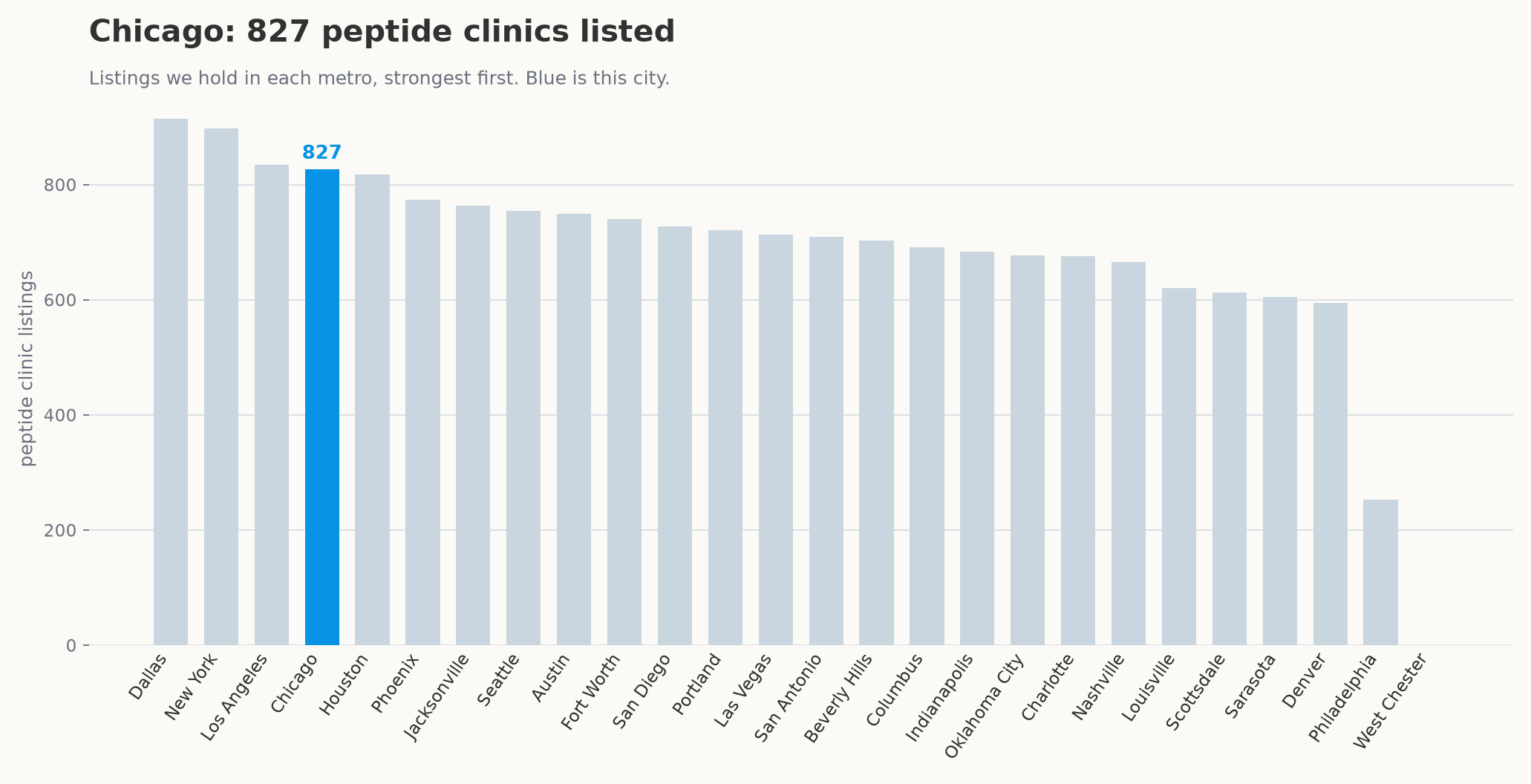
Chicago, Illinois searches for peptide clinics surface gamedaymenshealth.com and www.mypeptidematch.com among the local results. Rank position tracks search signals and little else. It says nothing about the pharmacy that fills the order.
One check matters before you send money. Ask which pharmacy compounds the peptide, and whether that pharmacy operates under Section 503A or Section 503B. Ask for the prescriber's name, then look up that person's license in the Illinois Board of Medicine or Board of Nursing public lookup. Check the license status and any public discipline record for that prescriber.
Federal law requires a prescription before a pharmacy dispenses. Some peptides hold FDA approval as drugs. Others sit on the FDA Category 2 list, which bars compounding of copies of approved drugs. Ask what the evaluation includes and what the first month costs in total. Pay first, verify later, and you carry the risk.
Who can prescribe peptides in Illinois
A prescription for a compounded peptide comes from a licensed prescriber. Federal law requires that prescription before a pharmacy dispenses the drug. Illinois decides who holds the license.
Patients who book a peptide consult in Chicago meet one of three license types.
Physician. Holds an MD or a DO. Practices without supervision.
Physician assistant (PA). Holds a PA license. Works under a supervising physician and a written protocol.
Advanced practice registered nurse (APRN). Holds an APRN license. Works under a supervising physician and a written protocol.
Ask the clinic which license type will run your evaluation. Request the name of the supervising physician if a PA or an APRN takes the appointment. A clinic that avoids the question leaves you without a way to trace responsibility.
Verify the prescriber. The Illinois Board of Medicine publishes a public license lookup for physicians and physician assistants. The Illinois Board of Nursing publishes one for APRNs. Search the prescriber's name. Confirm the license type, the status, and any public discipline record.
Verify the pharmacy. Ask which pharmacy compounds the peptide. A 503A pharmacy compounds for an individual patient under a prescription. A 503B outsourcing facility registers with the FDA and can produce larger batches.
Federal rules add a layer. The FDA keeps a Category 2 list of ingredients it deems unsafe for compounding. Some peptide ingredients sit on that list. An ingredient on that list is off limits for a 503A pharmacy.
Expect variation. Rules on compounded peptides shift as the FDA reviews ingredients, and no clinic can promise a prescription.
Questions that separate clinics
Does the clinic name the prescriber and license number?
Ask for the full name of the clinician who signs the order, plus the state license number. Illinois publishes license records through a state board lookup, and you can search that number before you pay. A clinic that dodges the question tells you something.
Does the clinic name the pharmacy, and is it 503A or 503B?
The FDA holds 503A and 503B compounders to different standards. A 503B outsourcing facility meets federal current good manufacturing practice rules, while a 503A pharmacy compounds for a named patient under a prescription. Ask to see the pharmacy name on the label.
Does the initial evaluation include a review of history and labs?
Ask which clinician performs the intake and how long the visit runs. Federal law requires a prescription before a pharmacy dispenses a compounded peptide, so a real assessment comes first. Get the scope in writing, including lab work and video versus in-person contact.
Does the clinic have a plan if a patient reacts?
Ask who answers the phone and how the clinic documents the event. Clinics and pharmacies report serious adverse events to the FDA through MedWatch. Ask about refund or replacement terms at the same time.
Does the quoted price cover consultation, medication, and follow-up?
Request one monthly figure that covers the intake visit, the drug, and follow-up. Starter pricing that jumps after month one deserves a hard look. Ask for the number in writing.
What Chicago clinics get right and wrong
Chicago hosts two shapes of peptide practice, and the shape predicts how a clinic answers a complaint.
Franchise men's-health clinics run the first model. One brand operates storefronts in several cities, and a corporate parent sets the intake script and the price sheet. A patient in River North may sit with a nurse practitioner who follows a template built elsewhere. The strength: consistent intake and clear pricing. The weakness: the corporate office absorbs a complaint, and the prescriber who signs the order may hold no stake in the business.
Physician-owned practices run the second model. The prescriber owns the practice, spends longer on intake, and reviews history before writing anything. Accountability lands on one person, the license holder. The Illinois Department of Financial and Professional Regulation lists that license, and a patient can pull the record in the state lookup. A longer intake means a longer wait for an appointment.
Both models answer to the same federal rules. A prescription precedes dispensing. Congress drew the 503A and 503B lines, and the FDA Category 2 list names peptides that remain off limits for compounding. Ask a Chicago clinic which pharmacy compounds the peptide and what the evaluation includes. Ask the total cost. A vague answer tells you something.
Red flags
Payment before evaluation. A clinic that collects a card number before a licensed prescriber reviews your history runs the process backward. Federal law requires a prescription before a pharmacy dispenses a peptide. Pay first, and you buy a promise from a company that owes you nothing.
Guaranteed outcomes. A promise of a lab result, a weight change, or a recovery timeline has no basis. A clinician who offers certainty about an unapproved compound sells marketing.
No verifiable practice address. Ask for the street address and the name of the supervising physician. Then check that prescriber's license in the state board's public lookup. A PO box with no license number gives you nothing to verify.
Urgency pressure. Countdown timers and "today only" pricing push you past the questions worth asking. Legitimate care survives a night of thinking it over.
Refusal to name the pharmacy. Ask which pharmacy compounds the peptide and whether it holds a 503A or 503B registration. A vendor that dodges the question hides the source. Some peptides sit on the FDA Category 2 list, which restricts compounding. A straight answer takes seconds.
What a legitimate Chicago clinic looks like
A Chicago clinic earns trust through paperwork. Leave the first appointment with four items.
- **The prescriber's name and license number.** Illinois licenses are public. Look the number up in the Illinois Department of Financial and Professional Regulation license search, and confirm the record shows an active status.
- **A compounding pharmacy you can name.** Ask which pharmacy fills the prescription. Federal law requires a prescription before dispensing, and that pharmacy holds a state license. A clinic that dodges the question gives you a reason to pause.
- **A written plan with costs.** Ask for the total monthly figure: medication, visits, shipping, refills. Get it on paper before you pay.
- **A contact for problems.** Ask who answers when a side effect appears at 9 p.m. Ask for a phone number and a response window.
Compounded peptides sit in a shifting federal zone. The FDA keeps a Category 2 list of ingredients that 503A pharmacies cannot use, and those rules change. A clinic that explains the uncertainty beats one that waves it off.
Frequently asked questions
Does Illinois require a prescription for peptide therapy?
Illinois requires a prescription before a pharmacy dispenses a prescription peptide, which aligns with the federal rule for compounded drugs under section 503A. That means a licensed provider evaluates you first and documents the decision. A clinic that ships peptides without an evaluation steps around both rules.
How do I verify a Chicago clinic's license?
Look up the prescriber in the Illinois Board of Medicine license lookup, or the Board of Nursing lookup for a nurse practitioner. Ask for the license type and number, then compare both against the state record. A clinic that stalls on that request gives you a reason to pause.
Are compounded peptides FDA-approved?
No. The FDA has not approved compounded peptides as finished drug products, and several peptides appear on the FDA Category 2 list, which flags substances where compounding raises safety concerns. A compounding pharmacy prepares these drugs under 503A or 503B rules, a status distinct from an approved drug.
Can a Chicago clinic prescribe peptides over a video call?
Telehealth rules vary by state, and Illinois sets its own requirements for the provider-patient relationship. The evaluation should cover a health history and a review of current medications. Ask which Illinois license the prescriber holds before you book.
What should peptide therapy cost in Chicago?
No public price list exists, so costs vary by peptide and pharmacy. Ask for the total monthly figure that covers the consultation and the compounded drug. A quote that leaves out pharmacy fees or lab work hides part of the bill.