
Louisville, Kentucky holds a crowded field of peptide and wellness clinics, and the local search results repeat the same promises: fast intake, discreet care. A patient who pays first and checks second sends money before confirming that a licensed clinician reviewed the case.
Verification before payment is the one item that matters. Search the prescriber's name in the state Board of Medicine or Board of Nursing public license lookup, then confirm the license reads active. Ask which pharmacy compounds the drug, what the evaluation includes, and the total monthly cost. A price quote without those answers gives a patient little to check.
Federal rules set the floor. The FDA has not approved compounded semaglutide or tirzepatide. The agency's Category 2 list bars 503A and 503B pharmacies from compounding the peptides named on it. A prescription must precede dispensing, and a licensed prescriber must conduct an evaluation. A clinic that skips that sequence skips the check a patient can make.
Who can prescribe peptides in Kentucky
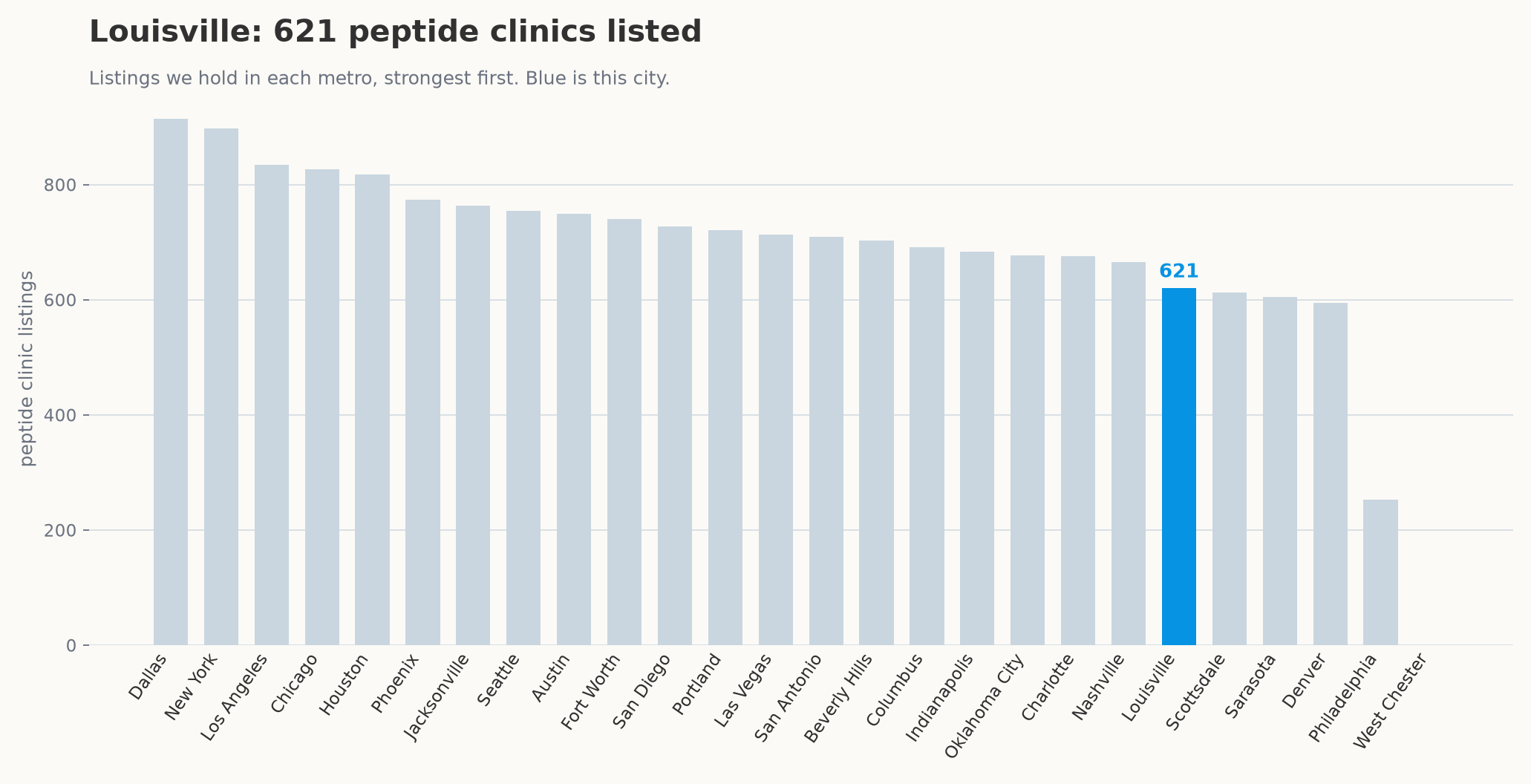
A prescription for a peptide must come from a licensed prescriber. A clinic or a website holds no prescribing license. A licensed clinician evaluates the patient and writes the prescription. The pharmacy compounds or dispenses under that order. Federal rules for compounded drugs add a second layer, including the 503A and 503B pathways. The FDA Category 2 list applies. Those rules limit which ingredients a compounder may use.
Patients in Louisville will meet one of three license types. The first is a physician, either an MD or a DO. A physician holds a full license and may prescribe without a supervising clinician. The second is a physician assistant. The third is an advanced practice registered nurse. A PA or an APRN works under a supervising physician and a written protocol. That protocol sets the scope of practice and the drugs the PA or APRN may order. Ask the clinic which license type applies to your visit. Ask for the name of the supervising physician when a PA or APRN provides care.
Confirm the license before you book. Use the state Board of Medicine public license lookup for physicians and physician assistants. In Kentucky, that lookup sits with the Kentucky Board of Medical Licensure. Use the Kentucky Board of Nursing public license lookup for advanced practice registered nurses. Search the prescriber's name. Check the license status. Check the license type. Check any public discipline. A match between the clinic's claim and the board record gives you a fact to trust.
Ask the clinic one more question: does the prescriber write the peptide order, or does a supervising physician sign it? The answer tells you who carries responsibility.
The compounding pharmacy question
The FDA has approved a small set of peptides as finished drugs. Compounding pharmacies make the rest under federal law: sections 503A and 503B of the Food, Drug, and Cosmetic Act.
503A covers a state-licensed pharmacy that compounds for an identified patient. The pharmacy needs a prescription before it dispenses. A licensed prescriber who has evaluated the patient writes that prescription. Batch size stays small.
503B covers an outsourcing facility. This entity registers with the FDA and can produce larger batches without tying each batch to one patient. The same rule applies at dispensing: a prescription must precede the handoff to a patient. A 503B facility follows current good manufacturing practice rules, and the FDA inspects it.
One more federal layer matters. The FDA keeps a Category 2 list of bulk drug substances it considers unsuitable for compounding. Safety concerns or a lack of effectiveness evidence put a substance there. A pharmacy that compounds a Category 2 substance runs against FDA guidance. Check the list before you pay for anything.
Ask the clinic which pharmacy fills the prescription. Get the full name and the state where it operates. Then verify three things. First, look up the pharmacy license in the state Board of Pharmacy public lookup. Second, check the prescriber's license in the state Board of Medicine or Board of Nursing lookup. Third, check the FDA's registered 503B list and the Category 2 list on fda.gov. A clinic that names its pharmacy and welcomes the check gives you a concrete fact to work with. A clinic that dodges the question leaves you with a claim and no way to test it.
Questions that separate clinics
Can the clinic name the prescriber and that prescriber's license number?
Ask for the prescriber's full name and state license number. Verify the license in the Kentucky Board of Medical Licensure or Kentucky Board of Nursing public lookup, which lists status and public discipline. A valid license shows the prescriber can practice in Kentucky.
Does the clinic name the pharmacy that compounds the medication and its 503A or 503B status?
Ask the clinic to name the compounding pharmacy. Federal law separates 503A traditional compounders from 503B outsourcing facilities. The FDA Category 2 list flags certain bulk substances that compounders may not use.
Does the initial evaluation include a medical history, lab work, a physical exam, and a medication review?
Ask for the list of items in the initial visit. A prescription must come after a licensed prescriber evaluates the patient. The evaluation should cover risks, side effects, and follow-up schedule.
If I have a reaction to the medication, what happens next?
Ask for the clinic's protocol for adverse events. Request a phone number for urgent questions and a plan for after-hours care. Ask who documents the reaction and how the clinic reports it to the pharmacy and the FDA.
Does the total cost each month include consultation, medication, shipping, and follow-up?
Ask for a written total that covers the initial consultation, the medication, shipping, and follow-up visits. Request the price for the first month and the price for later months. A low medication price can hide a separate consultation fee or a required membership, so ask for the full fee schedule in writing.
What Louisville clinics get right and wrong
Two business shapes dominate men's health care in Louisville. The first is the franchise model: a corporate parent sets the script and the pricing, and a local operator runs the storefront. Some of those companies run clinics across several states. The second shape is the physician-owned practice, where the prescriber owns the operation and intake runs longer.
Both shapes can serve a patient well. Both can cut corners.
Accountability separates them. A franchise answers to a corporate parent, and a complaint travels through a call center before anyone holding a medical license reads it. A physician-owned practice puts the prescriber's license on the line for each chart. That distinction matters when a patient asks who ordered the dose and why.
Federal rules apply to both. A prescription must precede dispensing. A 503A pharmacy compounds for a named patient under a state license, while a 503B outsourcing facility registers with the FDA. Peptides on the FDA Category 2 list cannot go into compounded products, and a clinic that advertises them invites scrutiny.
Patients hold the leverage here. Look up the prescriber's license in the state Board of Medicine or Board of Nursing public lookup. Ask which pharmacy compounds the drug. Ask what the intake evaluation includes, and ask what the monthly cost covers, labs and follow-up included.
A clinic that answers those questions in plain terms makes the decision easier. A clinic that dodges them hands the patient a reason to look elsewhere.
Red flags
A clinic that collects payment before a licensed prescriber evaluates you creates risk. Federal law requires a prescription before a pharmacy dispenses a compounded peptide. Ask who performs the evaluation and what records they review. A payment screen that appears before any clinical questions should stop the process.
A guarantee of results ignores diagnosis, dose, and individual response. Compounded peptides may lack FDA approval. The FDA Category 2 list restricts compounding for certain peptides. A clinic that promises a cure or a specific result moves past evidence. Treat that promise as a reason to pause.
A practice address should match a state license and a pharmacy record. Search the prescriber's license in the state Board of Medicine or Board of Nursing public lookup. Call the address. Ask who owns the practice and who answers the phone. A P.O. box alone fails this check.
Countdown timers and threats that a price ends today push a decision before you review records. Legitimate care allows time to read consent forms and ask about side effects. Urgency replaces evidence with pressure. A clinic that rushes you past these steps shows its priority.
Ask which pharmacy compounds the peptide. A 503A pharmacy compounds for a specific patient prescription. A 503B outsourcing facility compounds larger batches. Both operate under FDA rules. A clinic that refuses to name the pharmacy blocks a key safety check. You can then verify the pharmacy license and inspection history.
What a legitimate Louisville clinic looks like
A clinic that follows federal rules will hand you four items before you leave the first visit.
- **The prescriber's name and license number.** Ask for both. Check the number in the Kentucky Board of Medical Licensure lookup or the Kentucky Board of Nursing lookup. A prescription must come from a licensed provider, and federal law requires that prescription to exist before a pharmacy dispenses a compounded drug.
- **A compounding pharmacy you can name and look up.** Ask which pharmacy fills the order and whether it holds a 503A or 503B registration. The FDA Category 2 list includes peptides that compounders cannot use, so the answer matters.
- **A written plan with costs.** The plan states the drug, the dose, the refill schedule, and the monthly total. Ask what the price covers, including shipping and lab work.
- **A contact for problems.** You want a phone number or portal that reaches a person who knows your chart. Ask who answers after hours.
A clinic that withholds these items leaves you without a way to verify the care.
Frequently asked questions
Does Kentucky require a prescription for peptide therapy?
Yes. A licensed prescriber must authorize peptide therapy before a pharmacy dispenses it. Federal law sets that rule for compounded drugs, and Kentucky requires a licensed prescriber for the patient visit.
Verification: how do I check a Louisville clinic's license?
Look up the prescriber. The clinic brand does not hold the license. Kentucky licenses physicians through the Board of Medical Licensure and advanced practice registered nurses through the Board of Nursing. Ask for the prescriber's full name and license number, then confirm the license status, expiration date, and any public discipline record.
Are compounded peptides FDA-approved?
No. The FDA does not approve compounded drug products. A compounding pharmacy makes them under Section 503A or Section 503B rules, and some peptides sit on the FDA Category 2 list because of safety or effectiveness concerns. An FDA-approved peptide drug exists for certain uses, but that approval does not extend to a compounded copy.
Can a Louisville clinic prescribe peptides over a video call?
A Kentucky-licensed prescriber can use telehealth when state law and federal rules allow it. The prescriber must establish a patient relationship, review history, and decide whether a prescription is appropriate. Ask whether the video visit includes a licensed Kentucky prescriber and how the clinic handles refills or lab work.
Cost: what should peptide therapy cost in Louisville?
No single price applies. Ask for the total monthly cost, including consultation, medication, shipping, and lab work. Compare the itemized quote across clinics, and treat a price that hides fees as a warning sign.