
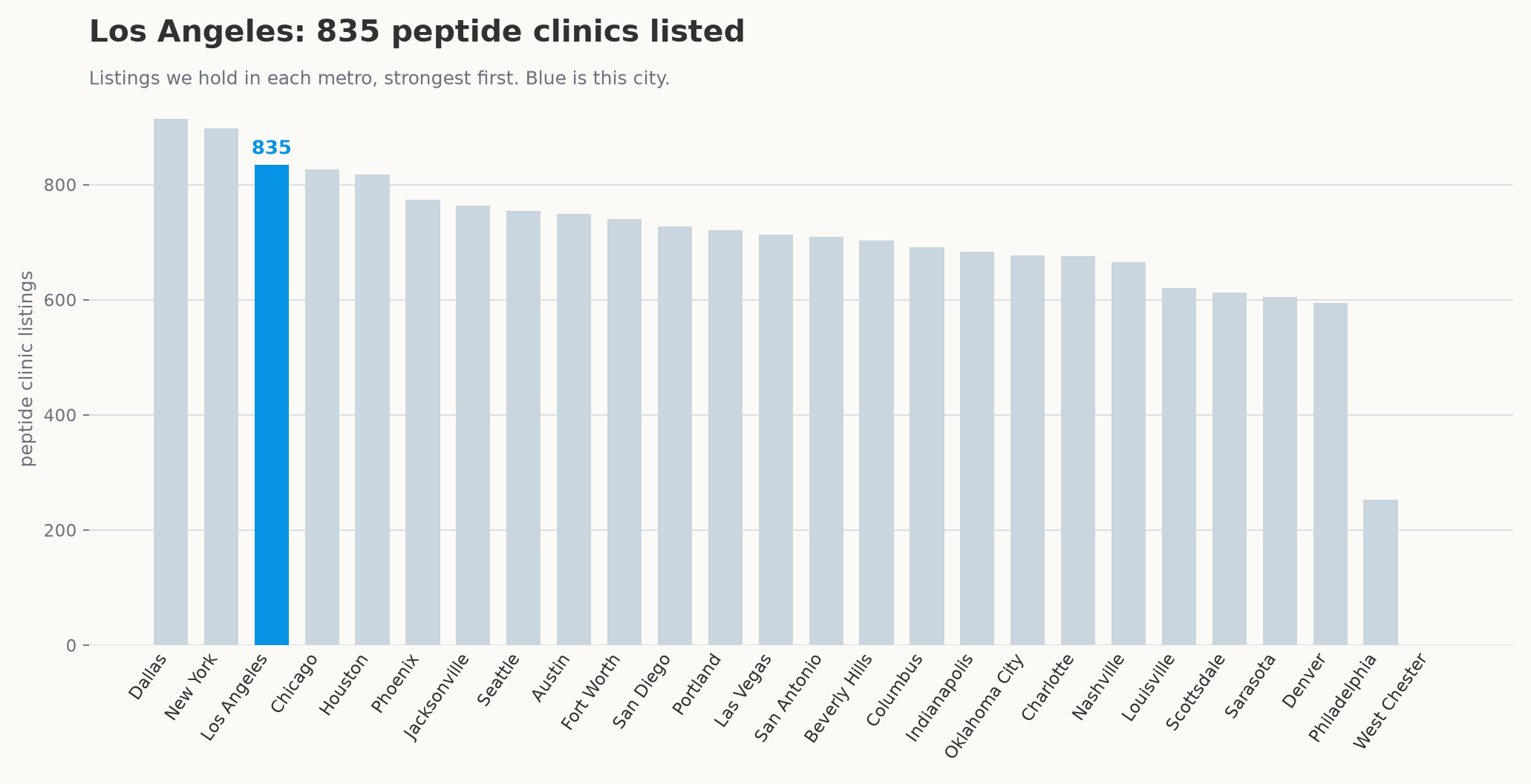
Los Angeles, California supports a crowded market for compounded peptides. A clinic in Westwood and a telehealth practice with a Santa Monica address can offer the same items: a prescription and a vial. Federal rules govern both.
Verification comes first. Ask for the prescriber's name, then check that name in the California Board of Medicine or Board of Nursing public license lookup. Ask which pharmacy compounds the peptide and whether that pharmacy holds a 503A or 503B registration. A prescription must precede dispensing. The FDA places some peptide ingredients on its Category 2 list, which restricts routine compounding, and most compounded peptides lack FDA approval for the use a clinic suggests.
Pay after those answers arrive. Ask what the evaluation includes and the total cost each month. Cost questions belong before payment, since a total can shift once a clinic adds consultation, shipping, or lab fees. A clinic that will not name its prescriber or its pharmacy gives you a reason to walk.
Who can prescribe peptides in California
A prescription must come from a licensed prescriber before a pharmacy dispenses a compounded peptide. That requirement starts with federal law, and California adds a licensing layer on top.
Patients in Los Angeles will meet one of three license types:
- **Physician (MD or DO).** A physician holds a license to practice medicine and can prescribe on their own authority.
- **Physician assistant (PA).** A PA works under a supervising physician and a written protocol that sets the scope of care.
- **Advanced practice registered nurse (APRN).** An APRN, including a nurse practitioner, also works under a supervising physician and a written protocol.
That third category deserves attention at your visit. The person who signs the prescription may hold a license type the clinic's marketing language blurs. Ask which license type the prescriber holds, and ask for the supervising physician's name when a PA or APRN writes the order.
You can confirm any of this through public lookups. The Medical Board of California publishes a license search for physicians and physician assistants. The Board of Registered Nursing publishes a lookup for APRNs and nurse practitioners. Search the prescriber's name, then compare license status, expiration date, and any public discipline record against the clinic's account.
Ask what the evaluation includes. An intake form paired with a payment screen falls short of a clinical exam, and a prescriber who skips a medical history cannot judge whether a peptide suits you. Ask which pharmacy compounds the drug, whether that pharmacy registers under 503A or 503B, and what the total monthly cost covers. Get those answers before you pay.
The compounding pharmacy question
Most peptides sold for human use do not carry FDA approval. A compounding pharmacy can prepare them under federal law. That law splits pharmacies into two tracks.
A 503A pharmacy compounds for a named patient. A prescriber writes a prescription before the pharmacy dispenses. The pharmacist prepares a dose for that person. State boards of pharmacy oversee 503A operations.
A 503B facility registers with the FDA as an outsourcing facility. It makes larger batches. It can ship a compounded drug without a patient-specific prescription, but a prescription still must come before a patient receives the drug. The FDA inspects 503B facilities under federal rules.
The FDA keeps a Category 2 list. The list names substances the agency considers unsuitable for compounding. A substance on that list may pose a safety risk or lack evidence. A pharmacy that compounds a listed peptide may face FDA action. The list changes, so check the FDA site for the version in force.
A compounded peptide lacks FDA approval as a drug. The agency approves a new drug application for a specific product. A compounded peptide lacks that review. This fact makes the pharmacy source central.
Ask the clinic which pharmacy fills the prescription. Then look up that pharmacy. In California, check the pharmacy's license with the state board of pharmacy. Check the prescriber's license in the state Board of Medicine or Board of Nursing public lookup. Ask what the evaluation includes and what the total cost each month is. Ask what happens if the pharmacy cannot fill the prescription. Ask if the pharmacy compounds the peptide or sends the prescription to another facility. Ask for the facility name and license number. Then check the state board and the FDA registration site. A clear answer tells you more than a marketing page.
Questions that separate clinics
The prescribing clinician's name and license number. Ask for both in writing, along with the license type and issuing state. A physician appears in the Medical Board of California public lookup, and a nurse practitioner appears in the Board of Registered Nursing lookup. Verify the number on the board site, then confirm the status reads active. A number that does not match the board record ends the conversation.
The compounding pharmacy and its registration type. Compounded peptides come from a 503A or 503B pharmacy. The FDA keeps a Category 2 list of ingredients it has flagged over safety or effectiveness questions, and several peptide ingredients appear on it. Ask the clinic to name the pharmacy and state the category it operates under. Then check that pharmacy's license with the state board.
The contents of the initial evaluation. Ask whether a licensed prescriber reviews the patient's history, current medications, and lab work before writing a prescription. Ask whether that visit happens by video or in person. Federal law requires a prescription before dispensing, so an order taken ahead of that evaluation signals a problem.
The reaction protocol. Ask for the phone number a patient calls after an adverse reaction, the hours someone answers, and whether the prescriber or a call center handles follow-up. Request that answer before the first dose. A clinic without a plan leaves the patient to arrange urgent care alone.
The total monthly cost. Ask for one figure that covers the consultation, the medication, shipping, and follow-up visits. Quotes vary by clinic and dose, so get the number in writing. A price that drops the follow-up visit hides part of the bill. Ask how the clinic bills a month when a patient pauses treatment.
What Los Angeles clinics get right and wrong
Los Angeles runs two clinic shapes, and the difference shows in who answers for a mistake.
The franchise men's-health model spreads one brand across the basin. Several storefronts, one corporate parent, a shared intake script. The visit runs short: a form, a questionnaire, a prescriber's signature. Convenience and a set price draw patients in. The follow-up question matters more. Staff at a franchise location follow corporate protocol, and the parent company owns the marketing budget and the intake script. A complaint about a compounded peptide meets a call center.
The physician-owned practice looks different. One doctor, one license, one address. Intake runs 30 to 60 minutes, and the prescriber asks about history and current medications. That costs time and a higher visit fee. It also puts the prescriber's name on the prescription. In California, that name sits in the Medical Board of California's public license lookup, and a complaint follows the record.
Accountability diverges at that point. A franchise answers to a corporate parent. A physician-owned practice answers to the state board that granted the license. A patient can read either record before booking.
Federal rules apply to both. A prescription must come before dispensing. The FDA holds compounded peptides outside the approval it grants to brand-name drugs, and the agency's Category 2 list names ingredients it deems unsuitable for compounding. Ask which pharmacy compounds the peptide, and ask what the total monthly cost includes. Ask whether that pharmacy holds a 503A or 503B registration. Those answers tell you more than the storefront does.
Red flags
Payment before evaluation. A clinic that asks for payment before a clinician evaluates you inverts the federal order. The FDA requires a prescription before a pharmacy dispenses a compounded peptide. A demand for payment before evaluation signals a sales pitch. A medical practice evaluates you before charging.
Guaranteed outcomes. No clinic can promise a specific result from a compounded peptide. The FDA has not approved most compounded peptides for any indication. A guarantee ignores that uncertainty. A prescriber who offers one acts as a seller.
No verifiable practice address. Ask for the street address. Check the prescriber's license in the state Board of Medicine or Board of Nursing public lookup. A post office box or a virtual office fails that test. A clinic with no physical location in Los Angeles leaves you no recourse.
Urgency pressure. A countdown timer pushes you past the evaluation step. Legitimate compounding pharmacies follow a prescription. A deadline that forces a decision before a medical visit serves the seller.
Refusal to name the pharmacy. Ask which pharmacy compounds the peptide. A 503A or 503B facility must appear on the FDA's list. A clinic that hides the source blocks your check of the FDA Category 2 list and the pharmacy's registration. That refusal ends the conversation.
What a legitimate Los Angeles clinic looks like
A clinic that sells compounded peptides operates under federal rules, and the first appointment should leave you holding paper and names.
Four items belong in your hand before you pay a second visit.
The prescriber's name and license number. Ask for both in writing. Then open the Medical Board of California license lookup and confirm the license is active. A nurse practitioner appears in the state Board of Nursing lookup. A prescriber who refuses to give a number is a stop sign.
A compounding pharmacy you can name. Federal law splits these pharmacies into 503A and 503B. Both dispense against a prescription, and a prescription comes first. Ask which pharmacy fills your order, then check whether the FDA placed that peptide on the Category 2 list. FDA adds and removes entries, so treat the list as a moving target.
A written plan with costs. The plan names the drug and the monthly total. Ask what the evaluation includes and what refills cost.
A phone number that reaches a person. Ask who answers when a dose goes wrong at night.
Frequently asked questions
Does California require a prescription for peptide therapy?
Federal law requires a prescription before a pharmacy dispenses a compounded peptide. California clinics fall under that federal rule. A clinic that offers peptides without a prescription violates federal law, and the pharmacy faces penalties.
How do I verify a Los Angeles clinic's license?
Ask the clinic for the prescriber's full name and license type. Then check that name in the Medical Board of California lookup or the Board of Registered Nursing lookup. A match confirms an active license and shows any public disciplinary record.
Are compounded peptides FDA-approved?
Compounded peptides do not hold FDA approval. The FDA approves finished drug products, and compounded preparations fall outside that approval path. The FDA Category 2 list identifies substances that raise safety concerns, and some peptides appear there, which limits 503A and 503B compounding.
Can a Los Angeles clinic prescribe peptides over a video call?
A Los Angeles clinic can prescribe a compounded peptide over a video call when the prescriber holds a California license and follows federal telemedicine rules. The evaluation must meet the same standard as an in-person visit, including a medical history and a review of current medications. Ask the clinic what the video evaluation includes and which pharmacy compounds the peptide.
What should peptide therapy cost in Los Angeles?
No single price covers peptide therapy in Los Angeles. Cost depends on the peptide, the dose, the pharmacy, and the evaluation fee. Ask for the total monthly cost in writing, including shipping, follow-up visits, and any lab work.