
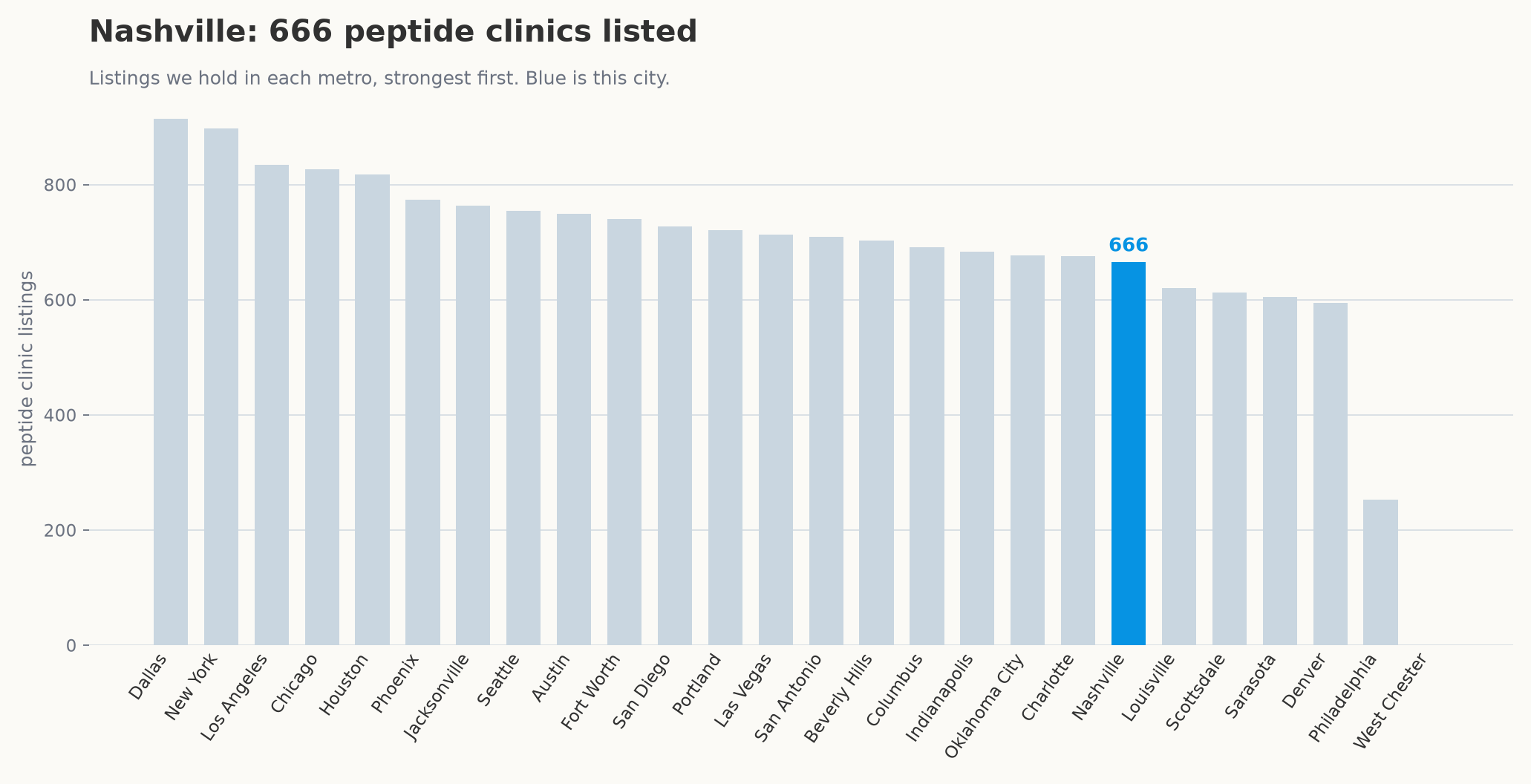
Nashville, Tennessee, search results for peptide clinics fill with sponsored links and map listings. Names such as gamedaymenshealth.com and vipweightlosscenters.com sit near the top of local queries. A ranking reflects ad spend and search optimization. It does not confirm who writes the prescription or who compounds the drug.
Verification comes before payment. Ask the clinic for the prescriber's full name, then check that name in the Tennessee Board of Medicine or Board of Nursing public license lookup. Ask which pharmacy compounds the peptide, and ask whether that pharmacy holds a 503A or 503B registration. Order the questions that way, because payment tends to arrive first in this market.
Federal law requires a prescription before a pharmacy dispenses a compounded peptide. The FDA places several peptides on its Category 2 list, a group of ingredients for which the agency questions compounding. Ask the license and pharmacy questions before you send money. The answers, or the lack of them, tell you whether to continue.
Who can prescribe peptides in Tennessee
A prescription for a compounded peptide comes from a licensed prescriber. Federal law requires that a prescription precede the dispensing of a compounded drug. Tennessee clinics staff three license types that can write one.
Physician (MD or DO). A medical doctor or a doctor of osteopathic medicine holds a full license from the state Board of Medicine. This prescriber evaluates you and writes the prescription without a supervising provider.
Physician assistant (PA). A PA holds a license from the state Board of Medicine and practices under a supervising physician. The physician and the PA work from a written protocol that sets the scope of care.
Advanced practice registered nurse (APRN). An APRN holds a license from the Tennessee Board of Nursing. An APRN practices under a supervising physician and a written protocol.
Confirm which license type will see you. Ask for the prescriber's name, then check that name in the public license lookup at the state Board of Medicine or the Board of Nursing. That lookup shows the license type, the status, and the expiration date.
Ask what the evaluation includes. A history, a review of your medications, and a conversation about goals belong in it. Ask which pharmacy compounds the peptide and whether that pharmacy holds a 503A or 503B registration.
A clinic that declines to name its prescriber gives you a reason to look elsewhere. The license check takes minutes and answers a plain question: does the person writing your prescription hold an active Tennessee license?
The compounding pharmacy question
Most peptides sold at clinics in Nashville do not carry FDA approval. A small number hold approval as finished drugs. The rest come from a compounding pharmacy, which makes them under federal law with conditions attached.
Two pathways exist. A 503A pharmacy compounds for a patient with a prescription in hand. A prescriber writes for a named person, the pharmacist reviews the order, and the state board of pharmacy licenses the work. A 503B facility registers with the FDA as an outsourcing facility. It makes larger batches, follows federal current good manufacturing practice rules, and reports adverse events to the agency. Some 503B products reach patients without a patient-specific prescription, though a prescription still precedes dispensing.
The FDA keeps a Category 2 list. The agency places a substance there when it sees a safety problem or a copy of an approved drug, and it treats those substances as unsuitable for compounding. A pharmacy that compounds a Category 2 substance works outside federal guidance. The FDA revises the list as evidence changes, so check the version in force today. The agency posts that list on its website.
Ask one question before you pay. Request the name of the pharmacy that fills the prescription, plus the state where it holds a license. Then look it up. The state board of pharmacy publishes a license lookup, and the FDA publishes a list of registered 503B facilities. Two records, two checks. Ask the pharmacy which pathway it holds, 503A or 503B. A clinic that declines to name the pharmacy gives you nothing to check.
What Nashville clinics get right and wrong
Two shapes dominate this market.
Franchise men's-health clinics run a repeatable playbook across several cities. Scheduling is quick, and pricing runs as a membership. The corporate parent sets the protocol, and the prescriber works inside it. That structure delivers convenience. It also puts distance between the patient and the person who signs the prescription. A patient with a complaint reaches a call center first.
Physician-owned practices move at a different pace. Intake takes longer, sometimes two visits, and the prescriber reads the chart before writing anything. The trade is speed for contact.
Accountability separates them. A franchise answers to a corporate parent and to franchisees who bought a territory. A physician-owned practice answers to the state board that issued the license. Tennessee's Board of Medical Examiners and Board of Nursing both publish a free lookup. Search the prescriber's name. A corporate clinic can staff a rotating roster, and the name on the prescription may differ from the name on the website.
Federal rules apply to both. A prescription must precede dispensing, and the FDA Category 2 list limits which bulk substances a 503A or 503B pharmacy may compound. Those constraints hold regardless of business model.
Both models share one flaw: neither guarantees a peptide carries FDA approval. Ask which pharmacy compounds, and ask the monthly total.
Red flags
Payment before evaluation. Federal law requires a prescription before a pharmacy dispenses a compounded drug. A clinic that charges your card before a licensed prescriber reviews your history has the sequence backward. Ask what the evaluation includes before you pay.
Guaranteed outcomes. The FDA has approved some peptides for specific uses and placed other ingredients on its Category 2 list. A clinic that promises a set result sells certainty it cannot support. Ask for the dose and the source.
No verifiable address. Ask for the street address, then check the prescriber's license in the Tennessee Board of Medical Examiners or Board of Nursing public lookup. Tennessee licenses physicians, and that lookup costs nothing. A practice that lists a mailbox suite, or lists no address, blocks the check.
Urgency pressure. A countdown timer or a discount that expires the same day compresses a medical decision into a sales deadline. Compounding rules follow the FDA's schedule. A clinic's countdown does not change that.
Refusal to name the pharmacy. Ask which pharmacy compounds the drug, and whether that pharmacy holds a 503A or 503B registration. A clinic that declines to answer keeps you from checking the pharmacy's state license.
What a legitimate Nashville clinic looks like
A first appointment should end with paper in hand. Four items belong in it.
The prescriber's name and license number. Write both down. Then check the license in the Tennessee Board of Medical Examiners or Board of Nursing public lookup, whichever matches the clinician's credential. A prescription must come before any dispensing, so the name on the order should match the name on the license.
A compounding pharmacy you can look up. Federal law splits compounders into 503A and 503B registrations. Ask which one fills the order, then confirm that registration. A clinic that declines to name the pharmacy leaves you with no way to check.
A written plan with costs. The plan should list the drug, the dose, the visit schedule, and the monthly total. Ask whether lab work and follow-up visits sit inside that number.
A way to reach a person when something goes wrong. Get a phone number that a clinician answers, plus instructions for after hours. Test the number before you leave the parking lot. A voicemail box and an email form are not enough.
Uncertainty exists at each step. Ask anyway.