
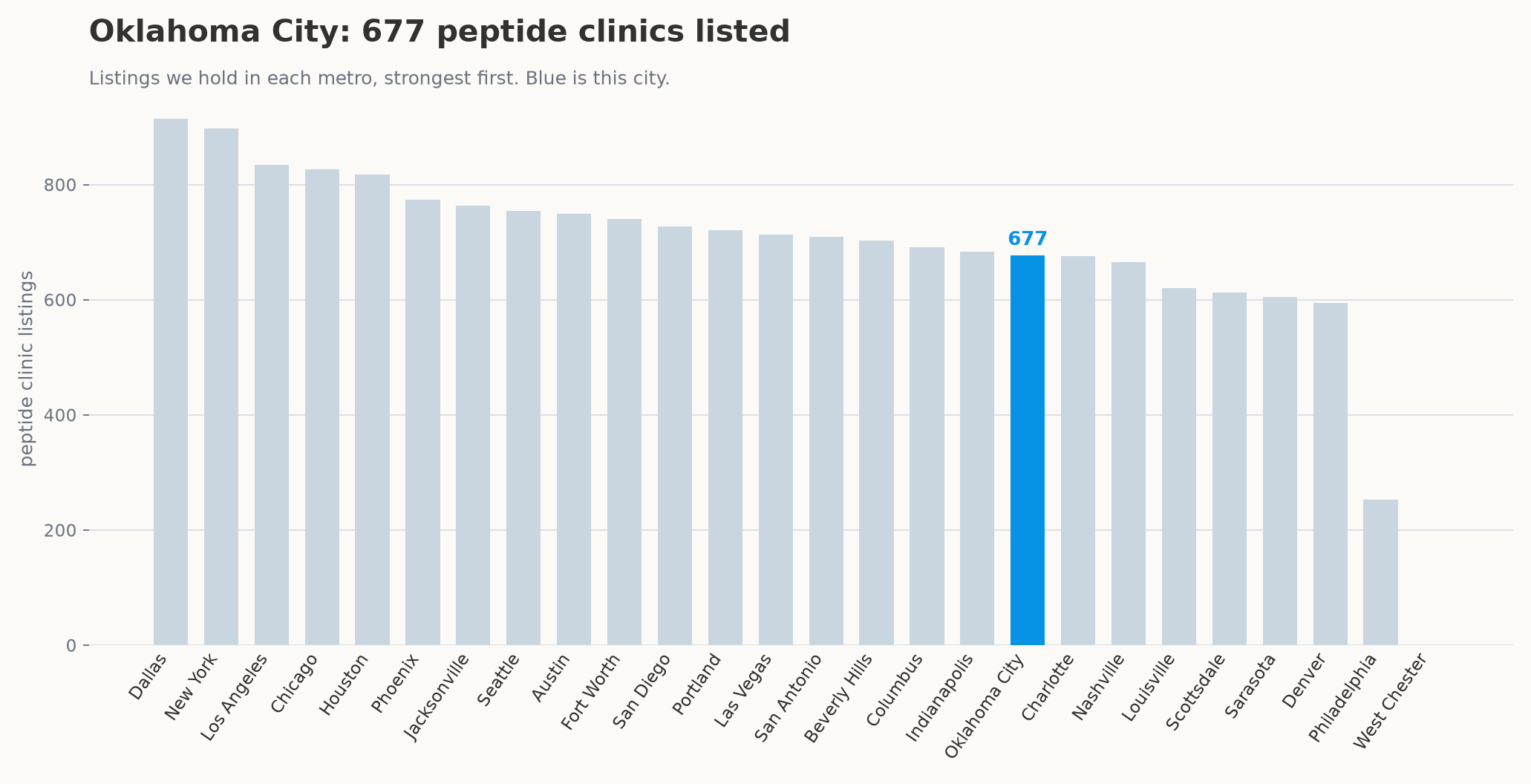
People in Oklahoma City, Oklahoma, who search for peptide clinics meet a crowded field. gamedaymenshealth.com, healingmaps.com, venturisclinic.com, kbanorman.com, and mypeptidematch.com all compete for that attention. Rankings show who markets well. They say little about who verifies a prescription before taking a card number.
One rule governs this market: confirm the clinician and the pharmacy before you pay. Ask for the prescriber's name, then check that license in the state Board of Medicine or Board of Nursing public lookup. Ask which pharmacy compounds the peptide and whether that pharmacy holds a 503A or 503B registration. Ask what the evaluation includes and what the total monthly cost covers.
Federal law adds context. The FDA has not approved compounded peptides as drugs, and several appear on the FDA Category 2 list, which restricts compounding. A prescription must precede dispensing. A clinic that collects payment first and answers these questions second gives you a reason to pause.
The compounding pharmacy question
Semaglutide and tirzepatide hold FDA approval. Many other peptides sold for wellness do not. A clinic in Oklahoma City can still offer those peptides, because federal law lets a compounding pharmacy prepare a drug for a patient who holds a prescription. That path carries limits, and the limits matter.
Two federal sections govern this work. A 503A pharmacy compounds for an identified patient. It needs a prescription before it dispenses. A 503B facility registers as an outsourcing facility. It makes larger batches and can ship without a patient-specific prescription, though the FDA inspects it and lists it in a public registry. Ask which type fills your order.
The FDA keeps a Category 2 list. This list names substances the agency considers unsuitable for compounding, often because of safety risk or because a commercial version exists. A pharmacy cannot compound a Category 2 substance through the standard route. The FDA also removed semaglutide and tirzepatide from its shortage list, a step that closed the standard compounding route for those drugs. Check the Category 2 list at fda.gov before you pay.
Then ask the clinic one direct question: which pharmacy fills the prescription? Write down the name. Visit the state Board of Pharmacy public lookup for that state and confirm the license stands active. Call the pharmacy and ask whether it holds a 503A or 503B registration.
Ask for the prescriber's name and license number too. Check the state Board of Medicine or Board of Nursing public lookup where that person practices.
A prescription should come first. A clinic that sells peptides before an evaluation, or that cannot name its pharmacy, gives you a reason to pause. Legitimate operations answer these questions without hesitation.
Questions that separate clinics
Does the clinic name the prescriber and the state license number?
Ask for the full name and the license number before you pay. Check that number in the state board of medicine or board of nursing public lookup for Oklahoma. A clinic that stalls on this detail gives you a reason to keep calling.
Does the clinic name the pharmacy, and is it 503A or 503B?
Compounded peptides come from pharmacies registered under one of two federal sections. A 503A pharmacy fills prescriptions for patients one at a time; a 503B outsourcing facility works at a larger scale under different FDA rules. Ask which one sends your medication, and ask whether that pharmacy appears on the FDA Category 2 list.
Does the initial evaluation include a medical history, lab work, and a visit with the prescriber?
Ask what a typical first appointment covers and how long it takes. A prescription must come before any dispensing, so the evaluation is a required step. Ask whether the clinic reviews your current medications and conditions during that visit.
Is there a written plan for a reaction, and can you reach a clinician after hours?
Ask who answers the phone at night and on weekends. Ask for the process in writing, including the phone number and the expected response time.
Does the total monthly cost include the consultation, the medication, and follow-up?
Ask for one number that covers all three. Prices for compounded peptides vary by dose, pharmacy, and refill schedule, so a quote for the first month alone tells you little. Request the figure in writing.
What Oklahoma City clinics get right and wrong
Two business shapes dominate the metro. One is the franchise men's-health model, a brand with locations in several cities, a central marketing team, and a scripted intake. The other is a physician-owned practice, often one office, where the prescriber runs the visit and sets the pace.
The franchise gets speed right. Scheduling is easy and the pitch stays consistent. The trade-off sits in accountability. A franchise answers to a corporate parent, and a complaint travels through a call center before it reaches a clinician. A patient who asks which pharmacy compounds the peptide may hear a corporate script.
The physician-owned practice gets intake right. A longer visit leaves room to review history and current medications. The prescriber holds the state license, so the decision to write a prescription carries personal weight. Ask the front desk a direct question and you reach the person who signs the chart.
Both models operate under the same federal rules. A prescription must come before a pharmacy dispenses a compounded peptide, and pharmacies that compound fall under section 503A or 503B. The FDA Category 2 list names bulk substances the agency says may not be used in compounding. Compounded peptides without FDA approval sit outside the approved drug pathway, and that status is worth saying out loud.
Vetting takes four questions. Ask which pharmacy compounds the drug. Ask who holds the state license and check that name in the state Board of Medicine or Board of Nursing lookup. Ask what the evaluation includes, and ask the total monthly cost.
Red flags
Payment before evaluation. Federal law requires a prescription before a pharmacy dispenses a compounded peptide. A clinic that charges first and screens later reverses that sequence. Ask for the evaluation before you pay. A subscription receipt does not replace a clinical visit.
Guaranteed outcomes. No compounded peptide holds FDA approval. Semaglutide and tirzepatide appear on the FDA Category 2 list, which names substances with known safety risks. A promise of results ignores that listing.
No verifiable practice address. Look up the prescriber's state license in the Oklahoma Board of Medical Licensure and Supervision or the Oklahoma Board of Nursing public lookup. The first licenses physicians; the second licenses advanced practice nurses. An address that fails to appear there or on a map deserves a pause.
Urgency pressure. A countdown timer or a same-day discount pushes a decision. Care allows time to read the consent form and ask about the pharmacy. A clinic that demands an answer within minutes shows its priorities.
Refusal to name the pharmacy. Ask which pharmacy compounds the drug and whether it registers as a 503A or 503B facility. A 503B outsourcing facility follows federal sterility rules. A clinic that declines to answer blocks your check. Ask for the name in writing.
What a legitimate Oklahoma City clinic looks like
A patient leaves a first appointment with four items.
First, the prescriber's name and state license number. Oklahoma licenses physicians through the State Board of Medical Licensure and Supervision and nurses through the Oklahoma Board of Nursing. Both boards publish a lookup a patient can search. Ask for the number, then use it.
Second, the name of the compounding pharmacy. Federal rules under section 503A and 503B separate these pharmacies, and each operates under different oversight. A clinic that names its pharmacy lets a patient check that pharmacy's license and inspection record.
Third, a written plan with costs. Ask for the monthly total in writing, including the consultation, the medication, and any shipping or follow-up fee. The FDA places several peptides on its Category 2 list, which restricts compounding. A clinic states the status of the specific peptide.
Fourth, a phone number or portal for problems. Side effects, a shipment delay, or a dosing question need a route to a person who answers.
A prescription must precede any dispensing. A clinic that skips that step fails the test.
Frequently asked questions
Does Oklahoma require a prescription for peptide therapy?
Yes. Federal law under sections 503A and 503B requires a prescription before a pharmacy dispenses a compounded peptide. Oklahoma adds its own medical and pharmacy rules, so confirm the details with the Oklahoma State Board of Medical Licensure and Supervision. A clinic that sells peptides without a prescription violates federal law.
How do I verify an Oklahoma City clinic's license?
Ask for the prescriber's name and license number. Then search the Oklahoma State Board of Medical Licensure and Supervision public lookup for physicians, or the Oklahoma Board of Nursing lookup for nurse practitioners. Confirm the license status and any public discipline record. A clinic that refuses to share this information warrants caution.
Are compounded peptides FDA-approved?
No. The FDA approves finished drug products. Compounded preparations fall outside that approval process. Some peptides appear on the FDA Category 2 list, which restricts compounding. Check the FDA's list for the specific peptide your clinic recommends.
Can an Oklahoma City clinic prescribe peptides over a video call?
A clinic can prescribe over a video call if the prescriber holds an Oklahoma license and follows state telemedicine rules. The evaluation must meet the same standard as an in-person visit. Federal law allows telehealth for non-controlled prescriptions, though state rules vary. Ask the clinic which prescriber will review your case.
What should peptide therapy cost in Oklahoma City?
Costs vary by peptide, dose, and pharmacy. Ask the clinic for the total monthly price, including the consultation, the compounded medication