
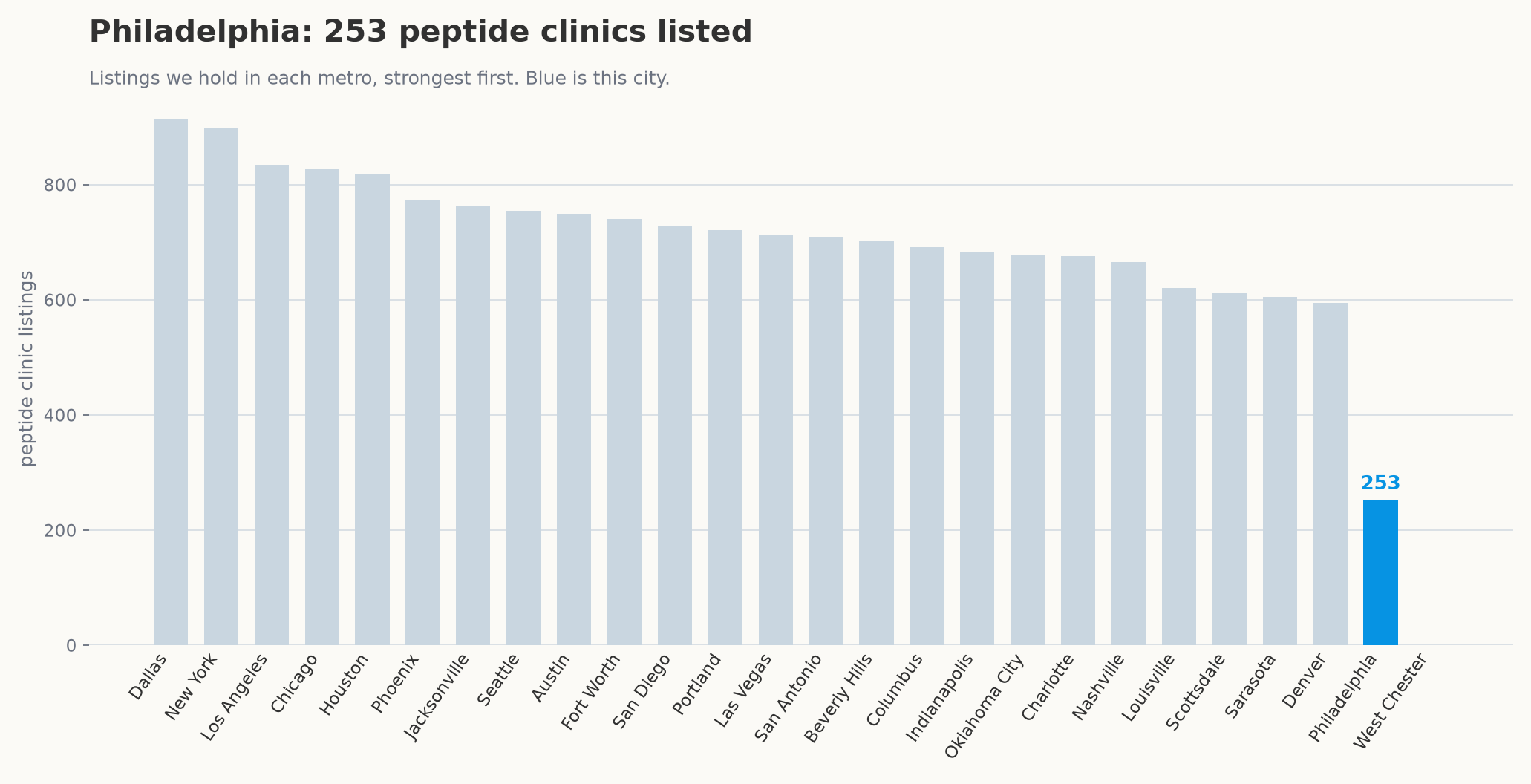
A search for peptide clinics in Philadelphia, Pennsylvania returns pages of results. Anti-aging practices and telehealth sites compete for the same click. The listings look polished. The credentials behind each one differ.
One step separates a clinic worth your money from a costly mistake: verification before payment. Check the prescriber's state license in the Pennsylvania Board of Medicine or Board of Nursing public lookup. Confirm which pharmacy compounds the peptide. Ask whether that pharmacy holds a 503A or 503B registration. That lookup takes two minutes.
The FDA places several peptides on its Category 2 list, and that listing restricts compounding. Federal law requires a prescription before a pharmacy dispenses. Ask what the evaluation includes, who performs it, and the total monthly cost. Then ask for the pharmacy's name in writing. A clinic answers those questions with documents. A seller answers with urgency and a countdown.
Who can prescribe peptides in Pennsylvania
A prescription for a compounded peptide must come from a licensed prescriber. Federal law requires that prescription before any pharmacy dispenses the drug. The FDA places several peptides on its Category 2 list, which restricts compounding, so the prescriber's identity and license matter.
Patients in Philadelphia will meet one of three license types.
A physician holds an MD or a DO. Physicians prescribe without a supervising provider and carry full responsibility for the order.
A physician assistant holds a PA license. In Pennsylvania, a physician assistant practices under a supervising physician and a written agreement that sets the scope of care.
An advanced practice registered nurse holds an APRN license. A nurse practitioner is the APRN most patients meet in this setting. An APRN works under a supervising physician and a written collaborative protocol that names the drugs each can prescribe.
Confirm which license type you will see. Ask the clinic for the full name and license number of the person who reviews your history and signs the prescription. A clinic that names a job title but withholds a license number has given you nothing to check.
Then verify the license. The Pennsylvania Board of Medicine publishes a public lookup for physicians and physician assistants. The Board of Nursing publishes a separate lookup for advanced practice registered nurses. Search the name, confirm the license status, and note the expiration date. A lapsed or restricted license changes the picture.
The same rule applies at clinics across the city. The person who signs the prescription must hold a current Pennsylvania license, and you can check that record in a few minutes.
The compounding pharmacy question
A clinic in Philadelphia can offer a peptide that carries no FDA approval. A compounding pharmacy made the vial behind it, and federal law sets the rules for that work.
Most peptides on these menus sit outside the approval pathway. The FDA has approved a small set for specific uses. The rest reach patients through compounding.
Federal law gives compounding pharmacies two routes.
A 503A pharmacy compounds for a named patient. A prescriber writes a prescription first, and the pharmacy prepares the drug after that. State boards of pharmacy license these operations. Batch size stays small and tied to that prescription.
A 503B facility registers with the FDA as an outsourcing facility. It follows current good manufacturing practice and can produce larger batches, sometimes without a patient-specific prescription. Hospitals buy from 503B facilities during drug shortages. The FDA publishes a registration list.
The FDA also keeps a Category 2 list. This list names bulk drug substances the agency considers unsuitable for compounding, based on safety risk or missing evidence. A pharmacy that compounds from a Category 2 substance steps outside the federal framework. Ask whether the peptide's ingredient appears there.
Three items to request from the clinic:
- The name of the pharmacy that compounds the peptide.
- Whether that pharmacy operates under 503A or 503B.
- The status of the bulk substance on the FDA Category 2 list.
Then verify. Pennsylvania's Board of Pharmacy maintains a public license lookup for the pharmacy and its pharmacist. The FDA's outsourcing facility list confirms 503B registration. A clinic that answers with a name and a license number gives you something to check. A vague answer leaves you with nothing.
Questions that separate clinics
The prescriber's name and license number. Ask for the full name of the clinician who signs the prescription, plus the license number and the state that issued it. Pennsylvania runs a public lookup through the Board of Medicine and the Board of Nursing, and you can confirm the record yourself. A clinic that answers with a supervising physician's name instead of the treating clinician's has given you half an answer.
The compounding pharmacy and its registration type. Ask which pharmacy fills the order and whether it operates under Section 503A or Section 503B of the federal Food, Drug, and Cosmetic Act. The two categories carry different oversight, and the FDA keeps a Category 2 list of bulk drug substances that raise safety concerns. Ask for the pharmacy name, then ask the clinic to repeat it in writing.
The initial evaluation. Ask what happens during the visit: a physical exam and lab work, or a questionnaire alone. Ask who conducts it. The scope of the evaluation tells you what the prescriber knows before signing anything.
The plan for a reaction. Ask who answers the phone if a patient develops a side effect, and the expected response time. Ask whether the clinic documents the event and reports it to the pharmacy or to MedWatch, the FDA's adverse event program. Get the protocol in writing.
The total monthly cost. Ask for one figure that covers the consultation, the medication, and follow-up visits. A clinic that quotes a medication price alone leaves the rest for later invoices. Request the number in writing before you pay.
What Philadelphia clinics get right and wrong
Two shapes dominate the Philadelphia market.
The first is the franchise men's-health clinic. A corporate parent operates locations in several cities, and the Philadelphia branch follows a shared script: short intake, membership fee, set menu of peptides or testosterone. This model moves people through a queue. It also produces consistency. A patient who travels to another city finds the same paperwork and the same price sheet.
The second is the physician-owned practice. One prescriber, or a small group, runs the clinic. Intake takes longer because the prescriber reads the chart. Scheduling bends around that person's calendar. Wait times stretch. The tradeoff is that the clinician who evaluates you also signs the prescription.
Accountability splits along the same line. A franchise answers to a corporate parent. A complaint lands in a customer service queue. A physician-owned practice carries the prescriber's state license, which sits in the state Board of Medicine or Board of Nursing public lookup. A complaint lands there.
Both shapes can serve patients. Both can fall short. The verifiable difference sits in who holds the risk. Ask which pharmacy compounds the drug. Ask which clinician signs the prescription. Confirm that license in the state lookup. Federal law requires a prescription before a pharmacy dispenses a compounded peptide, and the FDA Category 2 list restricts compounding for several peptides. A clinic that answers those questions in plain terms earns trust. A clinic that deflects them gives you a reason to keep looking.
Red flags
A clinic that collects payment before an evaluation inverts the order of care. Federal rules require a prescription before a pharmacy dispenses a compounded peptide, and a prescriber writes that prescription after an evaluation. Ask what the visit covers and when the charge posts.
Guaranteed outcomes signal a sales script. Medicine works in ranges and probabilities. A licensed prescriber describes expected results and known risks. A promise of a fixed result or a fixed timeline tells you the pitch outruns the evidence.
A verifiable practice address matters. Check the prescriber's state license in the Board of Medicine or Board of Nursing public lookup. Compare that address to a map and a business registry. A mailbox suite or a building with no suite number invites a question.
Urgency pressure compresses the time you need to think. Countdown timers and same-day pricing serve the seller. Legitimate care allows a second visit and a second opinion.
Refusal to name the pharmacy blocks the last check. Ask which 503A or 503B pharmacy compounds the peptide, then confirm that pharmacy's registration with the FDA. A clinic that hides the source removes your ability to verify it.
What a legitimate Philadelphia clinic looks like
Pennsylvania licenses prescribers through the State Board of Medicine and the State Board of Nursing. Both boards publish a free lookup where a patient types a name and reads the license status. A clinic that hesitates on that step gives a patient a reason to pause.
Four items belong in your hand before you leave the first appointment.
1. The prescriber's full name and license number, so you can confirm the record yourself.
2. The name of the compounding pharmacy that fills the order, so you can check its registration and its history.
3. A written plan that lists the drug, the dose, the schedule, and the total cost per month. Compounded peptides sit outside FDA approval, and the FDA Category 2 list restricts several of them. Ask whether the pharmacy holds a 503A or 503B registration.
4. A phone number or portal that reaches a person when a dose causes a problem.
Federal law requires a prescription before any dispensing. A clinic that sells peptides without an evaluation describes a different arrangement.
Frequently asked questions
Does Pennsylvania require a prescription for peptide therapy?
Yes. Federal law requires a valid prescription before a 503A or 503B pharmacy compounds a peptide for a patient. Pennsylvania licenses prescribers through the Board of Medicine and the Board of Nursing, and a clinic that sells peptides without a prescription from a licensed prescriber operates outside federal rules.
How do I verify a Philadelphia clinic's license?
Look up the prescriber's name in the state Board of Medicine or Board of Nursing public license lookup, then check the license status and any disciplinary record. Ask which licensed provider will review your intake, and confirm that provider holds an active Pennsylvania license. A clinic that dodges these questions warrants caution.
Are compounded peptides FDA-approved?
No. The FDA does not approve compounded peptides as finished drugs, and it places some peptides on its Category 2 list of ingredients with safety or effectiveness concerns. Compounding rules shift, so ask the clinic which peptides it can source and under what authority.
Can a Philadelphia clinic prescribe peptides over a video call?
A telehealth visit can lead to a prescription when a licensed Pennsylvania prescriber reviews your history and decides the treatment fits. Federal rules permit a prescriber to issue a prescription after a telehealth evaluation in defined situations, and those rules change. Confirm whether a Pennsylvania-licensed provider runs the evaluation or a staff member handles intake.
What should peptide therapy cost in Philadelphia?
No standard price exists. Total monthly cost depends on the peptide, the dose, the pharmacy, and whether the fee covers the evaluation, the medication, or shipping. Ask for a written breakdown of the consultation fee, the compounding pharmacy charge, and any refill cost before you pay.