
Peptide clinic searches no longer stop at weight loss. Patients now see clinic pages, YouTube videos, and ads around hair, skin, injury recovery, longevity, libido, and men’s health. Some of that interest points to serious research. Some of it points to marketing that moves faster than human evidence.
Use this guide as a claim-checking map before you book a consult. It does not recommend a peptide, medication, clinic, pharmacy, or treatment plan. It shows you which questions to ask when a clinic talks about peptides beyond weight management.
Quick definitions before you compare clinics
| Term you may see | Plain meaning | Verification question |
|---|---|---|
| Peptide | A short chain of amino acids. Some peptides are FDA-approved drugs. Many wellness-market peptides are research or compounded-drug topics. | Is the clinic discussing an FDA-approved drug, a compounded drug, a supplement, or a research-stage substance? |
| Compounded drug | A medication made for a patient when an approved drug cannot meet a medical need. FDA says compounded drugs are not FDA-approved. | Which licensed pharmacy prepares it, and why is compounding clinically appropriate for this patient? |
| 503A / 503B | Two different federal compounding frameworks. A 503A pharmacy compounds for individual prescriptions. A 503B outsourcing facility follows a different federal model. | Which model applies here, and who can explain the pharmacy path before payment? |
| Evidence map | A way to separate cell, animal, early human, randomized trial, and approved-label evidence. | Which level of evidence supports this exact claim? |
Demand signals FPC is tracking
YouTube and search data show where patient demand is moving. FPC uses those signals to decide which consumer guides to build. We do not treat viral videos as medical proof.
| Topic | Recent demand signal | Safer FPC angle |
|---|---|---|
| Hair and skin | High interest around copper peptides, collagen peptides, serums, and hair-loss language. | Compare topical, oral, and injectable claims separately. Ask whether human evidence supports the exact product and route. |
| Recovery and injury | Active interest around BPC-157, TB-500, collagen peptides, and athletic recovery. | Separate nutrition-support evidence from unapproved injectable peptide claims. |
| Longevity | Clinic and influencer language around MOTs-C, Epitalon, DSIP, and “anti-aging” programs. | Ask for human clinical evidence, U.S. regulatory context, and the clinic’s medical follow-up plan. |
| Men’s health | Search and video interest around PT-141, bremelanotide, libido, and erectile dysfunction. | Check the FDA-approved label, the sex-specific indication, and whether the clinic is drifting into performance claims. |
Evidence map by claim area
A clinic should be able to show the level of evidence behind the claim it makes. A study from another country can add useful context. It does not prove that a U.S. clinic can offer the same thing, use the same product, or promise the same outcome.
| Claim area | Published evidence context | How to read it before booking |
|---|---|---|
| Skin hydration and wrinkles | Korean, Japanese, and France/Japan-affiliated randomized studies have examined oral collagen peptides and skin measures. Examples include Nutrients PMID 29949889, Journal of Medicinal Food PMID 36516059, Skin Pharmacology and Physiology PMID 33774639, and Journal of Cosmetic Dermatology PMID 26362110. | Ask whether the clinic means oral collagen nutrition, topical cosmetic use, or an injected peptide. Do not let a skin-supplement study get reused as proof for an injection program. |
| Hair growth | A Korean in-vitro study examined a tripeptide-copper complex and human hair growth mechanisms, PMID 17703734. Our copper-peptide hair-loss evidence guide separates what that laboratory study found from what it cannot prove in patients. FDA also flags injectable GHK-Cu in its safety-risk table because limited human data inform safety for injectable routes. | Ask whether the clinic discusses topical cosmetic use, research evidence, or an injectable service. Route matters. |
| Joint pain and active adults | A U.S. 24-week study examined collagen hydrolysate supplementation in athletes with activity-related joint pain, PMID 18416885. | Collagen nutrition studies do not prove BPC-157 or TB-500 recovery claims. Ask the clinic to identify the specific molecule and human study behind the exact claim. |
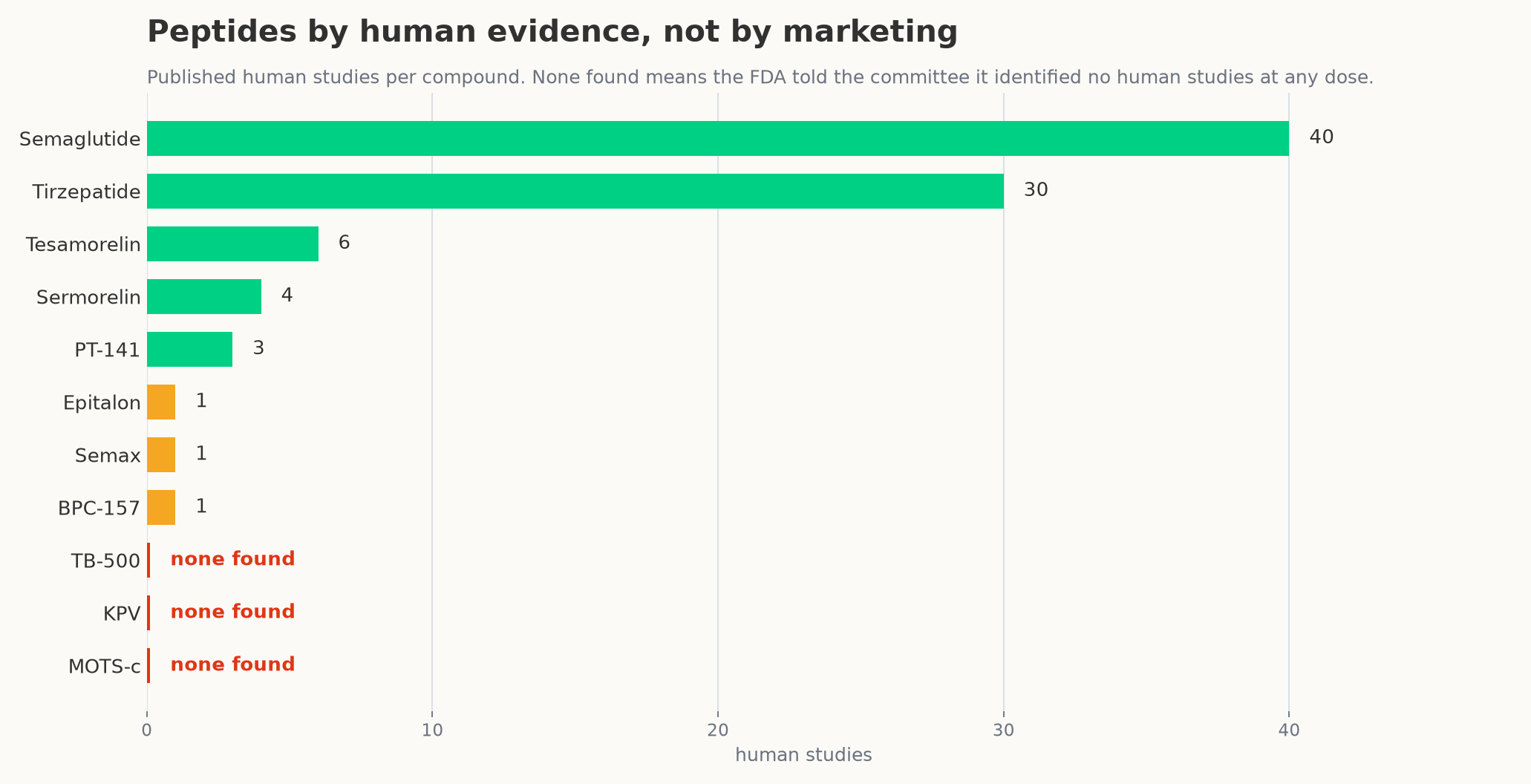
| BPC-157, TB-500, KPV, MOTs-C | FDA’s July 23, 2026 Pharmacy Compounding Advisory Committee agenda lists BPC-157, KPV, TB-500, and MOTs-C bulk substances for discussion under the 503A Bulks List process. | A scheduled FDA committee discussion is not approval. Ask what the clinic can legally offer today, what evidence exists in humans, and who monitors safety. |
| Men’s sexual wellness | FDA-approved bremelanotide labeling is for acquired, generalized HSDD in certain premenopausal women, and the label says it is not for men or sexual performance. Older male ED studies exist, including U.S. PT-141 work PMID 14963471 and an Iran study in sildenafil nonresponders PMID 18206919. A U.K. randomized trial examined kisspeptin in men with HSDD, PMID 36735255. | Ask whether the clinic is discussing an approved indication, off-label care, or research context. Be careful with ads that turn early studies into performance promises. |
| Longevity and anti-aging | FDA’s PCAC agenda lists MOTs-C for obesity and osteoporosis review context and Epitalon-related substances for insomnia review context. Other longevity language often comes from cell, animal, or review literature. | Ask for human clinical evidence, not “anti-aging” language. Ask what outcome the clinic measures and how it handles risk. |
Regulatory checks to run before you pay
| Check | Source | Question for the clinic |
|---|---|---|
| Compounded-drug status | FDA’s Compounding and the FDA Q&A | Why does this patient need a compounded drug instead of an FDA-approved option? |
| Bulk-substance safety context | FDA’s significant safety risks page | Does the clinic offer any substance FDA has flagged for limited safety data or peptide-related impurity concerns? |
| Upcoming peptide review | FDA’s July 23-24, 2026 PCAC calendar | Is the clinic using committee-review language as if FDA has already approved something? |
| Doctor license | FSMB DocInfo and the relevant state medical board | Who is the responsible licensed clinician, and where can you verify the license? |
| Pharmacy safety | NABP Buy Safely | Will the clinic name the pharmacy and explain whether it is licensed in the required jurisdictions? |
What a serious clinic should disclose
A clinic that handles peptide, longevity, recovery, or hormone-adjacent care should explain the medical process before it asks you to pay. Look for plain answers to these questions:
- Who reviews the intake and medical history?
- Which state license covers the clinician responsible for care?
- Which claims come from FDA-approved labeling, and which come from research context?
- Which published human studies support the exact use, route, and patient group?
- Which pharmacy prepares or dispenses the medication if a prescription fits?
- Who answers side-effect, lab, follow-up, and discontinuation questions?
- Does the clinic decline patients who do not fit the care model?
Strong clinics can answer without turning the consult into a product pitch. If the answer depends on “everyone gets approved” language, slow down.
Compare clinics by city
Peptide clinic quality varies by market. Use the city page closest to you, then apply the evidence and disclosure questions above.
- Austin peptide clinics
- Beverly Hills peptide clinics
- Charlotte peptide clinics
- Chicago peptide clinics
- Columbus peptide clinics
- Dallas peptide clinics
- Denver peptide clinics
- Fort Worth peptide clinics
- Houston peptide clinics
- Indianapolis peptide clinics
- Jacksonville peptide clinics
- Las Vegas peptide clinics
- Los Angeles peptide clinics
- Louisville peptide clinics
- Nashville peptide clinics
- New York peptide clinics
- Oklahoma City peptide clinics
- Philadelphia peptide clinics
- Phoenix peptide clinics
- Portland peptide clinics
- San Antonio peptide clinics
- San Diego peptide clinics
- Sarasota peptide clinics
- Scottsdale peptide clinics
- Seattle peptide clinics
Related FPC guides
- Hair loss clinic near me: what copper-peptide evidence shows
- How to check a peptide clinic before you book
- Peptide clinic vs med spa: what to check
- Questions to ask before paying for a peptide clinic consultation
- GLP-1 clinic near me: what to check before you book
- Peptide therapy near me: how to compare clinics before you book