
A clinic that says it uses a 503A compounding pharmacy for peptides has given you a starting point, not proof that a product is FDA-approved or that an active ingredient qualifies for compounding. Ask for the exact pharmacy, prescription, substance, and supporting records before you pay.
Section 503A covers patient-specific compounding when its conditions are met. FDA does not review each compounded drug for safety, effectiveness, or quality before it reaches a patient. The checks below help you separate a documented patient-care pathway from a label that carries no usable proof.
Editorial review: Find Peptide Clinics Editorial Desk. Federal compounding sources and public verification links checked August 16, 2026. No clinician reviewer is named for this article.
The one-page 503A pharmacy decision tree
| Gate | Evidence to request | Proceed when | Stop and verify when |
|---|---|---|---|
| 1. Substance | Exact active ingredient and the federal bulk-substance pathway used for it | The clinic can identify a USP/NF monograph, an FDA-approved-drug component, the 503A Bulks List, or an applicable FDA interim-policy category | The answer is only “peptide,” “pharmaceutical grade,” or “503A” |
| 2. Prescription | Prescriber identity, patient-specific prescription, and the documented clinical reason for compounding | A licensed prescriber evaluates you and explains why the compounded preparation fits your needs | A site sells a prescription product without a patient evaluation or prescription |
| 3. COA | Confirmation that the bulk substance arrived with a valid certificate of analysis | The pharmacy can explain how it verifies the ingredient identity and supplier records | A seller treats a marketing phrase as a substitute for source documentation |
| 4. Manufacturer | Name of the bulk-substance manufacturer and confirmation that the establishment is registered with FDA under section 510 | The pharmacy can trace the ingredient to the manufacturer and its records | The clinic or pharmacy will not identify the supply chain |
| 5. License | Pharmacy legal name, address, phone number, home-state license, and any license required where it ships | Public board records match the label and show an active, appropriate license | The trade name, address, or license details do not match |
| 6. Label | Patient name, prescriber, pharmacy, active ingredient, strength, directions, beyond-use date, lot or prescription number, storage, and contact information | The label lets you identify the product and reach the dispensing pharmacy | The product arrives with incomplete identity or handling information |
| 7. Follow-up | Monitoring plan, adverse-reaction instructions, refill process, recall process, and after-hours contact | A named clinician and pharmacy explain who handles each problem | The program ends after payment or shipment |
| 8. Report | State-board complaint route and FDA MedWatch path for adverse events or product-quality problems | The clinic gives you a written escalation path | Staff discourage reporting or refuse to document a quality problem |
Keep the clinic’s answers, prescription label, receipt, and pharmacy contact information together. Those records give a pharmacist, clinician, state board, or FDA enough detail to examine a problem.
Gate 1: the bulk substance needs a documented federal pathway
FDA’s current 503A bulk-substance page gives compounders three statutory routes. A bulk drug substance must comply with an applicable USP or National Formulary monograph when one exists. If no monograph exists, the substance may qualify when it is a component of an FDA-approved drug product. If neither condition applies, the substance must appear on the 503A Bulks List.
FDA also maintains an interim enforcement policy while it evaluates nominated substances. Category 1 means FDA may exercise enforcement discretion when the guidance conditions are met. Category 1 does not equal inclusion on the final 503A Bulks List, drug approval, or proof that a preparation is safe or effective. FDA says Category 2 substances present identified safety concerns and do not receive the Category 1 policy. Category 3 nominations lack enough supporting information for FDA to evaluate and do not receive that policy.
“Which USP/NF monograph, FDA-approved-drug component, final 503A Bulks List entry, or current FDA interim-policy category supports use of this exact bulk substance?”
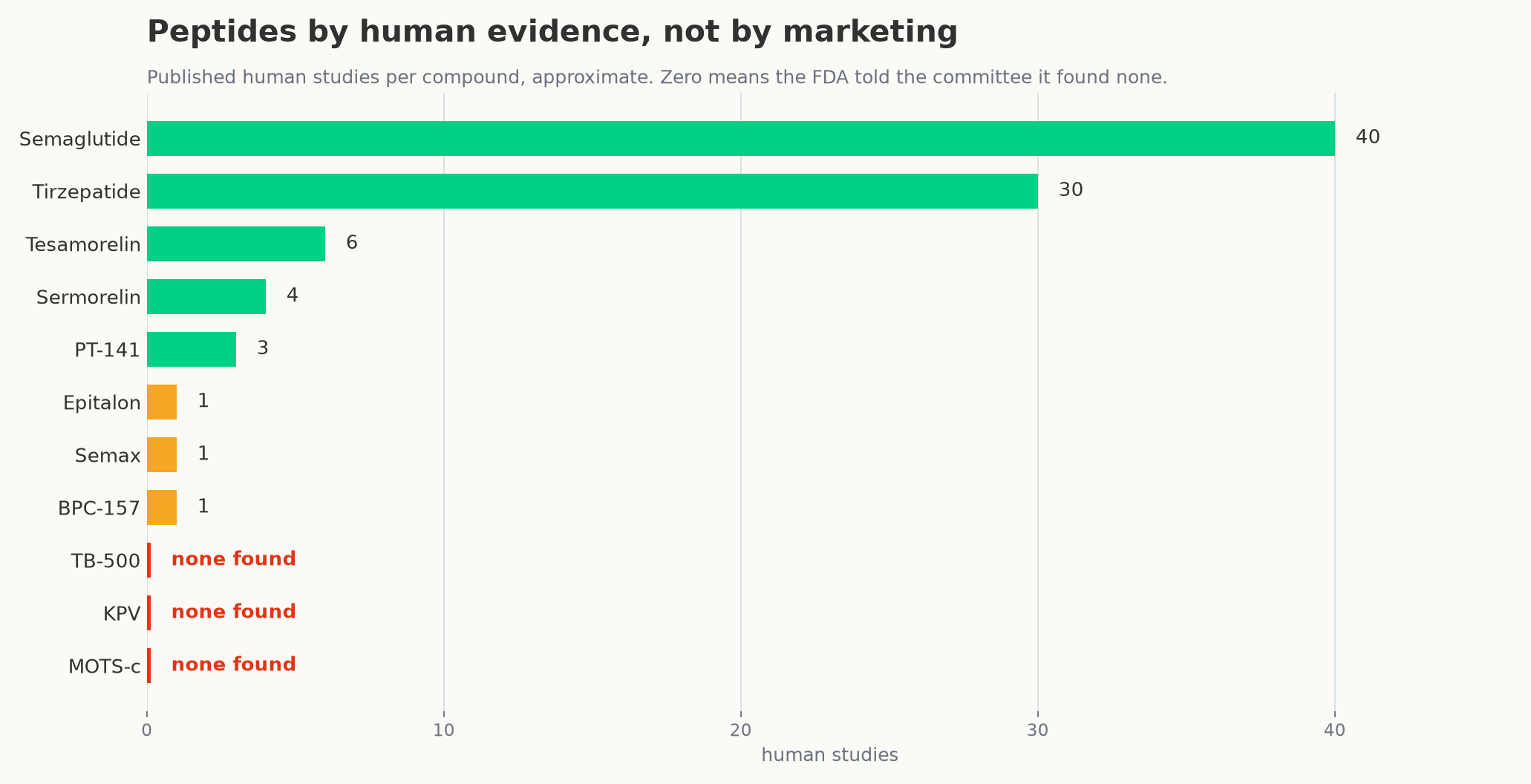
A committee recommendation or nomination does not answer that question. Use the compound-by-compound FDA vote explainer and the post-vote clinic questions when a sales page cites the July 2026 advisory meeting.
Gates 2 through 4: prescription, COA, and manufacturer
A 503A pathway centers on an identified patient and a valid prescription. Limited anticipatory compounding can occur under statutory conditions, but the pharmacy still needs a patient-specific prescription before dispensing the drug to you. Ask who prescribed the preparation and why the prescriber chose compounding for your case.
FDA also says each bulk drug substance must have a valid certificate of analysis and must come from an establishment registered with FDA under section 510. A COA is one supply-chain record. It does not turn the finished preparation into an FDA-approved drug, and it does not replace the pharmacy’s responsibility for compounding quality.
Ask the pharmacy to confirm the ingredient source, COA review, and manufacturer record. A clinic may protect confidential supplier documents, but it should still provide a clear written answer about the controls it relies on.
503A and 503B are different pathways
| Question | 503A pharmacy | 503B outsourcing facility |
|---|---|---|
| Usual order basis | Patient-specific prescription | May compound eligible products without first receiving a patient-specific prescription |
| Primary public identity check | State board of pharmacy license record | FDA registered-outsourcing-facility list plus applicable state records |
| Federal manufacturing standard | Section 503A exemptions apply only when its conditions are satisfied | Subject to current good manufacturing practice requirements |
| Does the label prove FDA approval? | No | No |
FDA does not maintain a national 503A registry that works like its 503B outsourcing-facility list. A 503A pharmacy’s absence from the 503B list does not prove fraud. Check the pharmacy through the state board instead.
Gate 5: verify the pharmacy license yourself
Get the legal name and physical address from the prescription label. FDA’s BeSafeRx directory links to every state board’s license database and tells consumers to confirm that an online pharmacy requires a prescription, provides a U.S. address and phone number, and has a licensed pharmacist available.
- Search the home-state board by the legal pharmacy name, not the clinic’s brand.
- Confirm that the license is active and that the address matches the label.
- Review public discipline or restrictions.
- If the pharmacy ships across state lines, check the board for the state where you receive the drug.
Use the FDA state-license directory, which links to each state board’s public database. FPC’s verification methodology explains how we separate public-record checks from paid placement.
Gates 6 and 7: inspect the label and follow-up plan
The label should let you identify the patient, prescriber, dispensing pharmacy, active ingredient, strength, directions, beyond-use date, storage requirements, and a lot or prescription number. Contact the pharmacy when the label conflicts with the clinic’s instructions, the package arrives damaged, the product contains particles, or temperature control may have failed.
Ask the clinic to name the person responsible for follow-up, adverse reactions, laboratory review, refills, cancellation, and record requests. A pharmacy license proves a facility’s authorization status. It does not prove that the clinic’s medical claim fits your diagnosis or that its follow-up plan is adequate.
The peptide compounding pharmacy near-me guide covers location-intent checks. Use the pre-payment clinic question list to itemize consultation, medication, laboratory, shipping, refill, and cancellation costs.
Gate 8: know where to report a problem
Contact the prescribing clinician and dispensing pharmacy when you suspect an adverse reaction or product defect. FDA directs pharmacy complaints to the relevant state board. FDA MedWatch accepts reports about serious reactions, product-quality problems, therapeutic failure, and use errors involving human medical products.
- Use the state board for license, dispensing, or pharmacy-practice complaints.
- Use FDA MedWatch for serious adverse events or product-quality problems.
- Call 911 for a medical emergency.
Save the product, packaging, label, lot or prescription number, receipt, photos, and messages unless a clinician or safety authority tells you otherwise. Those details help investigators connect your report to a pharmacy and batch.
Claims that need a second look
“The pharmacy is FDA-approved.” FDA does not approve pharmacies or compounded drugs. A 503B facility can register with FDA, but registration does not approve each product.
“It is 503A, so the peptide is allowed.” The facility label does not establish the bulk-substance pathway, prescription, patient need, copy restriction, state license, or current FDA policy.
“The ingredient is pharmaceutical grade.” That phrase does not provide the federal bulk-substance status, COA, manufacturer identity, finished-product quality, or clinical evidence.
“The shortage makes it legal.” FDA shortage status can affect some compounding rules, but the exact product, date, pathway, and remaining section 503A conditions still matter. Ask for the current basis in writing.
Find a clinic, then verify the pharmacy
Use FPC’s clinic request page or browse the city directory. A directory result starts your research. Check the clinician, pharmacy, product, written price, and follow-up plan before paying.
Browse all 26 maintained city guides
Austin, Beverly Hills, Charlotte, Chicago, Columbus, Dallas, Denver, Fort Worth, Houston, Indianapolis, Jacksonville, Las Vegas, Los Angeles, Louisville, Nashville, New York, Oklahoma City, Philadelphia, Phoenix, Portland, San Antonio, San Diego, Sarasota, Scottsdale, Seattle, and West Chester.
Common questions
Are 503A compounded peptides FDA-approved?
No. FDA does not approve compounded drugs before marketing. A product can qualify for certain section 503A exemptions only when the applicable conditions are met.
Does Category 1 mean FDA approved?
No. Category 1 is part of an FDA interim enforcement policy for nominated bulk drug substances. It does not place a substance on the final 503A Bulks List or approve a finished drug.
Can I verify a 503A pharmacy in an FDA registry?
FDA’s public outsourcing-facility registry covers 503B facilities. Check a 503A pharmacy through the state board of pharmacy using the legal name and address on the prescription label.
Why ask about a COA and the manufacturer?
FDA says bulk drug substances used under section 503A must have a valid certificate of analysis and come from an establishment registered with FDA under section 510. Those records support ingredient traceability but do not approve the finished compounded drug.
Where can I report a pharmacy or product problem?
Send pharmacy-practice complaints to the relevant state board. FDA MedWatch accepts serious adverse-event and product-quality reports. Contact your clinician first for medical care and call 911 for an emergency.
Limitations
Find Peptide Clinics is a directory and educational resource. It does not prescribe, dispense, recommend a treatment, or provide medical or legal advice. Compounding requirements depend on the exact substance, product, prescription, patient, pharmacy, jurisdiction, and current FDA policy. Confirm current facts with FDA, the relevant state boards, the dispensing pharmacy, and a licensed clinician who evaluated you.
Sources
- U.S. Food and Drug Administration. Bulk Drug Substances Used in Compounding Under Section 503A of the FD&C Act. Content current May 14, 2026.
- U.S. Food and Drug Administration. Compounding and the FDA: Questions and Answers.
- U.S. Food and Drug Administration. Locate a State-Licensed Online Pharmacy.
- U.S. Food and Drug Administration. Registered Outsourcing Facilities.
- U.S. Food and Drug Administration. FDA Clarifies Policies for Compounders as National GLP-1 Supply Begins to Stabilize. April 1, 2026.
- U.S. Food and Drug Administration. Reporting Serious Problems to FDA.
Which of these compounds may a compounding pharmacy lawfully prepare, and in which state? The peptide regulatory status tracker sets out FDA status compound by compound, with dates and sources.