
The Peptide Therapy Price & Verification Guide (2026)
**What peptide therapy actually costs, who is legally allowed to prescribe it, and the six questions
that separate a licensed clinic from a website with a credit card form.**
Find Peptide Clinics maintains this guide because the four questions people ask most often, what it
costs, where you can legally buy it, how to get prescribed, and whether insurance covers it, are
rarely answered in plain numbers by the people selling it. Here are the numbers.
1. How much does peptide therapy cost?
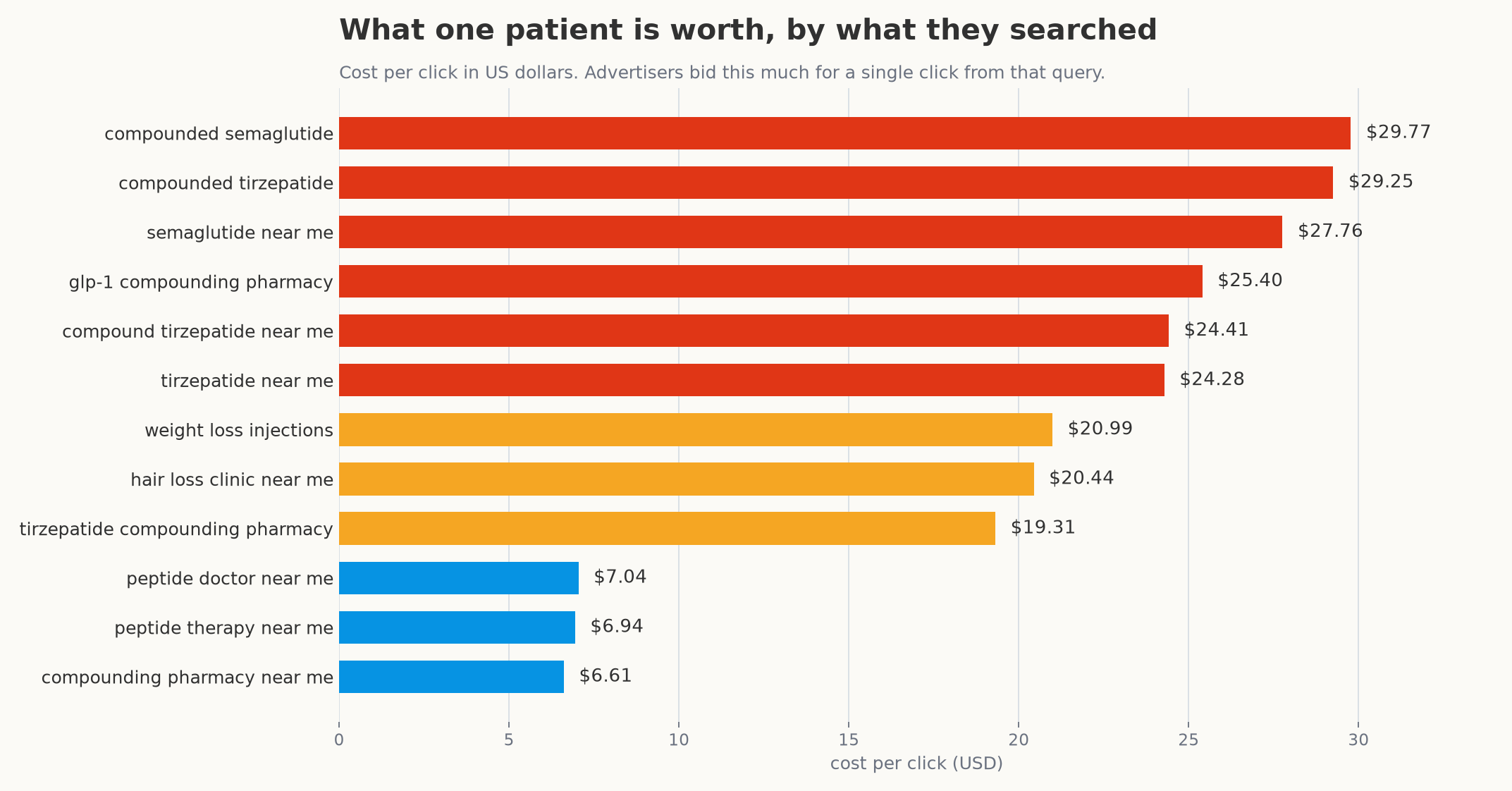
Real monthly ranges, gathered from publicly listed clinic pricing in the United States. Prices vary
by compound, dose, and whether a consultation or labs are bundled.
| Peptide | Typical monthly range | What drives the price |
|---|
|—|—|—|
| BPC-157 | $150 to $400 | vial size, injectable or capsule |
|---|---|---|
| TB-500 | $200 to $450 | often stacked, rarely sold alone |
| Sermorelin | $150 to $500 | dosing schedule, most clinics run 3 to 6 month programs |
| Semaglutide (compounded) | $200 to $500 | dose escalation, cost rises as the dose rises |
| Tirzepatide (compounded) | $300 to $800 | highest-demand compound, price moves with supply |
| Retatrutide | **not legally available** | see section 4, this one matters |
| GHK-Cu, Epitalon, others | $100 to $350 | topical or injectable, small batch premiums |
What usually sits outside the monthly number:
- Initial consultation: $0 to $250
- Lab work: $100 to $400 (often required before prescribing)
- Follow-up visits: $50 to $150 each
- Shipping: $20 to $60
Ask for the twelve-month total, not the monthly price. A $150 headline that requires a $250
consult and quarterly $150 follow-ups is not a $150 program.
2. Where can you legally buy peptides?
There is a short answer and it is worth reading twice.
**In the United States, peptides are legally obtainable through a prescription, dispensed by a
licensed pharmacy, typically a 503A or 503B compounding pharmacy, under the care of a licensed
prescriber.** That is the pathway. There is no legal retail route, and there is no legal
“research chemical” route for something you intend to put in your body.
When you look at any supplier, one of these is true:
- They are a licensed pharmacy filling a prescription from a licensed prescriber.
- They are selling you an unapproved drug, and the law does not protect you.
If a seller cannot name their pharmacy and their prescriber, you are looking at the second one.
3. How do you get prescribed?
The legitimate sequence, in order:
1. A consultation with a licensed prescriber. Physician, NP, or PA, licensed in your state.
Telehealth is fine and common.
2. A review of your history. Medications, conditions, prior treatments. If nobody asks, that is
your first warning.
3. Labs where appropriate. Not every compound needs them. A clinic that orders none is not
screening you, it is processing you.
4. A prescription sent to a licensed pharmacy. Ask which one. They should be able to tell you in
one sentence.
5. The pharmacy ships, and the pharmacy is licensed in your state. Verify that. It takes two
minutes.
The test that catches most problems: ask for the name of the prescriber and the name of the
pharmacy. A legitimate operation answers immediately. A reseller selling gray-market product cannot
answer either, because both are someone else’s licence to lose.
4. Will insurance pay for peptide injections?
Mostly no, and any clinic that tells you otherwise should be asked to show you the billing code.
- **FDA-approved peptide drugs** with an on-label indication are sometimes covered, subject to
prior authorisation. Coverage depends on your plan and your diagnosis.
- **Compounded peptides** are generally **not covered**. They are not FDA-approved products.
- **Wellness and optimisation use**, the most common reason people seek peptides, is almost not
covered.
Ask this specific question: “What diagnosis code are you billing, and is this on-label?”
If there is no diagnosis and no code, there is no insurance claim, and you are paying cash.
5. Retatrutide, read this before you search for a price
**Retatrutide is not approved by the FDA and is not legally available for sale in the United
States.** It is investigational. It has no approved price because there is no approved product.
That matters because retatrutide is currently one of the most-searched-for peptides in America, and
the gap between that demand and its legal status is the most exploited gap in this market. Anyone
offering to sell you retatrutide, anywhere, at any price, is selling you an unapproved
investigational drug with no quality assurance and no recourse.
**If a site offers retatrutide at a discount, stop. You have found the people you are protecting
yourself from.**
6. The six questions to ask before you pay anyone
Print this. Ask them in this order. Listen to hesitation.
1. Who is the prescriber, and what is their license number? You can verify it yourself in
minutes on a state board site.
2. Which pharmacy compounds it, and what is its license number?
3. What is the total twelve-month cost, including consults, labs and follow-ups?
4. What is the diagnosis code, and is this an on-label use?
5. What happens if I have a side effect, who do I call, and is that visit included?
6. Can I see the manufacturer’s certificate of analysis for my batch?
A licensed clinic answers all six. A reseller answers none and offers a discount instead.
**If the only contact is a phone number on a messaging app, there is nothing to verify, because
there is nothing there.**
Frequently asked questions
Are peptides legal in the United States?
Peptides are legal with a prescription from a licensed prescriber, dispensed by a licensed
pharmacy. They are not legal to buy at retail, and “research chemical” labelling does not change
that.
Can I buy peptides online legally?
Only with a prescription, and only from a licensed pharmacy that is licensed in your state. A
website that sells you peptides directly, with no consultation and no prescription, is selling you
an unapproved drug.
Do I need a prescription for BPC-157 or TB-500?
Yes. Both are sold as prescription products through compounding pharmacies in the United States.
Sellers offering them without a prescription are operating outside the legal pathway.
How long until peptide therapy works?
It depends on the compound and the person. Some effects are reported within weeks, others over
months. Any clinic promising a fixed timeline before assessing you is guessing.
Is peptide therapy covered by insurance?
Usually not, especially for wellness or optimisation use. Ask for the diagnosis code and whether
the use is on-label.
What should I do if a clinic cannot answer these questions?
Walk away. There are licensed clinics in most states, and these questions take four minutes to ask.
Why this guide exists
We built Find Peptide Clinics to check clinics, not to sell you one. Everything in this guide comes
from published pricing, state licensing boards, and FDA guidance, and we update it as those change.
**If you are looking for a clinic in your area, start with our city guides. We list what can be
verified and we mark what cannot.**
*Last updated: September 2026. Educational information, not medical advice, and not a substitute for
a consultation with a licensed prescriber.*