
Retatrutide remains investigational and is not FDA approved. Across Lilly’s 2026 sponsor-reported Phase 3 topline releases, the most frequently disclosed adverse events were gastrointestinal, including nausea, diarrhea, constipation, vomiting, or decreased appetite, with dysesthesia and urinary tract infections also reported in some trials. These TRIUMPH topline releases do not replace full peer-reviewed reports, and FDA says retatrutide cannot be compounded under federal law.
Evidence checked August 16, 2026. Study-arm labels below describe trial data, not dosing guidance.
Scope clarification, September 8, 2026: The TRIUMPH-1, -2 and -3 findings summarized here come from sponsor topline releases. This is not a claim that no Phase 3 retatrutide paper exists. The separate TRANSCEND-T2D-1 study in adults with type 2 diabetes was published in The Lancet in June 2026. Its population and study design differ; it should not be substituted for the TRIUMPH safety tables below.
FDA status: FDA has not approved retatrutide for any condition.
Registry status: TRIUMPH-1, TRIUMPH-2, and TRIUMPH-3 are complete; their current ClinicalTrials.gov records do not post results.
Public evidence summarized on this page: TRIUMPH-1, -2 and -3 sponsor topline releases; see the scope clarification above for the separate published diabetes trial.
Compounding status: FDA states that retatrutide cannot be used in compounding under federal law.
Editorial review: Find Peptide Clinics Editorial Desk. See how we verify sources and separate editorial work from paid listings. No clinician reviewer is named for this article.
Direct answer: what Phase 3 currently shows
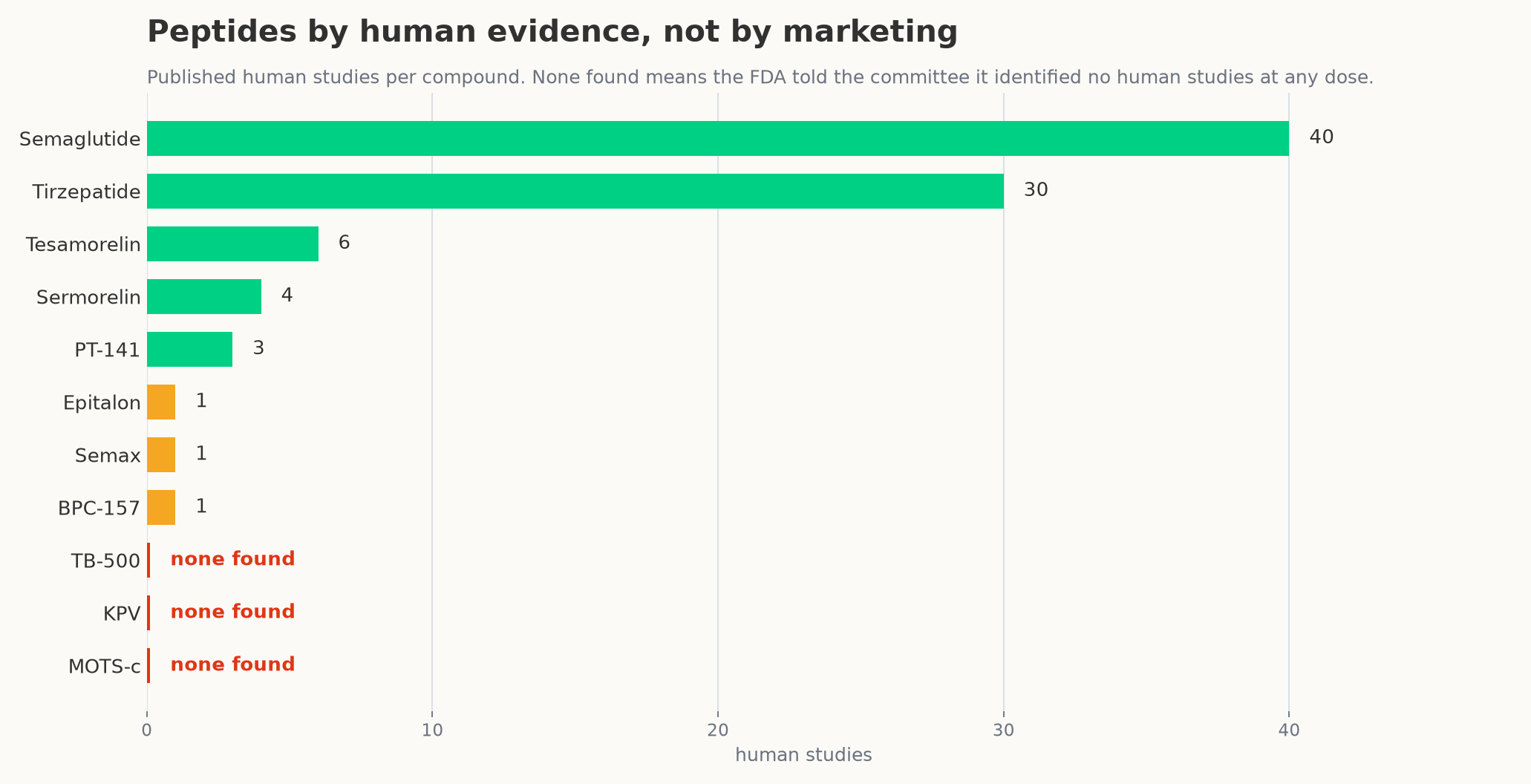
Lilly’s three sponsor-reported Phase 3 topline releases describe gastrointestinal events as the most frequent adverse events across the disclosed study arms. The releases also report dysesthesia and urinary tract infections in each trial. TRIUMPH-3 included people with severe obesity and established cardiovascular disease. Lilly reported cardiovascular estimates with wide confidence intervals that do not establish benefit or harm.
The releases do not provide the complete public safety dataset. They do not replace a peer-reviewed paper, a ClinicalTrials.gov results record, or an FDA review.
The evidence ladder: published, topline, registry, and FDA
| Evidence layer | What it contributes | Limit |
|---|---|---|
| Peer-reviewed | Published research includes the Phase 2 obesity trial and the separate TRANSCEND-T2D-1 Phase 3 diabetes trial. | Their populations and designs differ; neither is the source of this page’s TRIUMPH safety tables. |
| Sponsor-topline | Lilly reported selected TRIUMPH-1, -2, and -3 results in press releases. | A sponsor release reports what the sponsor disclosed. It is not independent verification or FDA review. |
| Registry | ClinicalTrials.gov records trial design, status, enrollment, and dates. | The three records do not post results as checked August 16, 2026. |
| Official regulatory | FDA states the drug’s approval and federal compounding status. | FDA has not approved retatrutide or reviewed a marketed retatrutide product. |
TRIUMPH-1: adults without type 2 diabetes
ClinicalTrials.gov lists TRIUMPH-1 (NCT05929066) as a completed Phase 3 trial with an actual enrollment of 2,335 and a primary completion date of April 6, 2026. The registry does not post results as checked. Lilly’s May 21 release says the sponsor randomized 2,339 participants. The sources use different counts, so this article keeps both labels rather than merging them.
Source type: Sponsor-reported topline; not peer-reviewed as checked August 16, 2026.
| Reported event | 4 mg arm | 9 mg arm | 12 mg arm | Placebo |
|---|---|---|---|---|
| Nausea | 28.6% | 38.4% | 42.4% | 14.8% |
| Diarrhea | 25.2% | 34.1% | 32.0% | 13.5% |
| Constipation | 23.8% | 25.9% | 26.1% | 10.9% |
| Vomiting | 10.6% | 22.8% | 25.3% | 4.8% |
| Upper respiratory tract infection | 14.2% | 12.2% | 13.1% | 11.6% |
| Dysesthesia | 5.1% | 12.3% | 12.5% | 0.9% |
| Urinary tract infection | 7.5% | 8.8% | 8.4% | 5.3% |
| Discontinuation due to adverse events | 4.1% | 6.9% | 11.3% | 4.9% |
The 11.3% discontinuation figure describes one study arm. The topline release cannot establish an individual’s risk, the cause of a specific event, or comparative safety outside the trial.
TRIUMPH-2: adults with type 2 diabetes and obesity or overweight
ClinicalTrials.gov lists TRIUMPH-2 (NCT05929079) as completed with an actual enrollment of 1,152 and a primary completion date of June 16, 2026. The registry does not post results as checked. Lilly’s July 23 release also reports 1,152 participants.
Source type: Sponsor-reported topline; not peer-reviewed as checked August 16, 2026.
| Reported event | 4 mg arm | 9 mg arm | 12 mg arm | Placebo |
|---|---|---|---|---|
| Diarrhea | 27.4% | 33.5% | 33.6% | 13.2% |
| Nausea | 13.7% | 20.8% | 28.0% | 8.0% |
| Constipation | 14.0% | 16.2% | 16.8% | 9.4% |
| Decreased appetite | 5.8% | 12.3% | 17.1% | 4.5% |
| Vomiting | 5.5% | 10.2% | 15.7% | 4.2% |
| Dysesthesia | 4.5% | 5.6% | 7.3% | 0.7% |
| Urinary tract infection | 3.8% | 6.3% | 8.0% | 6.6% |
| Discontinuation due to adverse events | 3.8% | 11.6% | 7.7% | 4.9% |
TRIUMPH-3: severe obesity and established cardiovascular disease
ClinicalTrials.gov lists TRIUMPH-3 (NCT05882045) as completed with an actual enrollment of 1,946 and a primary completion date of April 16, 2026. The registry does not post results as checked. Lilly’s July 23 release says the sponsor randomized 1,949 participants. The sources use different counts.
Source type: Sponsor-reported topline; not peer-reviewed as checked August 16, 2026.
| Reported event | 9 mg arm | 12 mg arm | Placebo |
|---|---|---|---|
| Diarrhea | 30.1% | 24.4% | 8.7% |
| Nausea | 21.7% | 22.4% | 5.8% |
| Constipation | 18.0% | 15.7% | 7.1% |
| Decreased appetite | 13.5% | 14.5% | 3.0% |
| Hyperglycemia | 3.9% | 3.1% | 13.4% |
| Dysesthesia | 6.4% | 6.4% | 1.3% |
| Urinary tract infection | 6.1% | 7.0% | 5.3% |
| Discontinuation due to adverse events | 9.8% | 13.5% | 4.8% |
What the Phase 3 topline releases still do not answer
- No peer-reviewed TRIUMPH-1, TRIUMPH-2, or TRIUMPH-3 Phase 3 paper was located as checked August 16, 2026.
- The three current ClinicalTrials.gov records do not post results.
- The sponsor releases do not provide complete serious-adverse-event tables, laboratory findings, subgroup analyses, missing-data methods, or longer-term safety results.
- FDA has not reviewed and approved retatrutide for any condition.
For any event that a release does not disclose, the correct entry is “not disclosed in the topline release,” not 0%.
What Phase 2 adds
The peer-reviewed Phase 2 trial randomized 338 adults with obesity or overweight. Gastrointestinal events were the most frequent adverse events. Discontinuation due to adverse events ranged from 6% to 16% across retatrutide groups. The authors reported that heart rate increased in a dose-dependent manner through week 24, then declined.
Phase 2 offers published context. It cannot answer the Phase 3 safety questions or establish how a future FDA-reviewed product would perform in routine care.
What dysesthesia means
Dysesthesia describes an unpleasant abnormal sensation, such as tingling, prickling, burning, or a crawling feeling. Lilly disclosed dysesthesia rates in all three Phase 3 releases. The within-trial rates appear in the tables above.
The topline releases do not provide enough detail to determine duration, mechanism, severity distribution, reversibility, or full adjudication. The reported percentages support a safety question. They do not establish a universal cause or predict an individual’s experience.
FDA status and products sold as retatrutide
- FDA states that retatrutide is not a component of an FDA-approved drug and has not been found safe and effective for any condition.
- FDA states that retatrutide cannot be used in compounding under federal law. See how 503A compounding checks work.
- A product sold direct to consumers as retatrutide is unapproved.
Our access guide covers where retatrutide access stands, including trial and seller-verification questions. Our pricing guide explains why there is no approved retatrutide price. This page stays focused on safety evidence.
Frequently asked questions
What side effects were most commonly reported?
Lilly’s Phase 3 topline releases most often disclosed gastrointestinal events, including nausea, diarrhea, constipation, vomiting, or decreased appetite. The specific events and rates differ by trial and study arm. The tables above preserve those differences.
Was dysesthesia reported?
Yes. Lilly disclosed dysesthesia in TRIUMPH-1, TRIUMPH-2, and TRIUMPH-3. The percentages above come from those sponsor topline releases, which do not fully characterize duration, severity, or mechanism.
Which retatrutide Phase 3 results are peer-reviewed?
The TRANSCEND-T2D-1 Phase 3 trial in adults with type 2 diabetes was published in The Lancet in June 2026. The TRIUMPH-1, -2 and -3 safety tables on this page come from sponsor topline releases checked August 16, 2026. These are different studies; match a claim to its trial, population and source before comparing results.
Is retatrutide FDA approved?
No. FDA has not approved retatrutide for any condition.
Can a compounding pharmacy make retatrutide?
FDA states that retatrutide cannot be used in compounding under federal law.
When could retatrutide become available?
Lilly says it plans to submit retatrutide to FDA in Q1 2027. That plan does not establish an approval date, review outcome, retail launch date, or price.
Use our clinic-verification checklist and compare licensed care options. Those resources do not imply that retatrutide is available through a local clinic.
Sources
- Official: FDA. “FDA’s Concerns with Unapproved GLP-1 Drugs Used for Weight Loss.” FDA drug alerts and statements. Checked August 16, 2026.
- Registry: ClinicalTrials.gov. TRIUMPH-1, NCT05929066. Current trial record. Checked August 16, 2026.
- Registry: ClinicalTrials.gov. TRIUMPH-2, NCT05929079. Current trial record. Checked August 16, 2026.
- Registry: ClinicalTrials.gov. TRIUMPH-3, NCT05882045. Current trial record. Checked August 16, 2026.
- Sponsor-topline: Eli Lilly and Company. “Lilly’s triple agonist, retatrutide, delivered powerful weight loss in pivotal Phase 3 obesity trial.” May 21, 2026 release.
- Sponsor-topline: Eli Lilly and Company. “Lilly’s triple agonist, retatrutide, successful in two additional Phase 3 trials.” July 23, 2026 release.
- Peer-reviewed: Jastreboff AM, Kaplan LM, Frias JP, et al. “Triple-Hormone-Receptor Agonist Retatrutide for Obesity: A Phase 2 Trial.” New England Journal of Medicine. 2023;389:514-526. PubMed record.
Which of these compounds may a compounding pharmacy lawfully prepare, and in which state? The peptide regulatory status tracker sets out FDA status compound by compound, with dates and sources.
For the tirzepatide-specific numbers, including the label tables, the pancreatic injury counts and what regulators found inside compounded vials sold under the same name, read our tirzepatide side effects breakdown.
For the dose schedule those trials actually used, and what the FDA says about retatrutide dosing, read retatrutide dosage: there is no approved dose.