
Phoenix, Arizona draws peptide clinics that advertise on Yelp, recruit staff on ZipRecruiter, and cite PubMed and ASCO abstracts in their marketing. Those sources answer separate questions. A journal abstract reports trial data. A hiring post reports staffing. Neither confirms that a given clinic may compound and dispense the peptide it sells.
One step matters before money changes hands: verification. Ask for the prescriber's name and license number. Then open the Arizona Board of Medicine or the Arizona Board of Nursing public lookup and confirm that license stands active.
Ask which pharmacy compounds the drug. The FDA places many compounded peptides on its Category 2 list, and a 503A pharmacy works under rules that differ from a 503B outsourcing facility. Ask what the evaluation includes, and ask for the total monthly cost in writing. A prescription must precede dispensing under federal law.
Who can prescribe peptides in Arizona
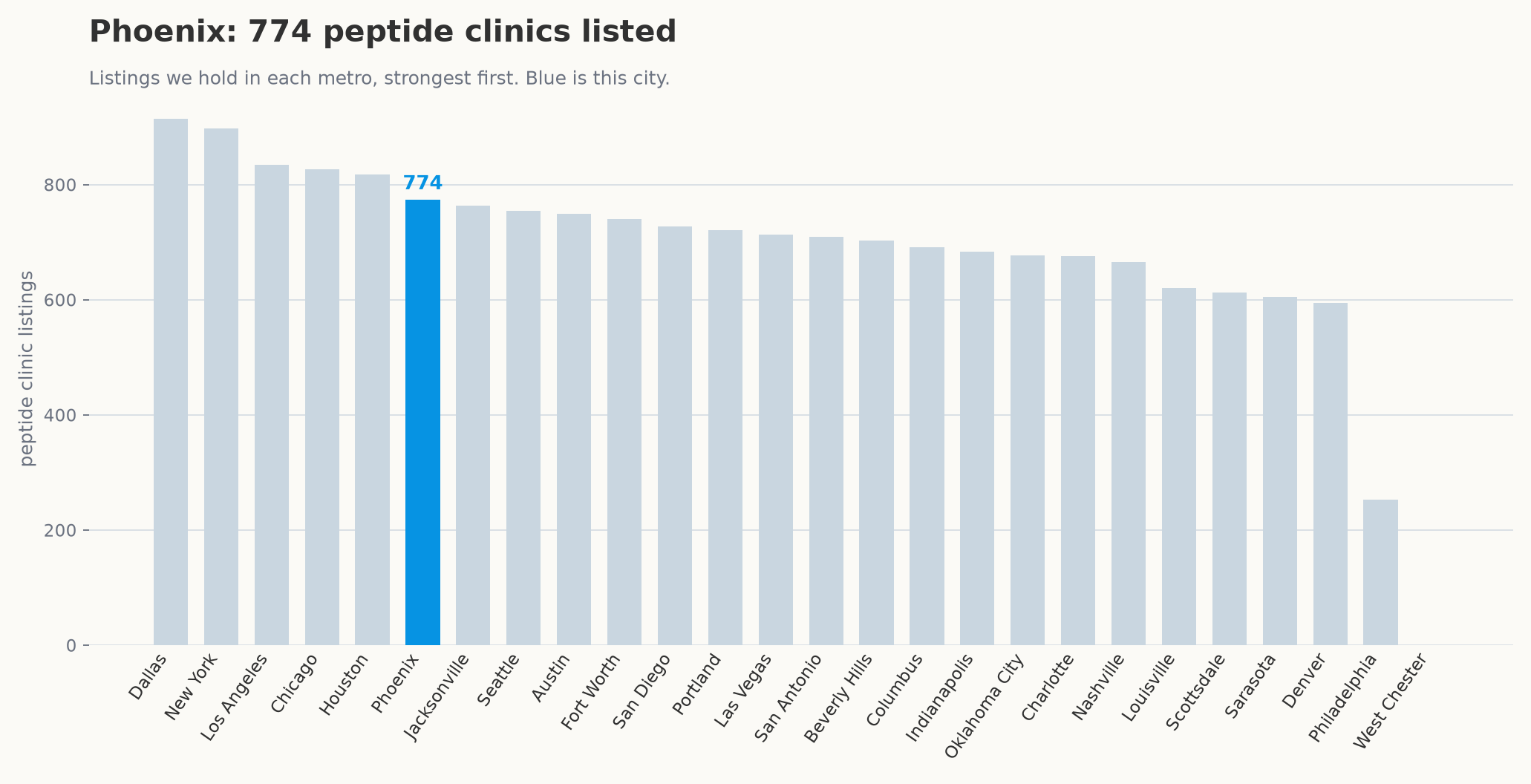
A prescription for a compounded peptide in Phoenix must come from a licensed prescriber. In Arizona, patients will meet three license types. A physician holds an MD or DO license. A physician assistant holds a PA license. An advanced practice registered nurse holds an APRN license. Each license type carries a different scope of practice. A PA or APRN can work under a supervising physician and a written protocol. That protocol can limit which peptides the clinician may prescribe, the dose, and the monitoring plan. Confirm which license type you will see at your visit. Ask for the prescriber's full name and license type before you book. That step matters when a clinic advertises peptide therapy but routes your intake to a provider whose protocol does not cover the product.
Arizona maintains public license lookups. The Arizona Board of Medicine lists physicians, physician assistants, and certain other providers. The Arizona Board of Nursing lists registered nurses and advanced practice registered nurses. Search the prescriber's name in the correct board lookup. Check the license status, expiration date, and any public discipline. The lookup shows the license type and whether the provider may practice in Arizona. A prescription from a provider who lacks an active Arizona license raises a red flag.
Ask the clinic which pharmacy compounds the peptide. A licensed pharmacy must dispense against a valid prescription. The FDA does not approve compounded drug products in the same way it approves brand or generic drugs. That distinction leaves questions about strength, purity, and labeling. A 503A or 503B pharmacy operates under federal rules. Ask which pathway the pharmacy uses. Ask what the evaluation includes. Ask the total monthly cost. A provider who answers these questions helps you verify the prescription path. A provider who avoids them leaves you with uncertainty.
The compounding pharmacy question
Most peptides sold as treatments do not hold FDA approval. A pharmacy can compound them. Federal law permits compounding under two tracks.
Section 503A covers a state-licensed pharmacy that compounds for a specific patient. The patient needs a prescription. The pharmacy mixes a formula for that person. Section 503B covers an outsourcing facility. An outsourcing facility can make larger batches without a patient-specific prescription. It registers with the FDA and follows stricter manufacturing rules. Both tracks require a prescription before dispensing.
The FDA maintains a Category 2 list. This list names substances the agency considers unsuitable for compounding. A substance on that list carries a risk. The FDA cites safety or efficacy concerns. A pharmacy that compounds a Category 2 substance may face enforcement.
Phoenix readers can verify a pharmacy with two checks. Ask the clinic which pharmacy fills the prescription. Write down the name and address. Open the Arizona Board of Pharmacy license lookup. Search the pharmacy name. Confirm the license status. For an outsourcing facility, check the FDA's 503B registration list. Both lookups are public.
A 503A pharmacy holds a state license. A 503B facility holds an FDA registration. These credentials differ. Ask the clinic which one applies. Confirm the record yourself.
Ask the prescriber one more question: does the pharmacy compound this peptide, or does it sell a finished product from another source? The answer changes which rules apply. A clinic that declines to name its pharmacy gives you a reason to pause. Legitimate compounding operates in the open.
Questions that separate clinics
Does the clinic name the prescriber and the license number? Ask for the full name and the license type, such as MD, DO, or NP. Arizona patients can confirm that license in the state Board of Medicine or Board of Nursing public lookup. A clinic that declines to share this detail gives a patient no way to confirm who writes the prescription.
Does the clinic name the pharmacy that compounds the medication, and does that pharmacy hold a 503A or 503B registration? Federal law treats these two paths in different ways. A 503A pharmacy compounds for an individual patient under a prescription, and a 503B outsourcing facility registers with the FDA under a separate set of rules. The answer tells a patient which oversight applies.
Does the initial evaluation include a review of current medications, a medical history, and baseline lab work? The scope varies by clinic and by treatment. Ask whether the prescriber reviews the patient's existing prescriptions and any conditions that could interact. Ask what the patient receives in writing after the visit.
Does the clinic describe a plan for a reaction to the medication? Ask who answers the phone after hours and how the clinic documents the event. A clear plan names a contact, a timeframe, and a step for stopping the drug.
Does the quoted price cover the consultation, the medication, and follow-up visits? Request one monthly figure in writing. Ask whether the pharmacy ships the medication and whether that shipping cost appears in the total. A price that omits a component is incomplete.
What Phoenix clinics get right and wrong
Two shapes dominate the Phoenix market.
Franchise men's-health clinics run one brand across several cities. Intake takes little time, sometimes a same-day visit, following a script the corporate parent wrote. Marketing promises a category of treatment. A bad outcome lands at a call center that reports to the parent company.
Physician-owned practices set a slower intake pace. The visit includes a medication history, prior labs, and a conversation with the prescriber. Scheduling can take days. That friction buys a direct line to the person whose name sits on the prescription.
Federal rules bind both. A prescription must precede dispensing. A 503A pharmacy compounds for an identified patient under state oversight. A 503B outsourcing facility registers with FDA and may compound without patient-specific prescriptions for certain drugs. Registration is not approval. FDA has not approved most compounded peptides as drugs, and the Category 2 list flags ingredients the agency considers unsafe for compounding.
Accountability splits along the same line. A franchise answers to a corporate parent, so a poor outcome becomes a brand and training problem. A physician-owned practice holds the prescriber's license, and discipline follows the individual.
Verification works the same for both. Ask which pharmacy compounds the drug and under which section. Ask what the evaluation covers and the total monthly cost. Then check the prescriber's license in the Arizona Board of Medicine public lookup, or the Board of Nursing lookup if the credential is a nursing one. Those records show status and discipline. The answers separate a careful clinic from a rushed one.
Red flags
A clinic that asks for payment before an evaluation inverts the federal rule. A prescription must come first. A licensed prescriber reviews your history, then a pharmacy dispenses the compounded drug. Payment upfront for a peptide with no exam and no script points to a sales operation.
Guaranteed outcomes. The FDA has not approved compounded peptides for the uses clinics market. The agency also lists several peptides on its Category 2 list, which bars compounding. A clinic that promises results, or cites a success rate, states something the pharmacy cannot support.
No verifiable practice address. Ask for the street address where the prescriber sees patients. Then check that prescriber's state license in the Arizona Board of Medicine or Board of Nursing public lookup. A clinic that lists no address, or lists one shared with a mail drop, leaves you nothing to check.
Urgency pressure. Countdown clocks and same-day pricing push a decision past the point where a patient reads the consent form. Legitimate medicine allows time to ask questions.
Refusal to name the pharmacy. Ask which pharmacy compounds the peptide and whether that pharmacy operates under Section 503A or Section 503B. A clinic that declines to answer hides the one part of the chain a patient can verify.
What a legitimate Phoenix clinic looks like
A first appointment ends with paperwork in your hand. Bring four items home from a Phoenix clinic that prescribes compounded peptides.
1. The prescriber's name and license number. Write both down. Then check the number in the Arizona Medical Board or Arizona State Board of Nursing public lookup. A license in good standing appears there with a status and an expiration date.
2. A compounding pharmacy you can look up. Ask which pharmacy fills the prescription and whether it registers as a 503A or 503B facility. Both types operate under federal rules, and the FDA places some peptides on its Category 2 list, which restricts compounding. A clinic that answers with a name and a registration type gives you something to verify.
3. A written plan with costs. The plan names the peptide, the dose, the schedule, and the total monthly price. Ask what the evaluation includes and whether follow-up visits cost extra.
4. A way to reach someone if something goes wrong. Get a phone number that a person answers, plus instructions for reporting a side effect.
Federal law requires a prescription before a pharmacy dispenses a compounded peptide. A clinic that skips the evaluation, or that cannot name its pharmacy, leaves you with nothing to check.
Frequently asked questions
Does Arizona require a prescription for peptide therapy?
A licensed prescriber must evaluate you and issue a prescription before a pharmacy dispenses a compounded peptide. Federal rules govern compounded drugs, and Phoenix clinics follow the same order of events: a prescriber evaluates you, then a pharmacy fills the order. Ask the clinic to name the prescriber who signs the order and the pharmacy that fills it.
How do I verify a Phoenix clinic's license?
Search the prescriber's name in the Arizona Board of Medicine or Board of Nursing public license lookup. Confirm an active status, and match the license type to the service the clinic advertises. Note the expiration date.
Are compounded peptides FDA-approved?
No. The FDA approves some peptide drugs as brand or generic products, yet a compounded version from a 503A or 503B pharmacy carries no such approval. The FDA Category 2 list names ingredients that pose known compounding concerns.
Can a Phoenix clinic prescribe peptides over a video call?
Telehealth rules vary, and a prescriber needs a license in the state where you sit during the visit. Ask whether a video visit meets Arizona requirements or whether the clinic schedules an in-person exam. Confirm that the same prescriber orders labs and handles follow-up.
What should peptide therapy cost in Phoenix?
Pricing varies by peptide, dose, and pharmacy, so one figure misleads. Ask for the total cost each month, which covers the evaluation, the prescription, the pharmacy fee, and shipping. Request a written quote before you pay, and compare two clinics side by side.