
How to check a peptide compounding pharmacy near you
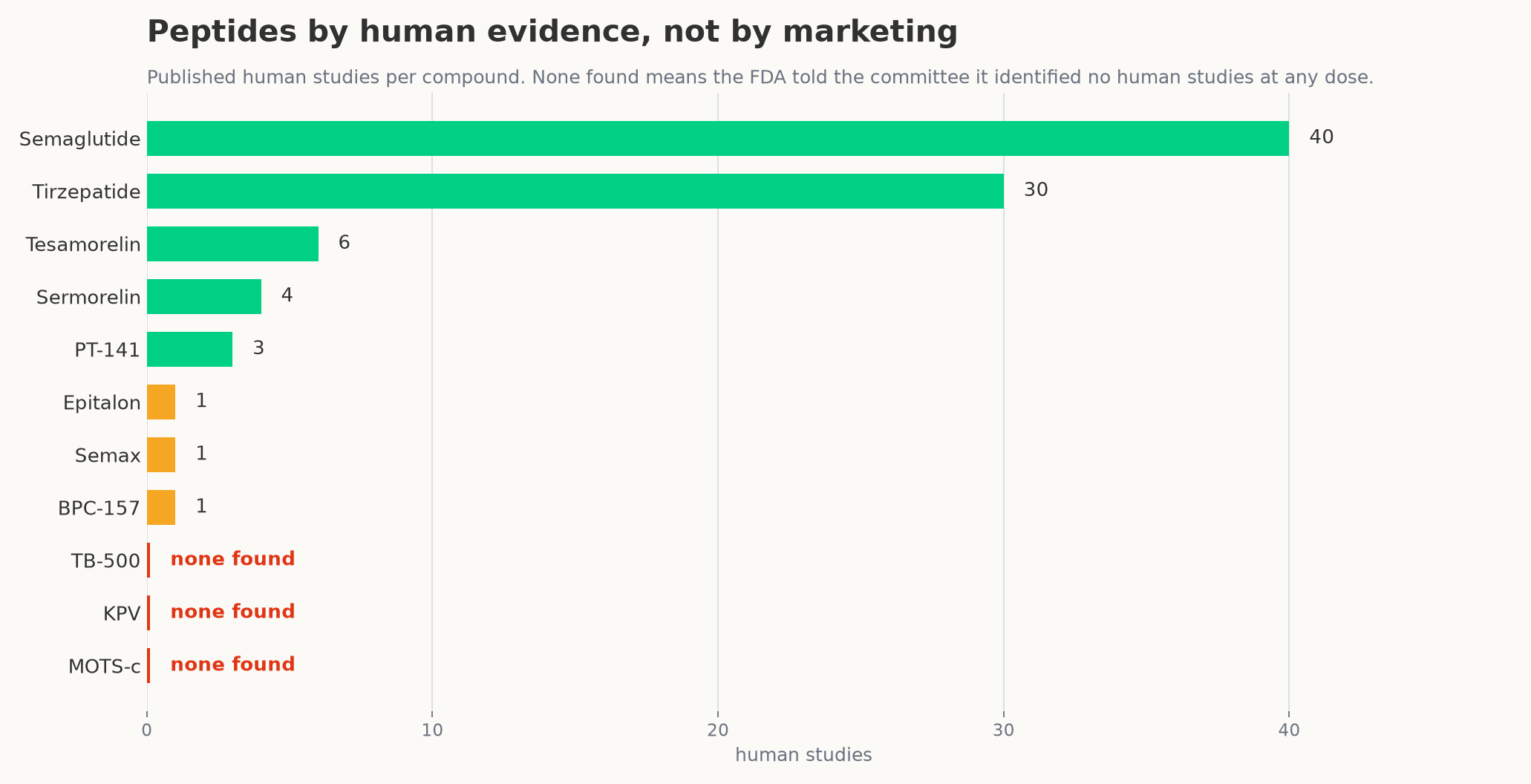
Start with the pharmacy’s exact legal name, physical address, and state license. If you are ordering online, open your state’s pharmacy-board license database through FDA’s BeSafeRx state-board list. Confirm that it requires a prescription and has a licensed pharmacist available for questions.
A pharmacy license is not FDA approval of a compounded product. FDA explains that compounded drugs are not FDA-approved. Use our 503A pharmacy verification guide and free clinic visit questions checklist to organize the records before you pay.
Table of Contents
- 1. What the Evidence Shows
- 2. FDA Status and Regulatory Context
- 3. Practical Questions for Clinic Visits
- 4. How Find Peptide Clinics Helps
- 5. Limitations of This Information
1. What the Evidence Shows
The U.S. Food and Drug Administration (FDA) provides specific guidance regarding the use of bulk drug substances in compounding under Section 503A of the Federal Food, Drug, and Cosmetic Act (FD&C Act). This guidance outlines the conditions under which state-licensed pharmacies and physicians may compound drug products. The primary source for this article is an FDA guidance document, which details the regulatory framework for bulk drug substances used in compounding.
According to the FDA, compounders operating under Section 503A must adhere to strict criteria when selecting bulk drug substances. These substances must meet one of the following conditions:
- They must comply with an applicable United States Pharmacopeia (USP) or National Formulary (NF) monograph, if one exists, and also adhere to the USP chapter on pharmacy compounding.
- If no applicable USP or NF monograph exists, the substance must be a component of an FDA-approved drug product.
- If neither of the above conditions is met, the substance must appear on the FDA’s official list of bulk drug substances that can be used in compounding (known as the 503A bulks list).
Beyond these criteria, all bulk drug substances used in compounding must be accompanied by a valid certificate of analysis. Furthermore, they must have been manufactured by an establishment that is registered with the FDA under Section 510 of the FD&C Act. The FDA emphasizes the importance for compounders to “know your bulks supplier,” highlighting the need for due diligence in sourcing these materials.
The FDA has been actively developing and updating the 503A bulks list. This process involves soliciting nominations for substances, consulting with the Pharmacy Compounding Advisory Committee and the U.S. Pharmacopeia Convention, and evaluating substances through a public rulemaking process. In February 2019, a final regulation was issued, placing six substances on the list, identifying four others not to be included, and establishing criteria for future evaluations. A proposed regulation in September 2019 suggested adding five more substances and not including twenty-six others. The FDA continues to evaluate nominated substances on a rolling basis, addressing them through notice-and-comment rulemaking.
Recognizing the potential for disruption to patient treatment during the evaluation process, the FDA developed an interim policy. This policy describes conditions under which the agency generally does not intend to take action against compounders for using certain bulk drug substances that might not yet fully meet the Section 503A criteria. The interim policy categorizes bulk drug substances into three groups:
- Category 1: These substances are considered eligible for potential inclusion on the 503A bulks list, were nominated with sufficient supporting information, and do not appear on any other restrictive list. The FDA generally does not intend to take action against compounders using these substances, provided specific guidance conditions are met.
- Category 2: These substances also had sufficient supporting information for evaluation and may be eligible for the 503A bulks list. However, the FDA has identified significant safety risks associated with their use in compounding, pending further evaluation. Therefore, the interim policy applicable to Category 1 substances does not apply. The FDA publishes safety information for Category 2 substances and would consider taking action against compounders using them under its general enforcement policies.
- Category 3: These substances may be eligible for the 503A bulks list but were nominated with insufficient supporting information for the FDA to evaluate them. They are not eligible for the interim policy that applies to Category 1 substances, and the FDA would consider taking action against compounders using them. These substances can be re-nominated with more comprehensive supporting information.
The FDA has since revised the application of this interim policy, stating that bulk drug substances nominated on or after January 7, 2025, will not be placed into these categories. Substances already in Category 1 may continue to be within the scope of the interim enforcement policy until the FDA makes a final decision on their inclusion on the 503A bulks list or removes them from Category 1 due to new safety information.
The limitations of this information are that it reflects the FDA’s regulatory stance and guidance, which can evolve. It provides a framework for understanding the legality and safety considerations for compounded drugs but does not constitute an endorsement or disapproval of any specific compounded product or treatment. The FDA’s focus is on the regulatory compliance of the substances and compounding practices, not on the clinical efficacy or safety of every possible compounded formulation.
2. FDA Status and Regulatory Context
For a pharmacy search, keep three questions separate: who is licensed to prescribe, who will compound or dispense, and what regulatory status applies to the exact finished product. Ask the clinic and pharmacy for verifiable records rather than inferring approval from the word “peptide.”
The FDA distinguishes between two types of compounding pharmacies: 503A pharmacies and 503B outsourcing facilities.
- 503A Compounding Pharmacies: These are traditional state-licensed pharmacies or federal facilities that compound drug products for individual patients based on a valid patient-specific prescription. They are primarily regulated by state boards of pharmacy. The FDA’s Section 503A guidance, as discussed above, specifically applies to these entities. For a 503A pharmacy to compound a drug, the bulk drug substances used must meet the criteria outlined by the FDA: either complying with a USP/NF monograph, being a component of an FDA-approved drug, or appearing on the FDA’s 503A bulks list. Additionally, the bulk substances must come with a valid certificate of analysis and be from an FDA-registered manufacturer.
- 503B Outsourcing Facilities: These are facilities that compound sterile drugs without patient-specific prescriptions and are subject to a more stringent set of FDA regulations, similar to those for traditional drug manufacturers. They are registered with the FDA as outsourcing facilities. The rules for bulk drug substances for 503B facilities differ from those for 503A pharmacies.
FDA uses off-label use to describe an FDA-approved drug used outside its approved labeling. An unapproved compounded preparation is different; a prescription does not give it FDA approval. FDA’s compounding explanation states that compounded drugs are not FDA-approved and that FDA does not verify their safety, effectiveness, or quality before they are marketed. Ask the prescriber and pharmacy to identify the exact finished product and its current regulatory pathway.
It is important to understand that just because a substance is on the FDA’s 503A bulks list or is permitted for compounding under the interim policy, it does not mean the compounded final product is FDA-approved. The FDA’s oversight in this context focuses on the quality and source of the bulk ingredients and the compounding process, not on the approval of the compounded drug itself for a particular medical use.
Patients seeking peptide therapies should be aware that compounded peptide products are not FDA-approved for safety, efficacy, or quality in the same way commercially manufactured drugs are. The responsibility for the quality of the compounded product rests with the compounding pharmacy and the prescribing clinician. The FDA’s guidance aims to ensure that the raw materials used in compounding meet certain quality standards, but it does not validate the clinical use of every compounded preparation.
3. Practical Questions for Clinic Visits
Use these questions to separate clinician credentials, pharmacy licensing, and product approval. Record the names, links, and dates you checked. These records do not determine whether a treatment is appropriate for you.
- Who is the prescribing clinician and what is their state license number? Ask for the prescriber’s full name, credential, and license number. Use the state board responsible for that professional credential; verify the pharmacy separately through the pharmacy board.
- Is this an FDA-approved medication, a compounded preparation, or an investigational product? Ask for the exact finished product and intended use, then request the source for its approval, compounding, or investigational status. Do not infer a product’s approval or availability from a clinic’s service menu.
- Which pharmacy compounds this medication and what is their FDA registration status? Ask for the name and location of the compounding pharmacy. Determine if it is a 503A compounding pharmacy or a 503B outsourcing facility. For 503A pharmacies, verify their state licensure. For 503B facilities, confirm their FDA registration.
- Can I see a copy of the prescription before it is sent to the pharmacy? Reviewing your prescription allows you to confirm the medication, strength, and instructions, and ensures it is patient-specific.
- How does the compounding pharmacy ensure the bulk drug substances meet FDA requirements under Section 503A? Inquire about the pharmacy’s process for sourcing bulk ingredients. They should be able to confirm that the substances comply with USP/NF monographs, are components of FDA-approved drugs, or are on the FDA’s 503A bulks list. They should also confirm that the bulk substances are accompanied by a valid certificate of analysis and come from an FDA-registered manufacturer.
- What is the process for quality control and testing of the compounded product? Ask how the pharmacy ensures the purity, potency, and sterility (if applicable) of the final compounded peptide product. While not FDA-approved as a finished product, reputable compounding pharmacies will have their own internal quality assurance protocols.
4. How Find Peptide Clinics Helps
Find Peptide Clinics is a provider directory and patient-education resource, not a prescriber or pharmacy. Directory information is not a clinical endorsement or proof that a treatment is available or suitable. Start with our city directory, then use how to check a peptide clinic before booking to organize the clinician records separately from the pharmacy and product checks.
5. Limitations of This Information
This article is intended for educational purposes only and should not be considered medical advice. The information presented summarizes FDA guidance on bulk drug substances used in compounding under Section 503A and is not exhaustive. The evidence cited, primarily from FDA guidance documents, represents regulatory frameworks and may be subject to change. Individual results from peptide therapies can vary significantly, and the safety and efficacy of compounded peptides for specific conditions are not universally established or FDA-approved. Always consult with a licensed and qualified healthcare clinician to discuss your specific health concerns, treatment options, and to determine if peptide therapy is appropriate for you. Do not make any changes to your medication or health regimen without professional medical guidance.
Sources
Bulk Drug Substances Used in Compounding Under Section 503A. U.S. Food and Drug Administration. Source accessed September 16, 2026. https://www.fda.gov/drugs/human-drug-compounding/bulk-drug-substances-used-compounding-under-section-503a-fdc-act
Which of these compounds may a compounding pharmacy lawfully prepare, and in which state? The peptide regulatory status tracker sets out FDA status compound by compound, with dates and sources.