
If you are comparing an Austin peptide clinic, start with seven facts: the treating clinician, the correct Texas license record, the NPI record, the dispensing pharmacy, any claimed 503B source, the exact product, and the written price and follow-up plan. The clinician’s credential determines which Texas board you search. A clinic brand, a medical director’s name, or an NPI alone does not answer that question.
This guide helps you build a small evidence file before you pay. It does not rank local clinics or tell you which care to choose. Use the card below during a call, save the public-record links you checked, and ask the clinic to correct any mismatch in writing.
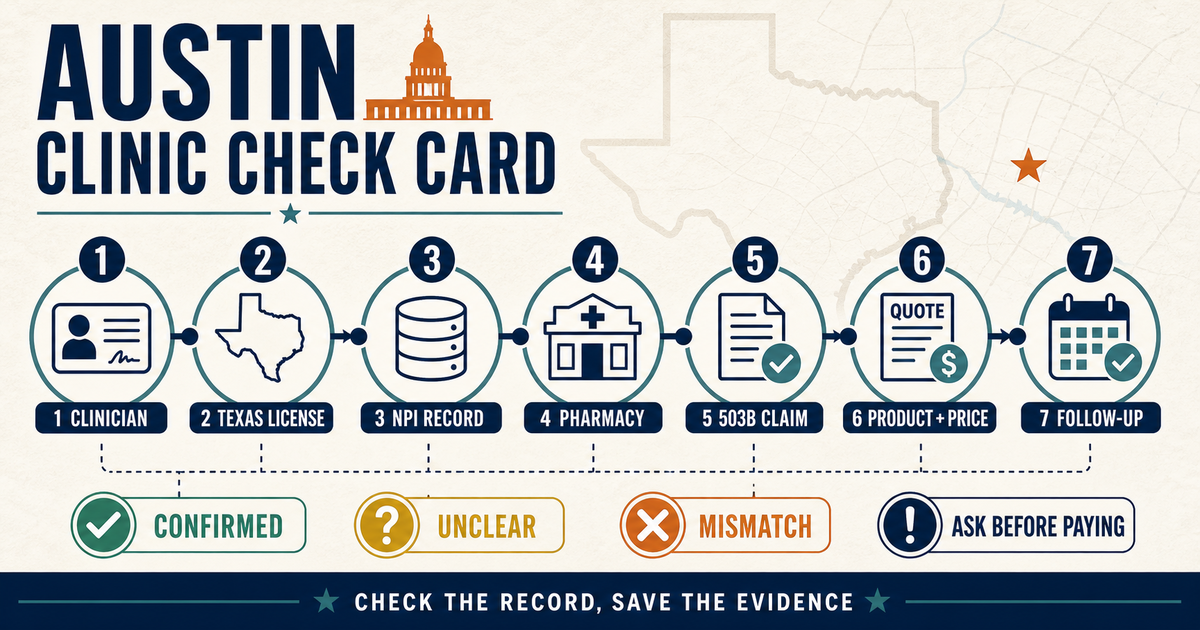
Austin Clinic Check Card
Mark each row Confirmed, Unclear, Mismatch, or Ask before paying. A confirmed record establishes the fact named in that row. It does not prove that a treatment fits your health history or that a compounded product has FDA approval.
| Check | Record | What it can establish | What it cannot establish | Your result |
|---|---|---|---|---|
| Treating clinician | Full name, credential, license number, board, status, expiration, and public orders | Identity and current public licensure data | Whether the proposed care fits you or works | __________ |
| NPI | Type 1 or Type 2 NPI, taxonomy, and practice address | An identity, taxonomy, and address cross-check | Licensure, credentialing, competence, or endorsement | __________ |
| Dispensing pharmacy | Exact legal name, physical state, Texas class, license status, address, and expiration | Public pharmacy-license data | FDA approval of a compounded product | __________ |
| Claimed 503B source | Exact facility name, current registration row, inspection, Form 483, recall, and action fields | What FDA’s current outsourcing-facility table reports | FDA approval, a clean history, or a quality guarantee | __________ |
| Exact product | Drug or substance, formulation, proposed use, and approved-versus-compounded statement | Whether the clinic gave you a specific answer you can check | A conclusion about every product marketed as a peptide | __________ |
| Written price | Consult, labs, medication, supplies, shipping, follow-up, renewal, cancellation, refund, and records | The charges included in the clinic’s written quote | Your future medical needs or total future spending | __________ |
| Follow-up | Responsible clinician, monitoring plan, contact route, escalation process, and records access | Whether the clinic described accountable follow-up | A treatment recommendation | __________ |
Step 1: Identify the clinician who will evaluate you
Ask for the full name and credential of the person who will review your history, evaluate you, and make the prescribing decision. Do not stop at the clinic owner, a supervising name on the website, or the phrase “medical team.” Record the clinician’s license number and the board that issued it.
Use the word clinician until you know the credential. Austin clinics may use physicians, physician assistants, advanced practice registered nurses, or other licensed professionals. Each credential has its own public record and scope.
Step 2: Use the Texas board responsible for that credential
The Texas Medical Board provider search covers physicians, physician assistants, and the other professions named on its search page. The Texas Board of Nursing license verification portal covers nurses and advanced practice registered nurses, including APRN and prescriptive-authority records where applicable. Do not send every clinician to the Texas Medical Board.
Match the public result to the name and credential the clinic supplied. Record status, expiration, and any public orders shown. A name match with the wrong credential or an expired record belongs in the Mismatch column until the clinic explains it with a current public record.
Step 3: Cross-check the NPI record without treating it as a license
Search the CMS NPI Registry for the clinician and clinic organization. Type 1 records identify individuals; Type 2 records identify organizations. Compare the name, taxonomy, and practice address with the clinic’s written answer. Our NPI walkthrough shows how to read those fields.
An NPI does not ensure or validate licensure or credentialing. CMS states that limitation in its NPPES data notice. Use the NPI as an identity, taxonomy, and practice address cross-check, then use the correct Texas board for the license.
Step 4: Identify the dispensing pharmacy by legal name and location
Ask the clinic, “What exact legal pharmacy name and physical location will appear on my label?” Get the exact legal name and physical location before you open any state board license search. A trade name without a city and state can send you to the wrong record.
For a Texas record, use the Texas State Board of Pharmacy search. Record the license number, class, status, address, and expiration. Texas publishes distinct pharmacy license classes for in-state and nonresident facilities, including sterile-compounding classes. The public record should identify the actual class; a federal section number is not a substitute for that state license data.
If the pharmacy is nonresident, verify its Texas status and check the home state license from the board for its physical address. Texas lists that resident-state verification in its nonresident pharmacy requirements. Do not assume that a telehealth clinic’s Austin address is the pharmacy’s location.
Step 5: Check what a 503A or 503B claim means
Sections 503A and 503B describe different conditions in federal compounding law. Section 503A covers conditions that may apply when a licensed pharmacist compounds in a state-licensed pharmacy or federal facility, or when a physician compounds. Section 503B covers outsourcing facilities that register with FDA and face a different federal oversight structure. The FDA compounding laws page links the governing sections.
FDA states that compounded drugs are not FDA-approved. A 503B facility is FDA-registered, but 503B status does not equal FDA approval of the facility or its products. It also does not establish a clean inspection history.
If a clinic names a 503B source, search FDA’s current registered outsourcing facilities table. Match the exact facility and address. Record the most recent registration date, last inspection, whether FDA lists a Form 483, any recall field, and the action based on the last inspection. FDA notes that a Form 483 lists investigators’ observations and is not a final agency determination.
For a state-licensed pharmacy, use the state pharmacy record and the federal 503A framework that applies to the activity. Texas records use license classes. Do not replace the class and license check with a made-up federal badge.
Step 6: Make the product answer specific
Ask the clinic to name the exact drug or substance, formulation, proposed use, and dispensing source. Ask whether it is an FDA-approved product, a use outside an approved label, a compounded drug, or an investigational product. The answer must address that product and use. A broad claim about “peptides” cannot do that work.
Ask the clinician to explain the reason for the proposed option, the known risks, the alternatives, and the limits of the evidence for a person with your health history. Keep the clinic’s answer in your file. The national clinic verification guide helps you compare a claim with its source, while the 503A pharmacy guide covers the longer federal framework.
Step 7: Put price and follow-up in writing
Ask for one written quote that separates the consult, required labs, medication, supplies, shipping, follow-up visits, membership or renewal charges, cancellation terms, refund terms, and records fees. Leave blank any item the clinic has not answered. The peptide clinic pricing guide explains common fee categories, and the questions-before-paying guide provides a longer call list.
Then name the person responsible for follow-up. Record how you reach that clinician, which monitoring the clinic expects, what symptoms or problems should trigger contact, how the clinic handles an urgent concern, and how you obtain your records. A portal or phone number without a responsible clinician is an incomplete answer.
Fictional example: catching a two-record mismatch
This fictional example uses an invented name and invented details. An Austin clinic says Jordan Ellis will evaluate a patient and supplies an NPI. The NPI record lists Jordan Ellis as an APRN, but the clinic points the patient to the Texas Medical Board. That is the wrong board for the stated credential. The patient checks the Texas Board of Nursing instead.
The NPI name and practice address match, but that NPI is not a license. The nursing-board result shows a different middle initial from the clinic’s form. The patient marks the clinician row Mismatch, sends both record links to the clinic, and asks for the correct license number before paying. The example ends there. A corrected identity record would not decide whether any proposed care is appropriate.
Save a record, not a score
Keep a copy of the clinic’s written answers, the public URLs, the date you searched, and a screenshot or PDF of each result. Public databases change. Your saved evidence shows what you reviewed and what remained unclear on that date. Find Peptide Clinics publishes a verification methodology so you can see what the directory checks and what you still need to confirm. You can also search the clinic directory.
Browse peptide clinic directories by city
The city directories below are in alphabetical order. They provide local discovery, not a clinic ranking:
- Austin, TX
- Beverly Hills, CA
- Charlotte, NC
- Chicago, IL
- Columbus, OH
- Dallas, TX
- Denver, CO
- Fort Worth, TX
- Houston, TX
- Indianapolis, IN
- Jacksonville, FL
- Las Vegas, NV
- Los Angeles, CA
- Louisville, KY
- Nashville, TN
- New York, NY
- Oklahoma City, OK
- Philadelphia, PA
- Phoenix, AZ
- Portland, OR
- San Antonio, TX
- San Diego, CA
- Sarasota, FL
- Scottsdale, AZ
- Seattle, WA
- West Chester, PA
Official sources
Retrieved August 17, 2026. The public databases and guidance linked in this article can change. Reopen each source when you use the card and record the date of your search.
- Texas Medical Board provider search
- Texas Board of Nursing license verification portal
- CMS NPI Registry and CMS NPPES data notice
- Texas pharmacy license search, pharmacy classes, and nonresident requirements
- FDA human drug compounding laws, FDA compounding questions and answers, and FDA registered outsourcing facilities
Medical and directory boundary: Find Peptide Clinics is an independent directory and educational resource. It does not provide medical advice and does not rank Austin clinics. Directory inclusion is not an endorsement. Confirm credentials, product information, pharmacy records, prices, and follow-up with the current public sources and your clinician. Read the full medical disclaimer.