
Before you pay for a clinic program, ask for a written, itemized quote. Compare the same time window and included services rather than the headline monthly price. This page helps you record the amounts you have actually been quoted; it does not estimate treatment prices.
Compare written totals, not headline numbers
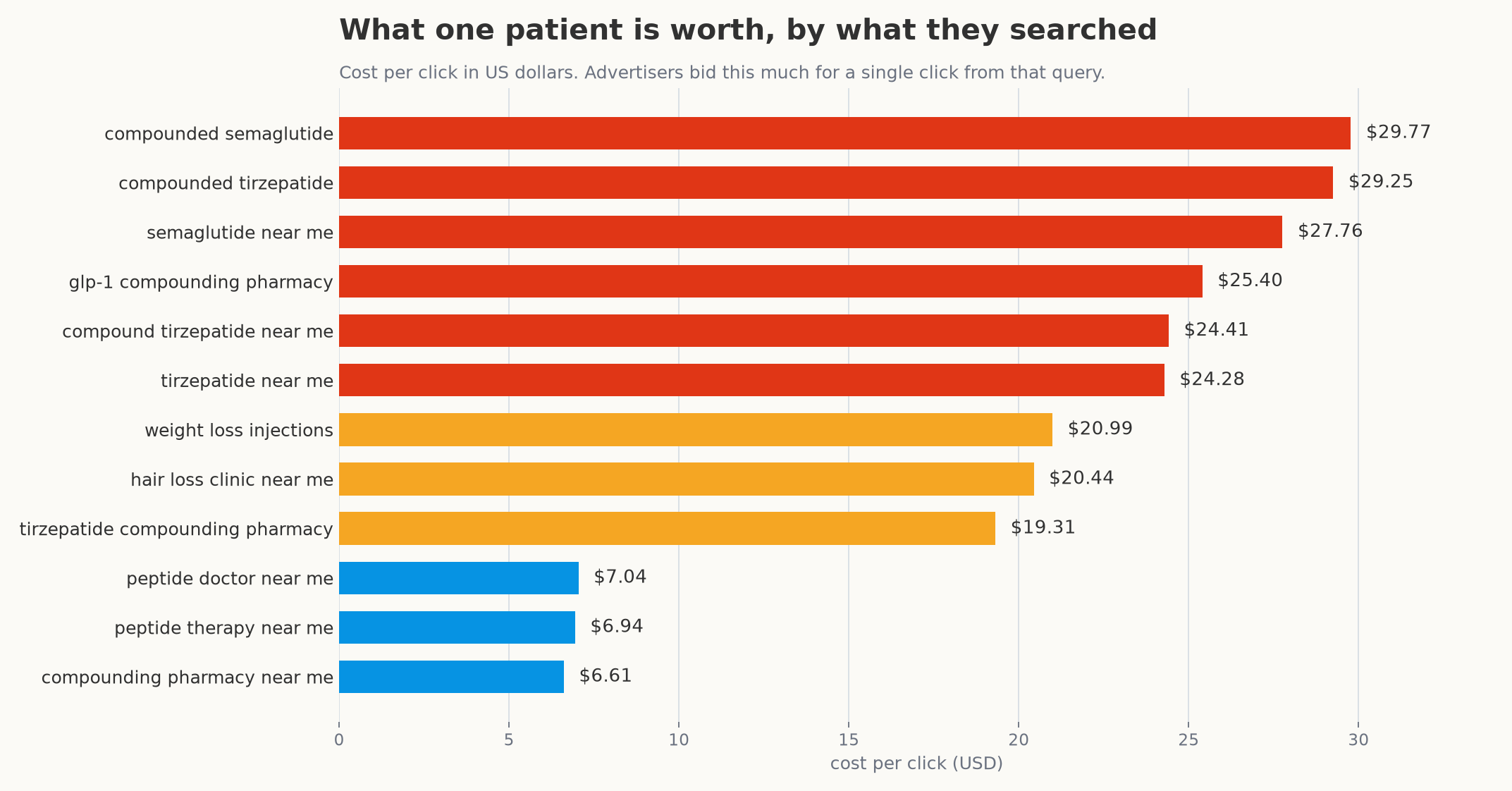
Direct answer: The meaningful comparison is the written total for the same time window and the same included services, not a headline monthly number.
A “per month” figure tells you little until you know whether it includes the clinician visit, the dispensed product, required labs, shipping, and any membership or refill fees. Ask each clinic to put every charge in writing, then compare the same items across clinics.
Build your written total before you pay
Use the worksheet below to assemble that total. Enter each amount the way you were quoted and choose whether it is a one-time charge or a monthly charge. Leave any item you have not been quoted blank and mark it “not yet quoted.” The worksheet counts unknown items separately and never treats them as zero.
Total-cost worksheet
| Line item | Amount you were quoted ($) | Charge type | Not yet quoted |
|---|---|---|---|
Enter your quoted amounts, then select Calculate totals.
This worksheet performs arithmetic only. It does not recommend a treatment, estimate a dose, infer product quality, predict insurance coverage, or rank any clinic.
Ask who bills each line item
Direct answer: Ask who bills each line item and whether it is one-time, recurring, conditional, refundable, or unknown.
Ask whether the clinic, dispensing pharmacy, lab, or another service bills each item. Record what the charge covers, when it applies, and whether it can change. Enter only charges that apply to the time window you are comparing. Keep possible future cancellation fees separate unless your quote says they are due in that window.
Verify the clinician and the pharmacy separately
Direct answer: Verify the named clinician and the dispensing pharmacy separately from the quote. A price is not a substitute for checking who will actually prescribe and dispense.
Before you pay, ask for the name and license number of the clinician and the name of the compounding pharmacy. You can check a California medical license through the Medical Board of California and a California pharmacy license through the California State Board of Pharmacy. Confirm the same names appear on your records and on any dispensed product.
Know what you are being asked to buy
Direct answer: Ask whether the quoted item is an FDA-approved drug, a compounded drug, or a service fee, and do not treat these as interchangeable.
A service fee pays for a visit, membership, or platform; it is not a medication. Ask the clinician and pharmacy to identify the exact drug and its approval status. FDA explains that compounded drugs are not FDA-approved and are not reviewed by FDA for safety, effectiveness, or quality before marketing. Do not interpret a quoted price as evidence of approval or quality.
503A and 503B are different federal pathways
Sections 503A and 503B establish different conditions for certain exemptions under federal drug law. Neither is a form of product approval.
- Section 503A addresses compounding by a licensed pharmacist in a state-licensed pharmacy or federal facility, or by a licensed physician, when the section’s conditions are met. State boards generally oversee state-licensed pharmacies that are not registered outsourcing facilities; FDA also conducts inspections. See FDA’s compounding overview.
- Section 503B outsourcing facilities elect to register with FDA and must meet applicable conditions, including current good manufacturing practice requirements, reporting, and risk-based FDA inspection. FDA describes those requirements here. Registration does not mean a facility or its products are FDA-approved.
Verify the named compounder separately from the clinic. FDA expressly warns against describing a pharmacy or outsourcing facility as “FDA-approved” or “FDA-licensed”; FDA does not approve or license facilities.
Before you book: print the 8 questions to ask a peptide clinic, and read the fuller guide to checking a clinic before booking.
Ask for the terms in writing before you pay
A prepaid or multi-month program is not automatically a problem, and a low advertised price is not automatically a deal. What matters is what the written terms say. Ask for each of these in writing before you commit:
- Renewal and refill terms, including whether charges recur automatically
- Cancellation and refund terms, including any partial-month policy
- Pause or hold terms if you need to stop or delay
- How to access and transfer your records, and any fee
- What happens to unused product if you stop
Check coverage in writing
Direct answer: Do not assume a plan will or will not cover a compounded drug. Ask the plan, the clinician, the lab, and the pharmacy for written coverage or cash-price information for your specific situation.
Coverage depends on the specific plan, the item, and how it is classified. Request the coverage decision in writing before you rely on it.
Compare clinic questions by city
Use the same written-cost, clinician, pharmacy, product-status, and cancellation questions when you compare local options. A city page is a starting point for verification, not an endorsement or proof that a treatment is available or appropriate.
- Austin peptide clinics
- Beverly Hills peptide clinics
- Charlotte peptide clinics
- Chicago peptide clinics
- Columbus peptide clinics
- Dallas peptide clinics
- Denver peptide clinics
- Fort Worth peptide clinics
- Houston peptide clinics
- Indianapolis peptide clinics
- Jacksonville peptide clinics
- Las Vegas peptide clinics
- Los Angeles peptide clinics
- Louisville peptide clinics
- Nashville peptide clinics
- New York peptide clinics
- Oklahoma City peptide clinics
- Philadelphia peptide clinics
- Phoenix peptide clinics
- Portland peptide clinics
- San Antonio peptide clinics
- San Diego peptide clinics
- Sarasota peptide clinics
- Scottsdale peptide clinics
- Seattle peptide clinics
- West Chester peptide clinics
Related reading
This page stays compound-neutral so you can compare any quote. For specific programs, see:
- What Are Peptides? What They Do and What Treatment Claims Mean: a plain-language guide to medicines, compounded drugs, supplements, cosmetics, and research claims.
- Sermorelin Cost in 2026: 4 Programs Compared: a dated, provider-by-provider comparison of one program type.
- Sermorelin Program Fees in 2026: A Pre-Payment Worksheet: a worksheet focused on one program.
- Retatrutide Price: Why No Official Retail Price Exists Yet: why a specific investigational peptide has no official price.
To search the directory by location, visit the clinic finder or the city index. Read how this site verifies and corrects information in the editorial policy, and review the medical disclaimer.
Sources
- FDA, Compounding and the FDA: Questions and Answers. fda.gov
- FDA, Information for Outsourcing Facilities. fda.gov
- FDA, FDA to Telehealth Companies: What to Know When Promoting Compounded Drugs. fda.gov
- FDA, FDA's Concerns with Unapproved GLP-1 Drugs Used for Weight Loss. fda.gov
- Medical Board of California, license verification. mbc.ca.gov
- California State Board of Pharmacy, license verification. pharmacy.ca.gov