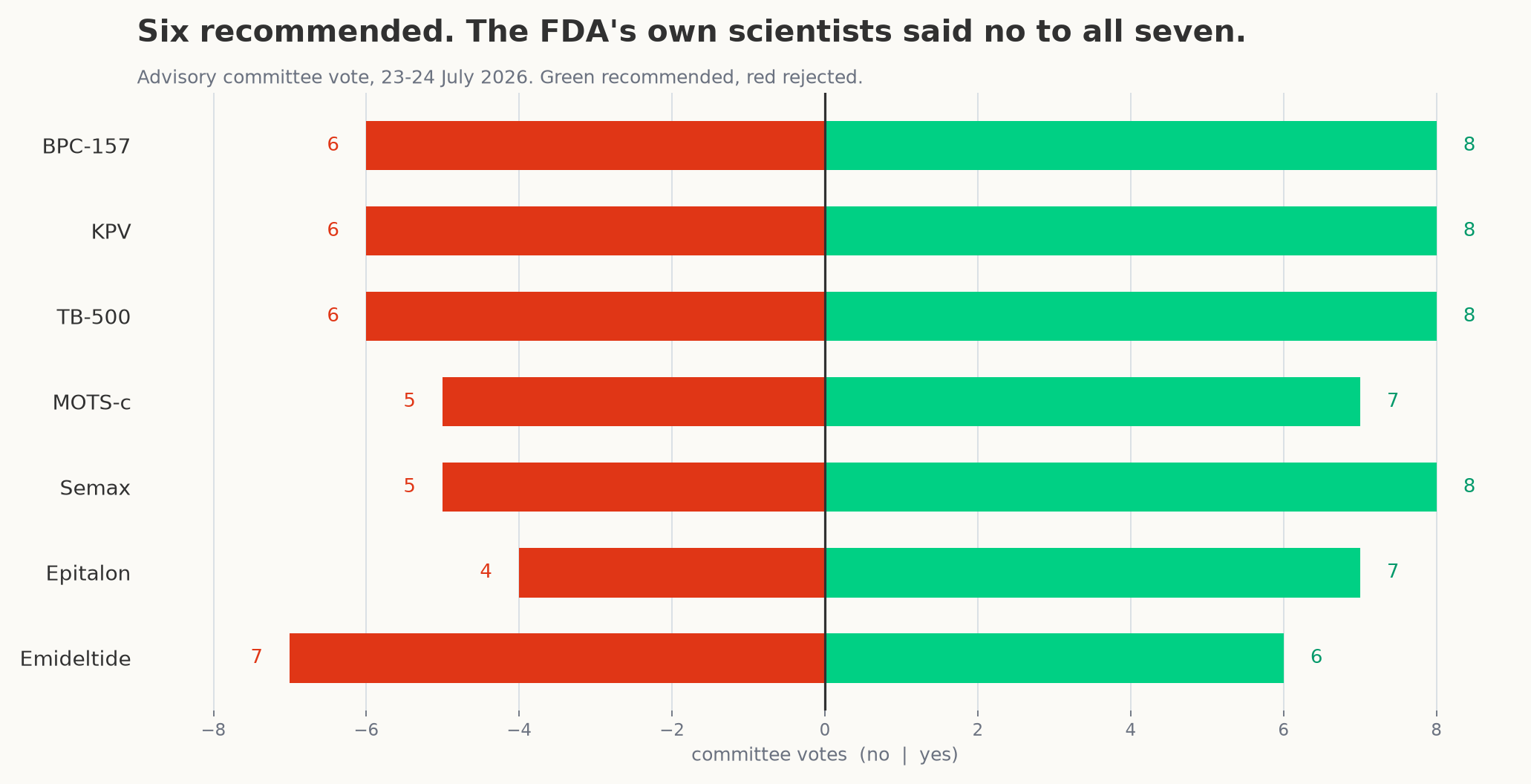
The FDA’s Pharmacy Compounding Advisory Committee (PCAC) met July 23–24, 2026 to discuss seven peptide-related bulk drug substances being considered for the 503A Bulks List. That list is one of three bulk-substance pathways described in section 503A; appearing on it is not the only condition a compounder must satisfy. After the meeting, contemporaneous news reports said the committee recommended six of the seven.
A committee recommendation is not FDA approval, a final rule, a prescription, a safety finding, or proof that a clinic can offer a peptide today. This page gives one dated evidence card per compound, separates what FDA staff reviewed from what the committee recommended from what the law actually is, and lists what the vote did not do.
Read this first: as of 2026-08-16, the current text of 21 CFR 216.23 lists six other substances and none of the seven discussed at this meeting. An advisory vote does not amend that regulation. See the peptide tracker for the live status of every compound covered here.
The three steps patients mix up
Advisory committee tallies for all seven peptides reviewed in July 2026.
Every claim about this vote should be tested against three separate things:
FDA written review. FDA published a briefing that proposed not adding either form of all seven substances after reviewing characterization, historical use, effectiveness, and safety. That was the agency’s written proposal, not a staff roll-call vote.
Advisory-committee recommendation. The PCAC — independent outside experts — voted. Its advice is non-binding; FDA “generally follows the recommendations but is not legally bound to do so.”
Current regulation. FDA addresses additions to the 503A list through notice-and-comment rulemaking. The committee vote itself did not change the current list in 21 CFR 216.23.
Seven evidence cards (current as of 2026-08-16)
1. BPC-157
Field
Finding
Use FDA evaluated
Ulcerative colitis
FDA’s evidence conclusion
The official briefing found insufficient evidence to conclude that BPC-157 is effective for ulcerative colitis and identified characterization, safety, and immunogenicity concerns.
Committee recommendation
Recommended (reported 8–6 with one abstention).
Current regulatory status
Not listed in the current text of 21 CFR 216.23; the advisory recommendation did not amend the list.
What the vote did not do
Did not approve BPC-157, prove it works for ulcerative colitis, or validate recovery, injury, or anti-aging marketing.
2. KPV
Field
Finding
Use FDA evaluated
Wound healing and inflammatory conditions
FDA’s evidence conclusion
The official briefing said neither the nomination nor FDA’s search identified clinical studies of KPV administered in humans for the evaluated uses.
Committee recommendation
Recommended.
Current regulatory status
Not listed in the current text of 21 CFR 216.23; the advisory recommendation did not amend the list.
What the vote did not do
Did not turn a broad “anti-inflammatory” claim into an FDA-reviewed indication.
3. TB-500
Field
Finding
Use FDA evaluated
Wound healing
FDA’s evidence conclusion
The official briefing found no clinical evidence for wound healing and no human-use information sufficient to assess safety or effectiveness.
Committee recommendation
Recommended.
Current regulatory status
Not listed in the current text of 21 CFR 216.23; the advisory recommendation did not amend the list.
What the vote did not do
Did not convert athletic-recovery language into human-outcome proof.
4. MOTS-c
Field
Finding
Use FDA evaluated
Obesity and osteoporosis (FDA lists the spelling “MOTs-C”)
FDA’s evidence conclusion
The official briefing found no clinical studies administering MOTS-c-related substances to humans for the evaluated uses.
Committee recommendation
Recommended.
Current regulatory status
Not listed in the current text of 21 CFR 216.23; the advisory recommendation did not amend the list.
What the vote did not do
Did not create a longevity, metabolism, or energy promise.
5. Semax
Field
Finding
Use FDA evaluated
Cerebral ischemia, migraine, and trigeminal neuralgia
FDA’s evidence conclusion
The official briefing found insufficient evidence for cerebral ischemia, migraine, or trigeminal neuralgia; the limited studies had major design and reporting problems.
Committee recommendation
Recommended.
Current regulatory status
Not listed in the current text of 21 CFR 216.23; the advisory recommendation did not amend the list.
What the vote did not do
Did not give FDA-reviewed support to focus, mood, or productivity claims.
6. Epitalon
Field
Finding
Use FDA evaluated
Insomnia
FDA’s evidence conclusion
The official briefing found no clinical safety data for human use and insufficient evidence of effectiveness for insomnia.
Committee recommendation
Recommended.
Current regulatory status
Not listed in the current text of 21 CFR 216.23; the advisory recommendation did not amend the list.
What the vote did not do
Did not endorse anti-aging or longevity language as the reviewed use.
7. Emideltide (DSIP)
Field
Finding
Use FDA evaluated
Opioid withdrawal, chronic insomnia, and narcolepsy
FDA’s evidence conclusion
The official briefing found limited, poorly controlled evidence and insufficient safety and effectiveness information for chronic insomnia, narcolepsy, and opioid withdrawal.
Committee recommendation
Not recommended (rejected).
Current regulatory status
Not listed in the current text of 21 CFR 216.23; the unfavorable advisory recommendation did not amend the list.
What the vote did not do
“Sleep peptide” marketing is not committee support; the committee declined to recommend access.
It did not approve any peptide as an FDA-approved drug.
It did not declare any peptide safe or effective for any use.
It did not put any peptide on the 503A Bulks List or change its legal status.
It did not override state medical-board, pharmacy, or prescription requirements.
It did not remove adverse-event risk or the need for a prescription and a licensed pharmacy.
It did not validate clinic sales language — a committee recommendation is not clinical evidence.
How to use this when comparing clinics
Ask each clinic to be specific. A precise clinic answer separates an advisory vote from a 503A Bulks List decision from an FDA-approved medicine and an off-label or compounded-care discussion. If a clinic collapses all of that into “FDA approved,” slow down. Run the same test with our verification methodology and 8-check 503A guide, then see the procedural walkthrough in what the vote fallout means for patient questions. When you are ready to compare providers, use the clinic finder.
Questions to ask before you book
Did FDA issue a final rule, or did an advisory committee make a non-binding recommendation?
Is this an FDA-approved drug, a compounded drug, or research context?
Does the evidence match the exact use being marketed — for this molecule, route, dose form, and patient group?
Can the clinic name the licensed clinician, the pharmacy path, the follow-up plan, and the total cost before payment?
Use the same questions locally. Start with the city page closest to you, then ask each clinic to explain its evidence, license, pharmacy path, and follow-up plan in plain language.
This page is educational information, not medical advice, a diagnosis, or a treatment recommendation. It does not recommend any peptide, medication, pharmacy, clinic, or treatment plan, and it makes no claim that an advisory-committee vote changed the law. Compounded drugs are not FDA-approved, and FDA does not verify their safety, effectiveness, or quality before they are marketed. Talk to a licensed clinician about your own situation. See our full medical disclaimer.